Kingsley
The Ballad of the Last DragonKingsley is the keeper of the Rusty Nail and one of the most important sources of stability in Sylvaine Abelan’s life. Beneath his blunt humor, commercial practicality, and imposing physical presence, he offers an elven performer a refuge from hunger, sexual exploitation, and anti-elf hostility. He does not merely employ Sylvaine: he makes room for her, protects her dignity, and becomes part of the home to which she returns after the dangers of the road.
Identity and Presence
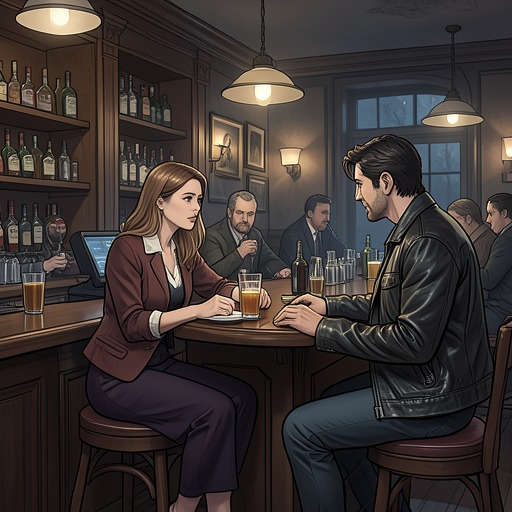
Kingsley is a giant of a man with black hair and beard streaked with gray, a figure whose laughter shakes his entire body and whose strength suggests a violent past he refuses to discuss. He manages the Rusty Nail in Hollowden with Brigitta, his wife, and is depicted most often behind the bar, cleaning tankards, assessing the empty room, or defending the tavern’s modest way of doing business. His physical scale contrasts with the ordinary intimacy of his work: he builds mismatched chairs from scrap wood, watches the tavern’s expenses, stocks provisions, and handles the daily obligations of keeping a poor establishment open.
He is also guarded. Sylvaine has tried to draw out his secrets, but Kingsley knows her fondness for turning private knowledge into songs and remains wary of telling her more than he intends. That reserve is part of his characterization rather than evidence of indifference. He allows affection to appear through practical action while keeping emotional declarations awkward and incomplete. Even when he is annoyed enough to address her as “Sylvaine,” his irritation exists within a relationship already shaped by patience and trust.
The Rusty Nail and Sylvaine’s Refuge
Kingsley’s relationship with Sylvaine begins in the aftermath of her flight from Birchfield. The owner of the Red Wyvern Tavern had attempted to make food conditional on sexual access after finding her scavenging half-eaten scraps from dirty plates. Sylvaine fled without planning, carrying little more than her lute, a few coins, and the cap she used to conceal her pointed ears. By the time she reached the Rusty Nail days later, she could barely stand. Kingsley nevertheless allowed her to sing, while Brigitta asked her to sample dishes for the tavern’s Winter Solstice celebration. Sylvaine later recognizes that the couple were already looking after her.
The Rusty Nail is not prosperous. Its chairs do not match, its floor slopes where softened ground has shifted beneath it, and dropped bottles roll toward the far end of the room. Kingsley refuses Sylvaine’s grand proposals for transforming it into the crowned jewel of Tarrgein, complete with wealthy patrons from the Western Isles, Dwarven merchants from Hawthok, and nobles who would abandon Lindale for Hollowden. He insists that business will come and that the incentive to drink is simply drinking. His refusal is not a failure to understand her ambition; it is a decision to preserve a manageable livelihood rather than gamble the tavern on her theatrical vision.
That disagreement gives their bond its distinctive texture. Sylvaine imagines expansion, themed events, and a glittering circuit of recognition; Kingsley sees the empty tables, the cost of supplies, and the work required to keep a small tavern alive. He will not pay her to sing to Petey in his sleep when no customers remain, yet he does not abandon her. When Sylvaine’s earnings and pride fail her, Kingsley ensures that she does not go hungry, while Brigitta quietly makes extra food and disguises the charity as an accident. Because the Rusty Nail has no kitchen, the gesture cannot be dismissed as routine hospitality. It is a deliberate effort to sustain someone whom poverty and prejudice have left vulnerable.
Care, Departure, and Memory
Kingsley and Brigitta give Sylvaine the small dwelling beside their barn after discovering that she has been sneaking back into the tavern to sleep. The house is modest, but it marks a decisive change in her circumstances: she has a place to keep her belongings, rest, and return without having to bargain for basic shelter. For an elf displaced from Smarighad by raids and forced to move through Bridgebarrow, Elmwood, Birchfield, and Hollowden, the room becomes evidence that temporary safety can develop into belonging.
When Sylvaine leaves to join the quest, Kingsley arrives at her door with a leather satchel. It contains a week’s supply of salted jerky, apples, carrots, and her favorite mushrooms, including witch’s butter and king bolete, gathered and stored with Brigitta’s help. He also gives her soap scented with black currant and mulberries, made from beech ashes and goat fat. The gift is small enough to be practical and personal enough to carry the household onto the road. Sylvaine cannot answer him with a composed thank-you; she embraces him instead. Kingsley responds by patting her head and explaining that he thought she might want simple comfort while traveling.
His farewell also reveals his understanding of care as something that must not become possession. He tells Sylvaine that it is acceptable not to return to Hollowden so long as she remains safe. She insists that she will come back before Winter Solstice, disguising the emotion of the promise beneath another argument about themed events and competitions. His response is bittersweet because he neither demands her return nor pretends that departure has no cost. Kingsley can offer shelter without claiming authority over Sylvaine’s future.
Even far from Hollowden, Kingsley’s gifts continue to operate as emotional objects. When Sylvaine takes a bath during the journey and washes with the black-currant soap, its scent brings tears to her eyes. She does not want to abandon the road, the quest, or Jaromir, yet she aches for the narrow cot in the room Kingsley and Brigitta prepared for her, the poor ale and wine of the Rusty Nail, and the evenings spent badgering Kingsley with ambitious ideas while waiting for Petey to wake and go home. The soap makes homesickness tangible: Kingsley’s care travels with her even when she is determined not to return.
Return and Reciprocity
After the quest collapses into loss and Sylvaine believes the dragon’s hoard may never have existed, she plans to return to Hollowden and work at Kingsley’s tavern, washing dishes or serving until she can afford a new lute. The thought is not presented as humiliation. It is the form of survival that remains available because Kingsley’s home has never ceased to be available to her. Her return would mean surrendering the heroic dream temporarily, but it would not mean losing every form of purpose.
The eventual return reverses that earlier fear. Sylvaine comes back to the Rusty Nail after Aeron’s deeds have become famous and the heroes’ work has generated new opportunities. Kingsley has left her stool in its familiar place, and she deliberately finds the creak in the floor that he never repaired. The tavern is still marked by the same mismatched chairs, and its lack of Winter Solstice decorations leaves open the possibility that he has been waiting for her. The setting has changed less than Sylvaine has, which makes the familiar imperfections function as proof of continuity.
Kingsley greets her with physical warmth, lowering her to her feet and nearly dragging her to the bar so that she can tell him everything that happened. He first proposes pouring drinks for the two of them, then notices Jaromir and grudgingly includes him. His welcome preserves the old rhythm of teasing, suspicion, and hospitality. He reaches behind the bar for the worst wine Sylvaine has ever tasted, but the poor drink becomes part of the reunion’s meaning: what matters is not refinement but the restoration of a shared ritual.
Sylvaine’s return is also an act of repayment. She gives Kingsley his share of the proceeds, explains that food and drink suppliers have already been paid, and commissions carpenters and builders to expand the tavern according to his wishes. She calls this only the beginning of reciprocating everything he has done for her, then makes clear that she intends to ensure that Kingsley and Brigitta want for nothing. The ambitious performer who once imagined the Rusty Nail becoming a grand destination now uses her success to strengthen the actual place and people who sustained her.
Narrative Role and Significance
Kingsley embodies home as an active practice rather than a fixed birthplace. Sylvaine’s original homeland, Smarighad, has been ravaged by elven raids, and the wider society has inherited fear and distrust of elves from histories that portray humans and Dwarves as heroes against an allegedly malicious ancient people. Against that hostile social order, Kingsley and Brigitta offer acceptance without demanding that Sylvaine conceal her identity beyond the protective choice of her cap. Their kindness does not erase persecution, but it creates a local counter-structure in which an elf can work, eat, sleep, and be treated as family.
His characterization also resists the usual split between sentimental caregiver and hardheaded businessman. Kingsley can be generous and financially cautious, affectionate and evasive, protective and willing to let Sylvaine leave. He does not share her appetite for expansion, but his refusal to change the Rusty Nail does not prevent him from accepting the material consequences of her success later. The apparent contradiction is the point: his care is reliable because it is grounded in judgment, labor, and limits rather than in grand promises.
For Sylvaine, Kingsley provides the first durable answer to the question of what survival can look like after displacement. He gives her more than food and shelter, but he gives those things first, when abstract encouragement would not have been enough. In the end, her return and investment transform charity into reciprocity. The Rusty Nail remains a tavern with uneven floors, handmade chairs, and bad wine, yet it becomes the place where Sylvaine’s fame is measured against the people who made her survival possible. Kingsley’s decisive significance lies there: he is the keeper of the humble home that allows an ambitious bard to leave, endure, become someone new, and still have somewhere meaningful to come back to.