Rebuilt Rust Nail Pub
The Ballad of the Last DragonThe rebuilding of the Rusty Nail is the practical and emotional centerpiece of Sylvaine Abelan’s return. The tavern is not merely a venue she once performed in: it is the place whose people made her survival their personal mission and came to regard her as family. Her decision to invest in its future turns gratitude into infrastructure, linking her new success as a world-famous bard to the preservation and renewal of the humble establishment that helped sustain her.
The Tavern as a Place of Return
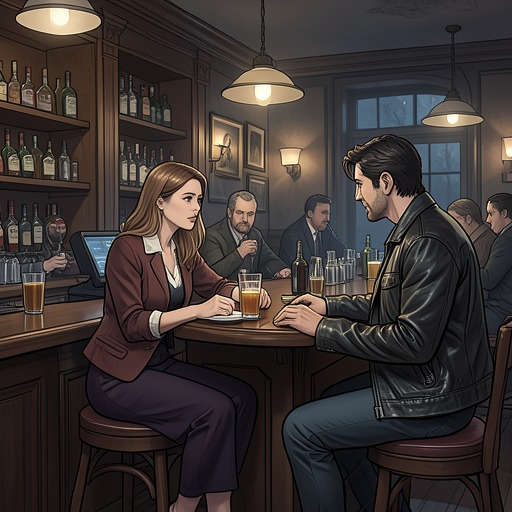
Sylvaine’s return begins with a performance before an almost empty room. She stands alone onstage at the Rusty Nail, bows deeply, and straightens her cap as she has done many times before. Kingsley has left her stool where it always stood, and she deliberately finds the familiar creak in the floor beneath her feet. The mismatched chairs, each made by Kingsley from leftover scrap wood, remain in place, giving the tavern the texture of continuity even as the room sits empty. The absence of Winter Solstice decorations, while unsurprising at the end of autumn, makes Sylvaine wonder whether Kingsley has been waiting for her.
The scene makes restoration inseparable from memory. What is being recovered is not an abstract business but a collection of recognizable objects, habits, and sounds: the stool, the unrepaired creak, and the handmade chairs. Sylvaine’s return therefore restores her connection to a specific domestic world before any money changes hands. Jaromir, watching as her first audience member, witnesses the moment in which professional performance becomes a homecoming.
From Gratitude to Investment
Sylvaine and Jaromir bring Kingsley a concrete share of the wealth produced by her new career. She explains that food and drink suppliers have already been paid and that she has commissioned carpenters and builders to follow Kingsley’s orders and expand the tavern however he wishes. The arrangement gives Kingsley both immediate relief and authority over the rebuilding: Sylvaine supplies the resources, while the tavern’s owner determines what the renewed Rusty Nail should become.
She presents this contribution as only the first part of repaying what Kingsley has done for her. Her gratitude is not expressed as a symbolic apology or a brief gift; it is organized as a continuing obligation to make sure that Kingsley and Brigitta never want for anything. Kingsley rejects the idea that she owes them anything beyond letters and occasional visits, but his protest does not undo the significance of the offer. Their exchange reveals two contrasting forms of loyalty: Kingsley understands care as freely given, while Sylvaine insists on answering care with lasting material support.
The rebuilding also widens the meaning of Sylvaine’s success. Her earnings do not remain private proof of artistic achievement. They become payment to suppliers, work for carpenters and builders, and a means of enlarging a community institution. The action converts the rewards of the road into renewal at home, allowing the Rusty Nail to benefit from the journey even though it was not part of the expedition itself.
A Favored Stop on the Bardic Circuit
Sylvaine’s promise to visit only occasionally is met with a playful correction: as a world-famous bard, she will make sure to visit the finest establishments on her circuit regularly. She then announces that the Rusty Nail will be her favored stomping ground. The declaration gives the tavern a future role in her public identity. It will not be a forgotten refuge from her earlier life but a deliberately chosen destination within the career she has built.
That promise also joins publicity to affection. A favored stop on a celebrated bard’s circuit can bring attention, customers, and prestige, while Sylvaine’s joking language keeps the gesture intimate rather than ceremonious. Her fame becomes another form of investment. The tavern receives not only money for construction but also the continuing presence and reputation of one of its own performers.
The scene’s theatrical timing reinforces this fusion of art and practical action. Sylvaine admits that Cadoc and Neith’s entrance was planned and that she wanted the theatrics of good timing. They sweep through the doors with a crowd of revelers whom the group has persuaded to come with the promise of free drinks. The rebuilding is thus announced as an event rather than handled as a private transaction: the tavern’s renewal is made visible through performance, company, and celebration.
Kingsley, Brigitta, and Shared Prosperity
Kingsley’s response is physical and immediate. He is startled by the arrangement, struggles to find words, and then pulls Sylvaine into another crushing bear hug. His insistence that she owes him and Brigitta nothing preserves the emotional history between them: their relationship was founded on care rather than expectation of repayment. Sylvaine’s answer does not deny that history; it extends it into a plan by which both of them can remain secure.
Brigitta is present in the structure of the promise even when the immediate exchange is chiefly between Sylvaine and Kingsley. Sylvaine specifically intends to ensure that both want for nothing, recognizing the couple as a unit whose shared life is tied to the Rusty Nail. The tavern’s expansion is consequently also an act of protection toward the people who protected her.
Kingsley’s suspicion of Jaromir adds a comic social note to the reunion. He notices Jaromir over Sylvaine’s shoulder and reluctantly agrees to pour a drink for three rather than two. Sylvaine calls Jaromir over and offers to tell the whole long tale on the condition that he not interrupt. Kingsley then serves the worst wine Sylvaine has ever tasted, preserving the tavern’s rough, imperfect character even at the moment of its renewal. The rebuilding does not erase what made the Rusty Nail familiar; it allows that familiarity to survive alongside improvement.
Renewal Through Story and Community
The action culminates in a promise that is both economic and narrative. Sylvaine will finance the building work, return as a celebrated performer, and make the Rusty Nail the favored setting for future visits and themed events. Her claim to be the ambitious force behind those events suggests that the tavern will become a continuing stage for the new life created by her adventures. The room that once held her solitary performance is prepared to receive a larger community.
The rebuilding also gives form to the book’s recurring connection between stories and survival. Sylvaine’s tale of the expedition is about to be told over drinks, while the crowd’s arrival turns the act of telling into a communal occasion. She refuses to reveal the secret of how Cadoc, Neith, and the revelers were gathered, preserving the playful mystery expected of a bard. Yet the larger secret is already clear: the Rusty Nail endures because affection has been converted into action, and action has been converted back into shared story.
As a result, restoration here is neither a return to an unchanged past nor a rejection of the past in favor of fame. The old stool, creaking floor, scrap-wood chairs, bad wine, familiar people, expanded rooms, paid suppliers, and future performances belong to one continuous design. Sylvaine returns with the means to alter the tavern, but she does so in order to keep its emotional function alive. The Rusty Nail becomes the place where her wandering career can repeatedly come home.