Rhosyn’s precarious inheritance status
The Ballad of the Last DragonRhosyn’s precarious inheritance status is both a material danger and a social trap: after Damir’s death, she risks losing the home he built because Kalinia’s inheritance law recognizes only a suitable male heir. The threatened loss binds her to an unwanted winter marriage with Jaromir, Damir’s brother, while making the preservation of her daughters’ home the central condition of her choices. Her crisis therefore exposes how grief, property, gender, and local law combine to turn a family tragedy into an institutional threat.
Legal and Material Precarity
Kalinia’s local system remains governed by an archaic rule under which the town absorbs an inheritance when no suitable male heir exists. Although Queen Dhara has promoted inclusive land and title ownership policies and other towns are moving toward broader next-of-kin inheritance, Kalinia has not adopted those reforms. The magistrate is not required to follow the new by-laws, leaving Rhosyn without a secure legal claim to the property where she lives with her daughters.
The danger is not abstract. Rhosyn explicitly warns that she has no claim to the land or home without Jaromir, while he fears that she and the girls will be left without safety or care. The threatened eviction is thus simultaneously an economic displacement, a maternal crisis, and a continuation of male-centered succession: her right to remain in her own home depends on a male relative’s intervention rather than on her widowhood, motherhood, or connection to the household.
The Home as Memory and Belonging
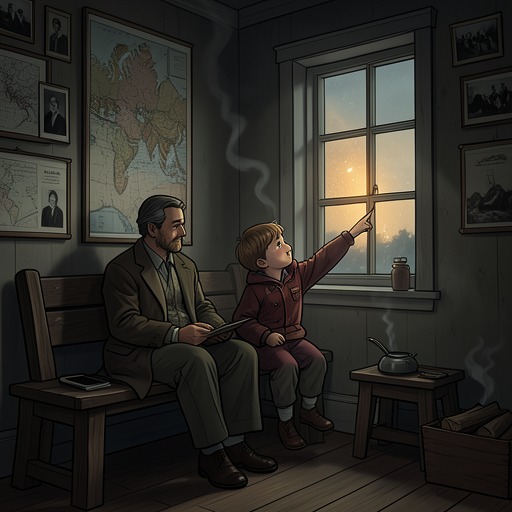
Rhosyn’s resistance to losing the property is rooted in more than ownership. Damir built the house, and its ordinary physical details preserve his presence: a creaking floorboard and the nail in the third step that he never fully hammered down. She cannot bring Damir back, but the house allows his touch to remain part of daily life. His father’s land, and the generation before him, also represent the future that Rhosyn and Damir imagined for their daughters.
This attachment makes the inheritance crisis a struggle over continuity. The house is a material archive of marriage, labor, parenthood, and projected family life; losing it would mean being separated not only from property but from the place where Damir’s life remains legible. Rhosyn’s demand is consequently framed as protection for the girls and as preservation of a home whose meaning exceeds its legal description.
The Betrothal to Jaromir
Jaromir’s connection to the crisis began as paid work rather than an immediate romantic commitment. He was hired to train Aeron Fowler with a sword roughly two weeks before Aeron posted his recruitment notice, accepting coin for each session. Jaromir initially refused Aeron’s invitation to join the expedition, but changed his mind after seeing the ridiculous notice because it offered a quick way to earn money and reach marriage sooner.
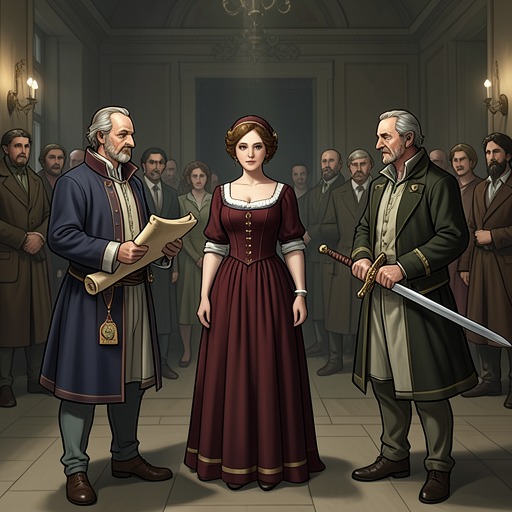
That marriage is the planned union with Rhosyn, scheduled for winter. Rhosyn explains that she has never wanted to marry Jaromir, having regarded him throughout their lives as Damir’s brother and her friend. Their arrangement allowed both of them to live as unattached and seek pleasure elsewhere before the ceremony, but the planned marriage was nevertheless meant to be taken seriously once its rites were performed. The arrangement is therefore neither a conventional love match nor a freely chosen domestic future: it is a legal and familial mechanism intended to protect the household from Kalinia’s inheritance rules.
Rhosyn admits that a small part of her hoped time and circumstance might eventually turn their friendship and respect into love. Yet her immediate motive is her daughters’ security, not desire. She dreads the approaching union because it asks her to convert a long friendship into a marriage while the law makes that conversion appear necessary for her continued possession of home.
Sylvaine Abelan’s Intervention
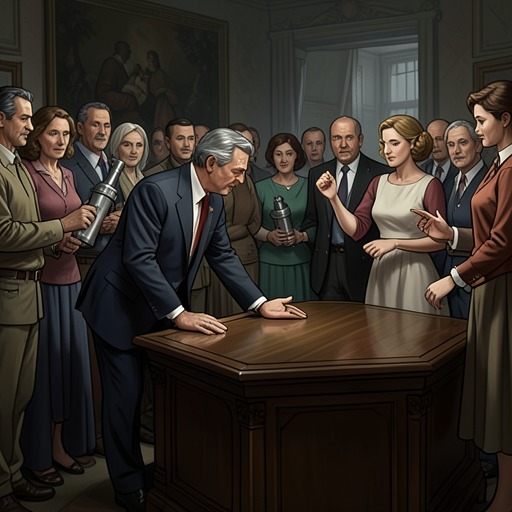
Sylvaine Abelan recognizes that a delicate petition has already failed. Rhosyn has repeatedly appealed to the magistrate without success, so Sylvaine chooses confrontation instead. Her method is deliberately theatrical: she arrives in road-worn clothing, places her filthy boots on Magistrate William M. Ridion’s ornate ebony desk, and sinks into a silk-cushioned chair. The gesture turns the magistrate’s cultivated authority against him, making the visible luxury of his office evidence of his distance from vulnerable residents.
When Ridion finally asks what they want, Sylvaine yields the demand to Rhosyn because it concerns Rhosyn’s home and life. Rhosyn rises with poise, lifts her chin, and requires the magistrate to abolish the antiquated inheritance law so that no person can be thrown from a home after family tragedy. She further demands that Kalinia enact Queen Dhara’s inclusive policies, allowing any person to establish a life in the town, and insists that the work be completed that day. Sylvaine’s threatened song about the magistrate’s conduct gives the petition a public and reputational force that ordinary legal appeals lacked.
Ridion attempts to delay by citing the need for legal documents, a scribe, and a notary. Sylvaine has anticipated the resistance. She produces the legislative document written on Rhosyn’s table while Rhosyn paced through the kitchen, and offers to witness Ridion’s signature and official seal as a notary. The threatened inheritance becomes, in this moment, a drafted reform: Rhosyn’s private fear is translated into enforceable public language, and the magistrate’s refusal is confronted with a ready-made alternative.
Consequences and Significance
Rhosyn’s status reveals the practical reach of Kalinia’s male-heir inheritance regime. The law does not merely assign property according to tradition; it creates dependency, pressures a widow toward marriage, and places children’s housing at the mercy of a local official’s willingness to preserve an outdated order. Jaromir’s role as prospective husband is consequently shaped by responsibility and legal necessity as much as by personal feeling.
The crisis also exposes a conflict between inherited local authority and Queen Dhara’s broader reform. Kalinia’s magistrate can preserve the old rule because the town has not yielded to the popular movement for inclusive inheritance, but Rhosyn and Sylvaine challenge that autonomy by forcing the reform into the magistrate’s own office. Their victory is not presented as passive rescue: Rhosyn states the policy she requires, while Sylvaine supplies the performance, pressure, and legal preparation needed to make her demand difficult to ignore.
The home’s threatened loss thus becomes the catalyst for institutional change. What begins as Rhosyn’s precarious position after Damir’s death expands into a challenge to the principle that property and belonging must pass through men. Her daughters’ safety, Damir’s memory, Jaromir’s unwanted betrothal, Sylvaine Abelan’s public intervention, and Magistrate William M. Ridion’s resistance all converge on the same question: whether a family home is a living inheritance held by the people who inhabit and sustain it, or an asset the town may seize when patriarchal succession fails.