Sylvaine Abelan
The Ballad of the Last DragonSylvaine Abelan, known among friends as Syl, is an elven bard and storyteller whose decisive power lies in making other people’s deeds endure. She begins as a precarious performer at the Rusty Nail, concealing the physical sign of her elven heritage to avoid prejudice, but the journey she joins with Aeron Fowler transforms her from an entertainer seeking work into the author of Aeron’s heroic legacy. Her arc joins artistic ambition to bodily survival, moral choice, and the discovery that home can be made through chosen loyalty rather than recovered unchanged from the past.
Identity and Background
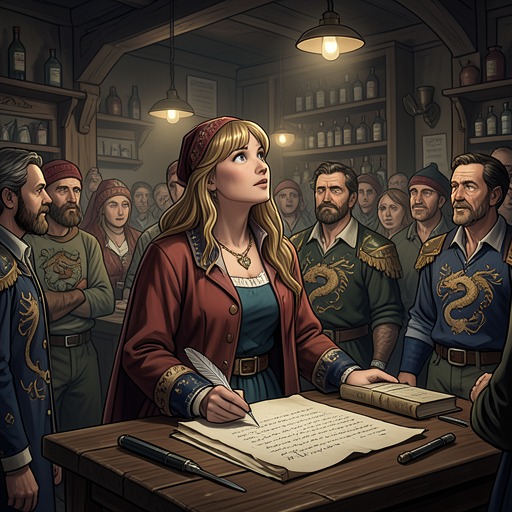
Sylvaine introduces herself with theatrical confidence, giving her full name as Sylvaine Abelan and offering Syl as the name used by friends. Her identity is inseparable from performance: she bows as though royalty were watching, takes the center-stage stool at the Rusty Nail, and plays the bawdy song “While the Fisherman’s Away” even on a night when there is scarcely an audience. The performance is not merely self-expression. It is labor undertaken for coin, and the empty cup before her makes the economic stakes plain.
Her elven heritage makes that labor more dangerous. Sylvaine’s ears are the most obvious sign of her ancestry, so she normally keeps them hidden beneath a velvet cap. She explains that prejudice against elves has taken root even in Tarrgein, where old superstition about the ancient elves has survived in altered form. Patrons may fear that she possesses “evil she-elf magic to bewitch them,” and she has learned that keeping her ears covered earns greater acceptance. The cap is therefore both costume and protection: its crushed red velvet and black plume advertise the performer, while its placement conceals the part of her body that exposes her to hostility.
Sylvaine’s education gives her access to a larger inheritance than the societies around her are willing to recognize. Her father required her to practice alphabets before allowing her to play in the forest, and she mastered Ancient Elvish, Dwarvish, Common Tongue, and forgotten human languages. Even Ancient Elvish, already a dead language in Smarighad, remains available to her through that training. Language is not academic ornament in her life; it is a means of opening stories that would otherwise remain inaccessible.
The Quest and the Making of a Bard
Aeron Fowler’s invitation to join an adventure offers Sylvaine more than travel. Aeron, Cadoc, Neith, and Jaromir are blades for hire, paid for the venture, and Sylvaine becomes part of the expedition under the same arrangement. She recognizes the practical appeal of coin and protection as the group moves from tavern to tavern, but she also sees the journey as a chance to make a name for herself by making a name for Aeron.
Her understanding of heroism is explicitly mediated by storytelling. When the group speaks of exploits being immortalized, Sylvaine explains that heroes cannot reliably create their own legends because people distrust self-praise and assume that fame encourages lies. A story whispered through taverns, however, can travel beyond the person who performed the deed. Sylvaine identifies herself as the agent who converts action into reputation: storytellers make legends. This gives her a role unlike that of the expedition’s fighters. She does not merely accompany the quest; she supplies the form through which the quest will be remembered.
The old map confirms how closely her artistic and intellectual abilities serve the expedition. Aeron’s parchment depicts Targgein with archaic names and contains directions written in old Common Tongue, dwarven runes, and Ancient Elvish. Sylvaine can read the elven portion because of the education imposed by her father, while her broader linguistic knowledge helps her treat the map as a layered historical document rather than a simple route. The map’s languages connect the present expedition to vanished cultures and lost knowledge, making Sylvaine’s literacy a practical instrument in the search for the dragon’s lair.
After Aeron is gone, Sylvaine faces the collapse of the purpose she had attached to the journey. At a tavern, when Tomas asks what she is doing with a group of hired swords, she recognizes an opening to perform the story of the expedition and prove that continuing is possible. Her body instead answers with panic and the desire to go home. The conflict is crucial: she wants to carry Aeron’s legacy, but grief and exhaustion make the role of his bard feel impossible. Her eventual decision to continue is not a denial of loss; it is an act of narrative responsibility undertaken after loss has stripped the quest of its original certainty.
Prejudice, Violence, and Survival
Sylvaine’s position is shaped by overlapping vulnerabilities. She is an elf in a culture marked by anti-elf prejudice, a woman whose safety depends on the presence of witnesses and allies, and a poor traveling performer whose livelihood can disappear with a damaged instrument. In one tavern, a man yanks her by the shoulder, calls her “knife-ear,” and claims that she is fortunate to be allowed inside. The insult reduces her to an unwanted racial identity while the demand that she fetch drinks treats her as subordinate labor. Her panic response—numb legs, a tightening throat, and a spinning head—shows that the threat is not abstract social discomfort but an embodied danger.
Jaromir’s command to remove the man’s hands and the group’s violent defense of her give Sylvaine immediate protection, but they do not erase the conditions that made protection necessary. She thanks them for defending her honor and recognizes the unsettling comfort of knowing that she has three people willing to tackle and beat a man who has hurt her. The moment establishes both her dependence on community and her growing awareness that the expedition has become a network of people who will stand between her and the violence of strangers.
That violence later becomes more direct. When three rowdy men approach her in an isolated field, Sylvaine climbs into a tree with her lute, carries the short sword Neith insisted she take, and keeps a shepherd’s sling in her pocket. Her caution is learned from experience: she normally refuses to be alone and far from witnesses because she knows what such isolation can invite. The men nevertheless reach her, destroy her lute, restrain her, and attempt to sexually assault her. She bites one attacker’s hand, spits his blood, claws, kicks, and tries to use the broken instrument and her body to resist while her wrists and legs are held down.
The assault leaves her emotionally detached and ready to abandon the expedition. At dawn she packs without looking at Jaromir or the ruined lute, exchanges her bright stockings for practical trousers, and plans to return to Hollowden. Her imagined future is reduced to washing dishes or serving at Kingsley’s tavern until she can earn enough for another instrument. The dragon’s hoard seems doubtful, the dragon remains undefeated, and the losses appear more tangible than any legend.
Moral Choice and Relationships
Sylvaine’s bond with the expedition develops through reciprocal protection rather than passive rescue. Neith pushes her physically, teaching her that strength can be found when endurance seems exhausted, while Jaromir and the others defend her in taverns and on the road. Sylvaine’s weakness during training recalls the forests of Smarighad, where she once ran and leapt without losing her breath; the contrast marks the distance between the life she left across the ocean and the body she now inhabits. Her struggle is therefore both physical and historical: she is trying to recover capacity without pretending that displacement has not changed her.
Her relationship with Neith becomes especially important after the assault and the later confrontation with Donnick. Sylvaine has the opportunity to kill Donnick while he is beneath her blade, yet chooses not to deliver the final blow. Neith interprets that restraint not as weakness but as strength: mercy in the face of anger is presented as a deliberate moral act. Sylvaine accepts that the decision was not simply instinctive survival; it was a moment in which she chose the person she would become. Her identity as a fighter is thus defined not by the ability to inflict violence alone, but by the ability to withhold it when she has the power to strike.
Jaromir becomes the central emotional counterpart to this moral and artistic development. Their relationship is expressed through practical intimacies: his wooden carvings, his scowling and grunting presence, his protection, and the songs she imagines writing to make him blush and laugh. When he asks whether she would still have him after he has broken her faith, Sylvaine answers by declaring that her thoughts are always of him and that she wants to remain his partner in all things. She imagines waking beside him, filling their days together, and continuing to learn the world at his side.
The language of home completes the relationship’s meaning. Earlier, Sylvaine had said that she would know where home was when she found it. In her confession to Jaromir, she gives the answer directly: he is her home. The declaration does not restore Smarighad or erase her displacement. Instead, it converts belonging from a lost geographic condition into a chosen, living relationship.
Change, Vocation, and Ending
Sylvaine’s turning point arrives when despair tempts her to define herself by what has been destroyed. The ruined lute and the failed quest threaten to reduce her future to humble work in Hollowden, but the thought of Aeron’s unfinished ballad gives her a more durable foundation. She concludes that the ballad will be completed and that she will be the bard who writes it. Her decisive self-recognition is that she is a storyteller and that Aeron’s story will be told; immediately afterward, she puts on the familiar velvet cap and refuses to leave, declaring that the expedition still has a dragon to slay.
This choice reverses the direction of the quest. At first, Sylvaine joins because Aeron offers coin, protection, travel, and the possibility of mutual fame. After his absence, she continues because storytelling itself has become an obligation and a form of agency. She is no longer merely hoping to profit from a hero’s story. She is choosing what the story will preserve, whom it will honor, and how loss will be transformed into collective memory.
By the end, Sylvaine’s mercy, persistence, and narrative skill coexist rather than compete. Neith’s praise helps her understand that softness can be strength, while her reconciliation with Jaromir gives that strength an emotional home. She acknowledges that work remains and that many people still need help, then imagines offering her services to anyone seeking refuge. Her conclusion therefore extends beyond private happiness: she intends to make refuge available to others because she has learned the value of being protected without surrendering her own authority.
Sylvaine’s final sense of home is deliberately practical and relational. She is beside Jaromir, still committed to helping those who come in search of refuge, and still alert to the ballad hidden within each significant moment. She thinks she may keep the song of this happiness for herself, a rare reversal for a woman whose vocation is to give other people’s stories to the world. That private song preserves an inner life not wholly converted into public legend, while her public work ensures that Aeron Fowler’s story will survive.
Narrative Role and Significance
Sylvaine occupies several narrative roles at once: elven outsider, performer, translator, witness, survivor, moral agent, and maker of heroic memory. Her position at the edge of respectable society allows her to observe its prejudices sharply, from the suspicion directed at her ears to Magistrate Ridion’s contemptuous dismissal of an elf who refuses to accept a degraded social position. When she introduces herself to Ridion as a bard, defender of written and spoken word, acting notary, formidable slinger of stones, and guide for a better tomorrow, she turns marginal occupations and acquired skills into a public claim to authority.
Her story also complicates the conventional hero’s journey. Aeron initially appears to occupy the heroic center, while Sylvaine is the chronicler who accompanies him. His disappearance forces her through refusal, grief, ordeal, and return to purpose, but the result is not a simple replacement of one hero by another. Sylvaine’s achievement is to preserve Aeron’s legend while refusing to disappear inside it. She becomes heroic through the acts the conventional quest can overlook: reading, performing, enduring prejudice, resisting assault, choosing mercy, protecting memory, and building a home from damaged lives.
The character’s deepest significance lies in her control over representation. Those who possess weapons may win a battle, but Sylvaine determines whether the battle becomes a story and what meaning later listeners draw from it. Her cap, lute, languages, and songs are not decorative markers of a bardic profession; they are tools for navigating a hostile world and converting scattered experience into shared history. By claiming herself as a storyteller, Sylvaine claims the authority to define both the past she inherits and the future she will help make.