Sylvaine Abelan–Kingsley
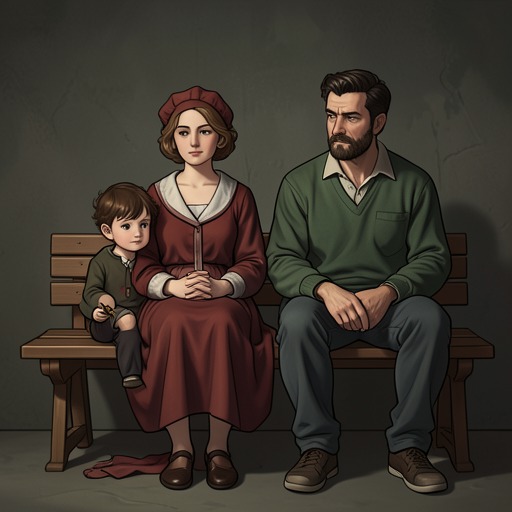
The Ballad of the Last DragonSylvaine Abelan–Kingsley is a family-like relationship built in the Rusty Nail through hospitality, protection, and an intimacy expressed more readily in acts of care than in declarations. Kingsley employs Sylvaine as a performer, accepts her elven identity without balking at her pointed ears, and becomes the practical center of a home in which she can survive poverty and prejudice without surrendering her pride.
A Tavern That Becomes Home
Kingsley and Brigitta are among the very few people in town who never recoil from Sylvaine’s ears. Their acceptance is not presented as ceremonial tolerance but as an ordinary fact of daily life: Kingsley asks no more from Sylvaine than professional courtesy, treats her with consistent kindness, and lets her work in the Rusty Nail without making her defend her presence. His physical size and guarded manner give him an intimidating aspect; Sylvaine imagines that he may have killed a man with his bare hands, while also recognizing that he knows her well enough to keep his secrets from her probing curiosity. The contrast makes his gentleness more substantial rather than less: the formidable tavernkeeper chooses restraint and care.
Kingsley and Brigitta give Sylvaine a small dwelling beside their barn when she begins working for him, after Kingsley discovers that she has been sneaking back into the tavern to sleep. The gesture changes the relationship from employment into belonging. Sylvaine’s place in the household is not secured by wealth—Kingsley is not rich, and the couple must manage the strain her needs place on their purse—but by their willingness to make room for her. The dwelling becomes a material answer to the insecurity that shadows her life as an elf and a performer.
Sustaining Sylvaine Through Poverty
Sylvaine wants little in theory beyond food, recognition, and admiring audiences, yet even food is not reliably assured. Kingsley does not let her truly go hungry, while Brigitta manages their limited resources and deliberately makes extra food for her. Because the Rusty Nail has no kitchen from which plates could be quietly carried away, this charity cannot remain invisible; Sylvaine must swallow her pride and accept it openly. The recurring provision therefore carries emotional weight. It is not a single rescue but a household practice that protects her from hunger without turning her into a spectacle.
The memory of Birchfield sharpens the difference. Two years earlier, when Sylvaine ate abandoned scraps there, the tavern owner tried to arrange what he called a mutually beneficial arrangement. Against that exploitative experience, Kingsley’s assistance appears as care without a demanded price. He and Brigitta do not convert her vulnerability into leverage. Their kindness allows Sylvaine to say that she has a good thing going at the Rusty Nail even while her grumbling stomach exposes how precarious that security remains.
The Farewell Gift and the Right to Return
When Sylvaine prepares to leave on a quest, she removes every sign of her life from the small dwelling, making departure look almost like erasure. Kingsley comes to her door carrying a medium-sized leather satchel in his massive hands. Inside are enough salted jerky, apples, and carrots to feed her for a week, along with her favorite mushrooms, witch’s butter and king bolete, which Brigitta has evidently foraged and taken from the larder. The contents are precise rather than grand. They show that the couple knows Sylvaine’s bodily needs and tastes, and that affection has been translated into provisions suited to the road.
Kingsley also gives her a small wrapped parcel containing soap scented with black currant and mulberries mixed into beech ashes and goat fat. He is the only person Sylvaine knows who makes that particular soap, so the object carries the intimacy of a household signature. It is a portable comfort, a familiar smell placed among the necessities of travel. Sylvaine cannot manage a conventional thank-you; her words catch between laughter and sobbing, and she throws herself into his arms. Kingsley pats her head and explains that he thought she might want simple comfort on the road, an understatement that matches the relationship’s mode of expression.
Affection Without Possession
Sylvaine once wondered about Kingsley’s intentions, but she eventually understands that his kindness is not a private bargain reserved for her alone: he would do the same for anyone. That realization does not diminish the bond. Instead, it distinguishes protective generosity from possessiveness and lets Sylvaine trust the care without fearing an invisible debt. Kingsley’s attention to her comfort becomes dependable precisely because it is grounded in character rather than manipulation.
The departure scene makes that ethic explicit. After Sylvaine promises to return before Winter Solstice, Kingsley offers a bittersweet smile and tells her that she need not come back to the tavern so long as she is safe. His concern therefore outranks the household’s convenience, the tavern’s business, and even his own wish to keep her nearby. Sylvaine answers by insisting that she will return and invoking their unfinished discussion about themed events to attract more customers. Her joke restores their familiar working rhythm, while Kingsley’s quiet laugh shows how deeply the prospect of losing her has affected him.
Narrative Significance
The Sylvaine Abelan–Kingsley bond gives the story a concrete image of home as something made through repeated acts rather than inherited status. Kingsley provides employment, shelter, food, and emotional permission to leave without treating departure as betrayal. Brigitta’s extra portions and foraged mushrooms extend the same household care, making the relationship a shared domestic refuge rather than a purely sentimental attachment between employer and performer.
For Sylvaine, the Rusty Nail offers a rare interval in which pointed ears do not automatically invite rejection and poverty does not force her into exploitative dependence. For Kingsley, caring for her means accepting both her vulnerability and her freedom. The satchel, the fragrant soap, the barn-side dwelling, and the final assurance of safety turn ordinary tavern life into a chosen family structure. Their farewell consequently carries more than the sadness of travel: it tests whether home can remain real when one beloved member walks beyond its door, and the answer is found in the confidence that return is welcome but safety matters more.