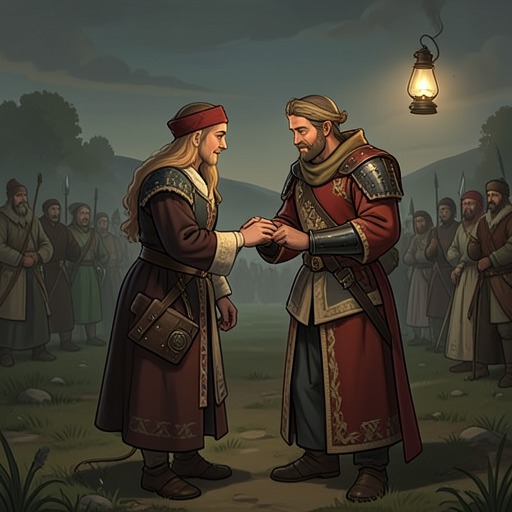
Sylvaine and Jaromir’s First Kiss
The Ballad of the Last DragonSylvaine and Jaromir’s First Kiss, also known as the First Kiss in the Copse, transforms a tense exchange between traveling companions into an unmistakably intimate encounter. In the secluded trees, Jaromir confronts Sylvaine about her fixation on his supposed intimacy with someone else; when she challenges him by asking why he did not ask her instead, he answers not with argument but with a sudden kiss. The moment reveals attraction through action before either character can safely name it, while Sylvaine’s immediate withdrawal establishes intimacy as both desired and dangerous.
Causes and Background
Sylvaine and Jaromir retreat to a copse at the edge of the woods after Sylvaine closes her book and follows him there. The setting briefly appears removed from ordinary travel: sunlight filters through vivid green leaves, overturned earth scents the air, cicadas hum, and Sylvaine experiences the forest as dreamlike, almost as though it were a place where wishes might be granted. Against that atmosphere, however, her inability to write remains unresolved. The empty page links the scene to her professional purpose and gives the encounter an immediate counterforce: desire may be gathering, but Sylvaine has come to create Aeron’s ballad and cannot afford to lose concentration.
Jaromir initiates the confrontation by watching Sylvaine with an unreadable expression and suggesting that her inability to write might be penance for the ballad she sang the previous night. His remark recalls the earlier incident that has provoked Sylvaine’s jealousy and gives their conversation its combative surface. She responds with sarcasm, framing his interruption as an intrusion into a supposedly scholarly discussion concerning sexual exchange. Their banter is not detached wit; it is a way of circling an emotionally exposed subject without admitting that either of them has been wounded by it.
What Happens
Jaromir abruptly closes the physical distance between them. Sylvaine is backed against a tree, with her notebook the only space separating their chests, while he crouches to meet her at eye level. His gaze moves over her face with openly greedy intent, and his proximity makes her breath, thoughts, and composure unreliable. He tells her that nothing else happened the previous night, but his explanation does not settle the tension. Instead, it places the disputed question directly between them: whether his encounter with another person was real, and why Sylvaine cares enough to challenge him about it.
Jaromir then presses the issue by describing intimacy on the road as comfort that may be taken in stolen moments with strangers. He asks whether Sylvaine is offended by the possibility itself or finds only him loathsome. Her answer turns the confrontation into a test. Burning with embarrassment and unable to think clearly while he is so close, she asks why he did not ask her if anyone would do. The challenge shocks him into pulling back, giving her a brief breath of air and the impression that she has regained control.
That control lasts only until Jaromir tips up her chin and kisses her before she can finish a startled gasp. The gesture overturns the verbal contest: he does not answer her provocation through explanation, and she does not receive the safety of distance she had just recovered. The first kiss therefore functions as both reply and revelation. It confirms that his bluster has concealed a response to her, while making the attraction impossible to treat as merely imagined or argumentative.
The encounter continues long enough for Sylvaine’s desire to become bodily rather than merely speculative. She allows her legs to fall until her feet meet the ground, and Jaromir kisses her forehead, runs his hands down her sides, searches her face, and gives her a second kiss that is softer than the first. His touch draws her toward him despite her intention to resist. The contrast between the initial force of the kiss and the tenderness of the later one complicates the encounter: Jaromir is not simply overpowering her with confidence, and Sylvaine is not simply rejecting him. Both are caught in a movement toward intimacy that their spoken defenses have failed to prevent.
Resistance and Stakes
At the height of the encounter, Sylvaine’s logic returns. She recognizes that the scene began because she was disturbed by seeing Jaromir with someone else despite their status as nothing more than travel companions. She also recognizes that her challenge may have offered herself as an outlet for the physical needs she had accused him of satisfying elsewhere. This realization makes the kiss more troubling, not less, because it exposes the possibility that jealousy and desire have been entangled from the beginning.
Sylvaine finally tells Jaromir that they cannot do this and then revises the statement into a more personal admission that she should not do it. Jaromir’s pinched brows and visible swallow register the effect of her refusal, but the scene ends with her resisting the impulse to continue. Her reason is concrete: she has a job to do. If thoughts of Jaromir, regret, and possible pain consume her attention, she fears she will be unable to write Aeron’s ballad or establish herself as an artist. The kiss thus creates a direct conflict between erotic attachment and artistic ambition, rather than resolving either one.
Consequences and Significance
The kiss changes the meaning of Sylvaine and Jaromir’s earlier hostility. Their arguments have been carrying attraction beneath them, and the encounter converts suspicion, jealousy, and verbal provocation into a shared physical fact. Yet it does not produce emotional security. Sylvaine’s retreat preserves the unstable pattern of approach and withdrawal: Jaromir moves toward her with confidence, she answers with a daring challenge, desire brings them together, and responsibility forces her apart.
The scene is also shaped by the tension between speech and the body. Sylvaine insists that she does not care, calls the matter none of her business, and attempts to dismiss Jaromir’s behavior as irrelevant; her jealousy and physical response contradict those claims. Jaromir likewise explains intimacy in general terms, but his actions reveal that his attention is specifically fixed on Sylvaine. The encounter’s decisive knowledge is therefore conveyed through distance, breath, touch, gaze, and hesitation before either character can make a stable verbal declaration.
For Sylvaine, the first kiss becomes a threat to the identity she is trying to construct through work. Her empty page, her ambition to write Aeron’s ballad, and her fear of distraction all remain present inside the romantic breakthrough. The scene does not allow desire to replace vocation; instead, it makes the two obligations newly inseparable. Jaromir becomes not only a companion who provokes her, but also a possible source of regret and pain whose presence may alter the story she has undertaken to tell.