Tempest Trials
The Ballad of the Last DragonTempest Trials are the dangerous tests guarding The Dragon’s cave and hoard, but their decisive significance lies in their double nature: they appear to be the ordeal imposed by a surviving dragon, while in truth they are the elaborate final project of a dying man who wanted to manufacture an enduring legend. By surviving them, Sylvaine Abelan and Jaromir do not merely claim treasure; they uncover how stories, traps, prejudice, and death have been made to reinforce one another across generations.
Design and Purpose
The trials were created by the man who spent his final years acting as “the dragon.” A letter reveals that he had been in his third year of the role while suffering from a collapsing lung. His physician had advised him to pursue leisure, and he transformed that limited remaining life into a diversion whose scale far exceeded his own lifespan. He deliberately made the map difficult to translate, knowing that most seekers would not survive the trials, and later admits that many people had already tried and failed.
The trials were therefore not an accidental obstacle course but a calculated system of selection and attrition. Their designer had no heirs and no desire to leave his wealth to a kingdom that denied him a title because he lacked noble blood. Instead, he forged his own title and sought a legacy that no one would soon forget. The cave, the map, the hazards, and the dragon story function together as an artificial inheritance: a private fortune converted into public myth.
The Dragon-Fire Mechanism
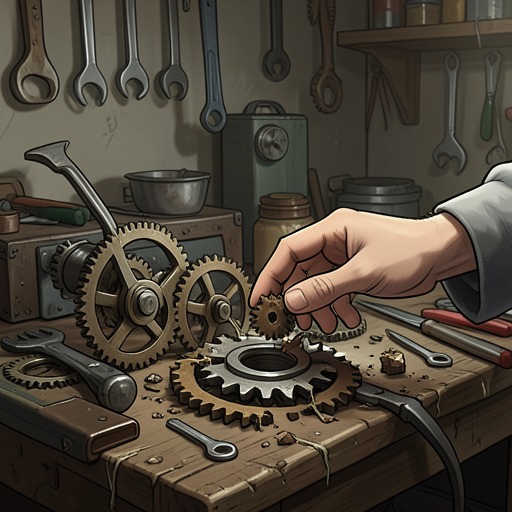
One of the most lethal components is the dragon-fire apparatus. The letter states that an alchemical formula was placed in the top-right-hand drawer, while steam was sent through small pipes inside the cave. The mixture was designed to react with that steam and ignite anyone who ventured into the dragon’s cave. The supposed breath of a supernatural creature was thus a concealed chemical and mechanical process, made terrifying by darkness, isolation, and the expectations created by the legend.
The designer could have sold the formula to a nation seeking an incendiary weapon for use at sea, but he regarded wealth as useless when he would not live long enough to spend it. That choice links the trials’ destructiveness to his personal philosophy. The danger was not built for military power or practical profit; it was built for spectacle, amusement, and remembrance. The same mechanism that might have become a weapon instead became part of a performance in which adventurers supplied the casualties and the dying inventor supplied the story.
Discovery and Reinterpretation
When Sylvaine Abelan reads the letter, the central mystery changes shape. The dragon is not real in the way the expedition had believed. The threat is a clever trick and a story spun by a dying man more than a century and a half earlier. The corpse-eaters served as an additional barrier, discouraging investigation and helping preserve the impression that a monstrous being still occupied the mountain. Over time, the original account faded into myth, while Aeron Fowler’s map—obtained from a traveling merchant—became a false trail that nevertheless led the adventurers toward the truth.
The revelation also exposes the trials’ dependence on belief. Sylvaine Abelan recognizes that the expedition followed the map and began to believe in the dragon because faith can offer comfort when everything else seems lost. The deception succeeded not only because its machinery was dangerous, but because its victims wanted the world to contain a meaningful legend. The trials converted uncertainty into conviction, then used that conviction to draw more people toward fire, traps, corpse-eaters, and death.
The date on the letter places the scheme in the Age of the Wolf, more than one hundred and fifty years before the discovery. That distance intensifies the horror. The original architect is long dead, yet his private amusement continues to shape the behavior and deaths of people who never knew his name. The trials are a delayed action whose consequences outlive their maker, surviving through copied maps, distorted retellings, and the persistent promise of a dragon’s hoard.
Survival, Secrecy, and the Hoard
After surviving the trials, Sylvaine Abelan and Jaromir take the treasure, filling heavy bags with gold and loading additional coins into their horses’ saddlebags. Sylvaine Abelan also carries an ancient elven prayer stone, giving the material reward a personal and cultural dimension beyond its monetary value. The hoard is not treated as a simple triumph: it is physically burdensome, difficult to transport, and inseparable from the deaths that made its discovery possible.
The survivors destroy the dragon-fire formula rather than preserve or sell it. Sylvaine Abelan burns the parchment over a half-melted candle, watching the alchemical instructions become ash. The act is a refusal to extend the inventor’s design into another generation. Although the formula and the memory of its creator are not hers to erase, she cannot regret destroying the means by which the same deadly spectacle could be repeated.
They also burn Aeron Fowler’s map and use blackpowder to collapse the cave entrance after removing the treasure. The decision is morally uneasy: sealing the cave may damage the forgotten man’s legacy, but the survivors owe no allegiance to The Dragon, whose amusement led countless people to their deaths. They leave behind a site that appears to be only a corpse-eaters’ nest and a destroyed cave. Furnishings and mechanisms remain buried deep inside, but the evidence that could authenticate the dragon’s true history is deliberately concealed.
The Substitute Legend
The destruction of the trials’ evidence does not end the story; it redirects it. Sylvaine Abelan and Jaromir invent an account in which the dragon was killed by Aeron Fowler’s blade, the collapsing body brought down the cave, and Aeron delivered the final blow before receiving a mortal wound. In this version, the surviving companions dragged the brave, dying Aeron into the open air so he could see the sky once more.
The fabricated tale replaces one legend with another. The original story glorified The Dragon’s deception and made unknown adventurers expendable; the new story converts Aeron Fowler’s death into a heroic sacrifice and gives the expedition a narrative the wider world can understand. Yet the dragon tooth in Sylvaine Abelan’s satchel remains a physical reminder of the buried truth. The trials therefore end not with the disappearance of storytelling, but with a struggle over which story will survive: the cruel legacy of a dying trickster, or the protective memorial built around Aeron Fowler.
In this sense, Tempest Trials are both a quest ordeal and a critique of quests. They promise wonder, treasure, and heroic transformation, but their machinery reveals the human cost hidden beneath the fantasy of discovery. The survivors’ final acts—burning the formula, destroying the map, collapsing the entrance, and reshaping Aeron Fowler’s death into a protective legend—turn survival into an ethical choice. The trials can no longer be repeated in their original form, but their consequences persist in the story made from their ruins.