Thalon
The Ballad of the Last DragonThalon is a dark-haired, bottle-green-eyed carpenter whose drunken reunion with Jaromir turns an apparently ordinary tavern departure into a decisive revelation. His easy familiarity, careless questions, and unguarded knowledge of Jaromir’s past puncture the identity Jaromir has been using, while Thalon’s warmth and social confidence sharply contrast with Jaromir’s immediate panic.
Identity and Introduction
Thalon first appears as a man who darts out of a tavern and staggers toward Jaromir with an easy, wide grin. Although drink makes his gait laborious, it does not diminish his physical exuberance: he claps Jaromir on the back and pulls him into a half-hug before Jaromir can prepare for the encounter. The gesture is spontaneous and intimate, presenting Thalon as someone who regards Jaromir not as a recent acquaintance but as a person whose history he shares.
That recognition is alarming because Jaromir has been traveling under Aeron’s name. Thalon does not mention the assumed name, and the surrounding uncertainty leaves open whether he fails to notice it or simply has no reason to treat it as important. His appearance therefore carries an ambiguity that belongs less to Thalon’s intentions than to the unstable identity Jaromir is trying to maintain. To Thalon, the man before him is plainly Jaromir; to Jaromir, that plainness is dangerous.
Background and Social Connections
Thalon explains that he came to town for a change of scenery and accepted a small carpentry job after a fire destroyed most of his wife’s cousin’s barn. His work is practical and immediate: he is rebuilding a structure damaged by fire, and he remarks that the blaze also destroyed a small leather shop next door. He treats the loss with the brisk commercial logic of a tradesman, observing that the destruction is bad luck for the owners but good for his own business.
The fire has wider implications beyond Thalon’s employment. The leather shop belonged to the armorer associated with Welkin's guardians, making the damage a serious personal and material loss. Thalon does not dwell on that consequence, because he is absorbed in talking about carpentry and structural integrity, but his ordinary account of a building job opens onto the harsher economic aftermath of disaster: one person’s ruin supplies another person with work.
Thalon also places Jaromir within a long-established circle of family and community ties. He asks whether Jaromir will soon be visiting Kalinia, where Avalie and Rhosyn have already entered an intensive period of planning. The question implies that Jaromir has a recurring connection to Kalinia rather than merely passing through it with the current expedition. It also suggests that Thalon understands Jaromir’s movements through a shared social network, one that extends beyond the immediate tavern encounter.
The Revelation of Jaromir’s Past
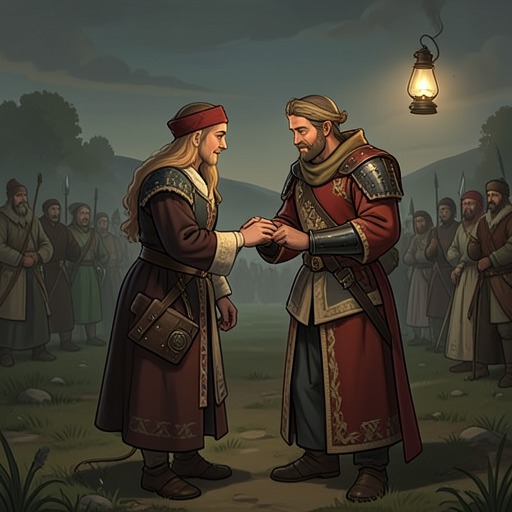
The most important information Thalon provides is his account of how long he has known Jaromir. He apologizes for failing to address the narrator properly, bows low, kisses her hand, and jokes that he has been married for only two years yet has already forgotten how to behave toward a lady. His manners are theatrical but not distant; even while drunk, he assumes the confidence of someone accustomed to entering other people’s social space.
Thalon then says that he grew up with Jaromir and Damir, as well as with Jaromir’s betrothed. The statement instantly changes the meaning of the reunion. Until this point, Jaromir’s connection with the man is unexplained, but Thalon’s words establish a shared childhood and identify a previously concealed engagement. When the narrator asks whose betrothed he means, Thalon answers that it is Jaromir’s, treating the fact as self-evident.
The revelation is devastating precisely because Thalon does not present it as a confession. He announces it in the course of casual conversation, while laughing, elbowing Jaromir, and losing his balance. The social ease of the disclosure intensifies Jaromir’s distress. Thalon behaves as though he is confirming familiar biographical information; Jaromir watches the narrator with a haunted expression and appears close to becoming sick. The scene makes secrecy visible through the difference between the speaker’s carelessness and the listener’s terror.
Relationships and Narrative Function
Thalon’s relationship with Jaromir is rooted in childhood. He names Damir alongside them, placing the three men within a formative local history rather than an isolated adult friendship. His knowledge is therefore more comprehensive than that of Jaromir’s current companions: he knows the name Jaromir has set aside, the family and community around him, and the existence of his betrothal. In narrative terms, Thalon functions as an accidental witness whose memory cannot be controlled by the present deception.
His relationship to Jaromir is affectionate but destabilizing. The half-hug and back-clap communicate genuine familiarity, yet the same gestures carry danger because they publicly claim Jaromir as someone Thalon has known for years. Thalon’s friendliness is not presented as calculated malice. The threat arises from his lack of awareness—or lack of concern—that the truth he carries could destroy Jaromir’s current arrangement.
Thalon’s marriage also gives him a place within the domestic network surrounding Jaromir. He refers to his wife’s cousin and speaks of Avalie and Rhosyn’s plans in Kalinia, linking occupational, marital, and familial relationships in a single conversation. Most significantly, his mention of Jaromir’s betrothed reveals that Jaromir’s romantic and family obligations predate his present journey. Thalon thus exposes not merely a name but an entire structure of belonging from which Jaromir has attempted to remain separate.
Change and Narrative Significance
Thalon undergoes no visible transformation during the encounter; his importance lies in the change he produces in the other characters and in the reader’s understanding. Before he appears, Jaromir’s identity and emotional commitments remain partially concealed. After he speaks, Jaromir’s use of Aeron’s name becomes newly precarious, his connection to Damir acquires deeper childhood context, and his betrothal becomes an explicit fact rather than an absent or uncertain detail.
The scene also turns ordinary sociability into a mechanism of exposure. A carpenter returning from a tavern, a job created by a fire, a question about visiting Kalinia, and a kiss offered in greeting all seem harmless. Yet each casual detail draws Jaromir closer to the life he has tried to hide. Thalon is memorable because he does not enter as an investigator or enemy. He enters as the past itself: drunk, affectionate, talkative, and incapable of understanding why the truth he remembers should be dangerous.