The Aeron Impersonation Scheme
The Ballad of the Last DragonThe Aeron Impersonation Scheme is the companions’ attempt to keep Aeron Fowler’s legend physically present after his death. Rather than rely on songs alone, Sylvaine Abelan proposes that Jaromir and Cadoc take turns wearing Aeron’s armor and appearing before tavern patrons. The scheme converts mourning into performance: the dead hero becomes a repeated public sight, sustained by trusted bodies, selective disclosure, and the appetite of strangers for something extraordinary.
Purpose and Conception
The plan arises when people begin wanting to see the hero in the flesh. Sylvaine recognizes that the story of Aeron Fowler has spread beyond the group’s control and that admirers may soon seek tangible proof of the figure celebrated in song. She argues that the power of a story can be strengthened by giving believers something physical to encounter. In a bleak world defined by boundaries, the appearance of Aeron offers an object for hope, allowing the legend to seem briefly present rather than confined to recollection.
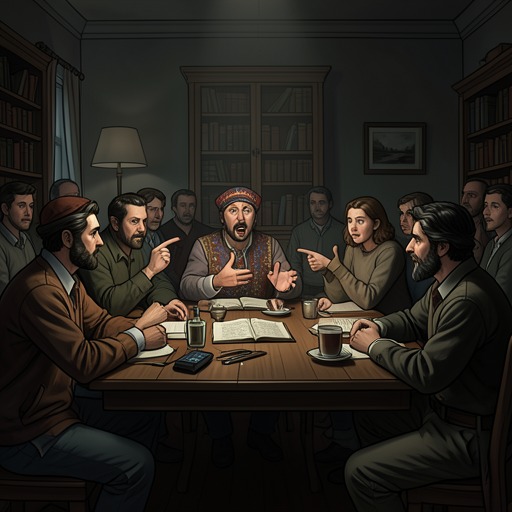
Sylvaine’s proposal is not to hire an outsider. Jaromir immediately identifies the danger of bringing another person into the confidence of the group, since an accomplice might talk or attempt blackmail. Sylvaine answers that the necessary people are already available and trustworthy. The deception therefore depends on the existing bonds among the survivors rather than on a professional impersonator or an anonymous actor. Its intimacy is also its safeguard: the people preserving Aeron’s image are those who knew him and bear the consequences of his loss.
Design and Participants
The practical arrangement assigns Jaromir and Cadoc to alternate appearances in Aeron’s armor. Jaromir initially reacts with disbelief, but the proposal quickly becomes workable, and Neith endorses it. The armor is the scheme’s central prop and its principal claim to authenticity. It carries Aeron’s recognizable public image even when the person inside it is someone else, making the costume a portable substitute for the absent hero.
The arrangement also reveals the scheme’s theatrical logic. Sylvaine remains responsible for the performance surrounding the entrance, while the armored figure supplies the visual spectacle. On the night Cadoc is due to appear, Jaromir asks whether Sylvaine is ready; she returns to the stage to sing an encore no one requested, using the song to prepare the room for the entrance. Her readiness is not merely emotional bravado. It is a professional response to danger and uncertainty, the decision to make a show at the precise moment when the show becomes a tactical operation.
The Tavern Performance
Cadoc’s first appearance is carefully staged. The group polishes Aeron’s armor to a high sheen, and in the candlelight Cadoc appears as a fierce guardian descended from the Welkin. The lighting, polished metal, song, and timed entrance collaborate to produce an image larger than the man beneath the armor. Cadoc addresses the room with the proud, theatrical manner expected of the hero, allowing the patrons to participate in the fiction before they have time to examine it closely.
The impersonation is not designed to withstand exact scrutiny. The group knows that Cadoc’s face will be visible because a helm would be impractical in a tavern, especially if the supposed hero is expected to mingle with patrons. Jaromir and Cadoc will also show different faces on different occasions, so eyewitness accounts will conflict. That inconsistency is treated not as a flaw but as protection. Drunken witnesses are especially useful because their testimony can preserve the broad conviction that Aeron appeared while undermining any precise reconstruction of who stood inside the armor.
The performance thus creates a carefully managed gap between recognition and knowledge. Patrons are given enough visual and dramatic evidence to believe they have encountered Aeron, but not enough reliable information to identify the impersonator. The armor supplies continuity; changing faces supply deniability; Sylvaine’s song supplies the emotional frame in which contradiction can be absorbed as part of the legend.
Violence and the Cost of the Legend
The scheme also places Sylvaine in the path of the social forces that the heroic performance is meant to challenge. In the tavern, a hostile patron seizes her and calls her a “knife-ear,” telling her that she is fortunate to be allowed inside and threatening to show her what her kind deserves. Her body reacts before she can answer: her throat tightens, cold panic fills her chest, her legs go numb, and the returning panic threatens to overwhelm her. The planned appearance of Aeron is therefore not staged in a neutral public space. It unfolds amid anti-elf prejudice, gendered intimidation, and the constant vulnerability of a performer who must remain visible to strangers.
Cadoc’s intervention gives the impersonation an immediate protective function. He orders the attacker to remove his hands from Sylvaine, and the armor’s symbolic authority becomes materially useful. The false Aeron is not only an image for admirers; he is also a shield that can command a room when violence begins. Yet the scene makes the cost plain. The legend can protect Sylvaine only because another living companion is willing to occupy its dangerous role, while Sylvaine herself remains exposed as an elf woman and public performer.
That danger becomes even more severe away from witnesses. Later, Sylvaine hears men approaching while she is alone in a field at night. She climbs into a concealed branch, carries a short sword that Neith insisted she take, and keeps a shepherd’s sling in her pocket. When the attackers overpower her, she bites one man’s hand, endures a blow to the face, and fights while her broken lute presses into her back; they restrain her wrists and legs and force her mouth shut with her crumpled cap. These circumstances clarify what the tavern appearances cannot solve: a heroic disguise may alter the balance of power in a crowded room, but it cannot erase the structural danger surrounding Sylvaine when protection, witnesses, and performance are absent.
Consequences and Significance
The scheme’s immediate consequence is the extension of Aeron’s posthumous presence. By alternating Jaromir and Cadoc beneath the same armor, the companions make the hero appear to return, allowing rumor to travel through patrons whose contradictory accounts may actually strengthen the mystery. Aeron’s absence is not overcome; it is theatrically reorganized. His armor becomes a medium through which the living continue to distribute his identity.
The plan also exposes the unstable boundary between truth and useful fiction. Everyone inside the group knows that Cadoc is not Aeron, yet the performance aims to produce a public belief that Aeron has been seen. The deception is protective and memorial at once, but it risks making the legend more authoritative than the person it remembers. The armor can preserve a heroic outline while concealing the different bodies, fears, loyalties, and injuries of those who carry it.
That tension is visible in the later confrontation with Magistrate Ridion. Sylvaine presents herself as a bard, defender of written and spoken word, acting notary, formidable slinger of stones, and guide for a better tomorrow. Ridion responds with disgust toward an elf who refuses to accept a degraded social position, while Jaromir physically threatens him for insulting her. In this broader struggle, the Aeron Impersonation Scheme belongs to the same campaign of resistance: it uses public narrative to contest authority, prejudice, and the attempt to decide whose presence counts. Its deepest achievement is not simply that people glimpse a figure in polished armor. It is that the companions make memory active, collective, and capable of intervening in the living world.