The Assault on Syl in the Pasture
The Ballad of the Last DragonThe Assault on Syl in the Pasture is the book’s most direct confrontation between Sylvaine Abelan’s precarious public safety and the anti-elven hostility that surrounds her. Three men from the tavern pursue her into an isolated field, where ethnic insult, sexual menace, and physical violence converge. Sylvaine survives not by remaining a protected performer but by using the weapons and combat lessons her companions have given her, while the attack’s aftermath binds her trauma, anger, and dependence on her chosen family into a single violent turning point.
Causes and Background
Sylvaine’s vulnerability has been established long before the assault. As an elven performer in Tarrgein, she keeps her ears hidden beneath a velvet cap because their shape marks her heritage and invites prejudice. She has learned that audiences reward concealment, and that even a place where people have gradually accepted her still contains the superstition that she might use “evil she-elf magic to bewitch them.” Her livelihood therefore requires a compromise between comfort and safety: she plays while overheated and uncomfortable rather than risk losing the coins on which she depends.
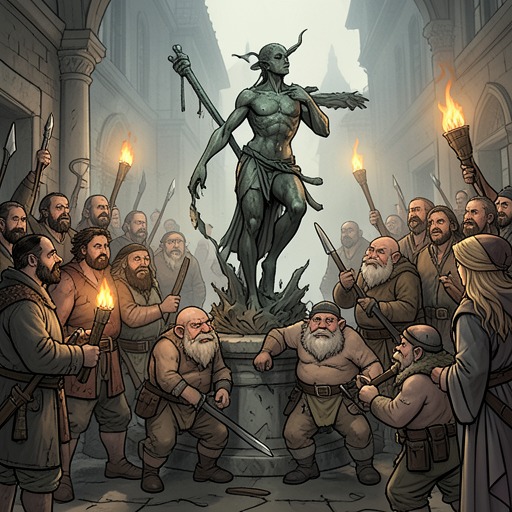
The danger is not limited to private suspicion. In the tavern, a man grabs Sylvaine and calls her a “knife-ear,” claiming that she is lucky to be allowed inside and threatening to show her what her kind deserves. The insult converts social exclusion into an immediate physical threat, while the sight and expectation of another panic attack interrupt her ability to answer. Later tavern chatter continues the same objectifying gaze, reducing elves to questions about whether they are attractive and treating elven identity as material for crude speculation. The pasture assault is thus not an isolated breach of ordinary conduct; it is the violent extension of a prejudice already embedded in everyday speech, custom, and the conditions of Sylvaine’s work.
Isolation and First Resistance
The attack begins when Sylvaine hears several men approaching while she is alone in the field at night. She recognizes the danger of being caught without witnesses and cannot safely run if they might see her, so she slings her lute over her back and climbs into a thick, leaf-hidden branch. The decision is practical rather than heroic: concealment is her first defense, and the tree gives her distance from men whose loud presence has already taught her to be wary.
She carries more than music into that hiding place. Neith has insisted that she take a short sword, and Sylvaine also has a shepherd’s sling in her pocket. When one of the men looks up and recognizes her as the bard, his drunken grin turns the tree into an exposed stage. His question about what he has found there is a moment of discovery for the attackers, but it also confirms that Sylvaine’s public identity has followed her into the darkness. Panic constricts her chest as the man begins climbing, making the threat bodily before it becomes fully articulated.
Cadoc’s instruction supplies the counterforce to that fear: “Aiming should be instinctive, not exact.” Sylvaine pulls the sling’s leather strap and releases when the climber’s coif-covered head appears. The stone strikes him between the eyes and drops him to the ground. She then hits the tall blond man in the nose, drawing blood and sending him falling from the branches. These are not effortless victories. They are improvised acts performed through terror, and they mark the first reversal in the men’s assumption that Sylvaine is defenseless.
Overpowering and Flight
The attackers recover their advantage by attacking the very object that defines Sylvaine’s public life. One of them seizes the lute strapped to her back and tears her from the branch, sending her cap flying as she crashes onto the ground. The instrument’s wood and strings snap beneath her, turning music into wreckage at the instant her concealment fails. Before she can regain her footing, hands drag her backward; she claws at the earth, kicks, and screams while the men strip away the distance that had allowed her to fight from above.
The struggle becomes inseparable from an older memory. As Sylvaine runs toward the road, she recalls her ahntan chasing her through the forest when they were children, a game that ended in bewilderment when the woman failed to appear and later in horror when Sylvaine learned that her ears had been cut off and her body left on the forest floor. The memory gives the present pursuit a historical shape: the men’s violence is not merely frightening because it is immediate, but because it repeats the logic of attacks that have already taken someone from her. Even while her legs ache and her head throbs from the blow that knocks her down, she keeps moving toward the possibility of calling Neith, Cadoc, or Jaromir for help.
The men seize her again before she reaches safety, wrenching the short sword from her grasp and attempting to overpower her. Sylvaine’s remaining weapon is the dagger hidden at her ankle, a weapon Neith had told her never to rely on as her principal defense. She twists toward her boot and pulls it free when the attackers do not anticipate the movement. The blade cuts one man’s cheek, but his punch breaks through before she can escape, exploding pain across her mouth and jaw and coating her tongue with blood. When the attackers try to take the dagger, her resistance becomes more than an effort to survive the immediate assault: rage rises from the accumulated pain she has concealed behind smiles, jokes, and songs, and she resolves not to submit quietly even as her body is held down.
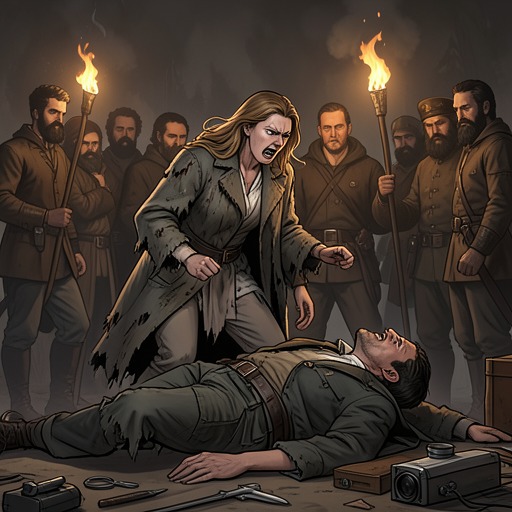
The reversal arrives through the arrival of Jaromir, Neith, and Cadoc. A sword thrust through the blond attacker’s chest removes him from Sylvaine’s body and leaves her staring at his convulsing final breaths, as though witnessing the death is necessary to prove that the danger has truly ended. Jaromir then reaches her, his face marked by rage and grief, and calls her by name. The moment his hands steady her, the anger sustaining her defense collapses into sobbing relief. Neith and Cadoc hold the remaining men at swordpoint while Sylvaine rises unsteadily, no longer hidden in a tree or fleeing across the grass but standing before those who attacked her.
Retaliation and Consequences
Jaromir’s rescue does not erase Sylvaine’s agency or convert the assault into a simple scene of male protection. After he kills the man in the velvet doublet, he moves toward the remaining attacker with the same furious certainty, but Sylvaine touches his arm and stops him. She retrieves her short sword from the wet grass and approaches the man who first discovered her in the tree—the man who had the opportunity to walk away and refused. By making him face her, she reverses the scene’s earlier power arrangement: the woman who had been watched, pursued, dragged down, and treated as an object now becomes the person before whom the aggressor must answer. His fear is not abstract to her; it is the consequence he had never imagined for his actions.
The interruption also reveals the complicated shape of Sylvaine’s survival. She has needed Neith’s insistence that she carry a sword, Cadoc’s instruction in instinctive aiming, and the timely arrival of Jaromir, Neith, and Cadoc; yet she herself hides the dagger, fires the sling, endures the pursuit, refuses surrender, and decides what happens to the last man. Her response is neither a clean triumph nor a passive rescue. It is a hard-won claim to judgment after terror has reduced the world to weapons, bodies, and the next possible breath. The broken lute and fallen cap remain the material cost of the attack, while her continued ability to stand, choose, and confront the surviving assailant becomes its moral reversal.
Trauma, Identity, and Narrative Significance
The assault’s violence is intensified by the way it activates wounds that precede the immediate scene. Sylvaine’s panic is not an ornamental expression of fear: it constricts her chest, numbs her legs, disrupts speech, and returns through the memory of her ahntan’s mutilation. The present attack therefore joins private recollection to the wider history of elven persecution. The men do not merely threaten an isolated performer; they reproduce the danger attached to an elven body whose ears must be hidden, whose presence is questioned, and whose safety depends on anticipating the hostility of strangers. Her survival is consequently measured not by a clean victory but by her refusal to let inherited terror determine the final movement of the scene.
The encounter also exposes the gap between Sylvaine’s public image and the conditions beneath it. Tavern life turns her into a bard to be watched, mocked, desired, and discussed, while her red cap, concealed ears, and practiced songs help her earn money without inviting open hostility. In the field, those defenses fail at once: the cap flies away, the lute is broken, and the men’s recognition of her as “that bard” becomes a pretext for pursuit rather than protection. The shattered instrument is especially consequential because it materializes the cost of making art in a society that consumes performance while denying the performer security. Her artistry has not protected her from prejudice; instead, it has made her visible to men who believe visibility grants them access.
Yet the attack does not leave Sylvaine in the same position in which it finds her. Before the assault, her companions’ preparations can seem like precautions imposed upon someone who would rather rely on music and wit: Neith insists on the short sword, and Cadoc teaches her to use the sling. Under pressure, those gifts become embodied knowledge. She climbs rather than exposes herself, fires when the climber appears, reaches for the dagger concealed at her ankle, and continues fighting after being struck and disarmed. The scene makes training meaningful not because it transforms her into an invulnerable warrior, but because it gives her choices inside a crisis designed to remove every choice.
The companions’ intervention establishes another form of strength. Jaromir’s arrival ends the immediate imbalance with lethal force, while Neith and Cadoc restrain the surviving attackers. Their protection matters because Sylvaine has called for them in her mind as she runs toward the road, but the aftermath refuses to make rescue the whole meaning of survival. Jaromir’s rage nearly carries him into killing the last man; Sylvaine stops him, retrieves her sword, and approaches the aggressor herself. That decision turns communal protection into renewed personal authority. The people who love her can end the danger, but they cannot decide what the final act means on her behalf.
As an event, The Assault on Syl in the Pasture gathers the book’s conflicts over anti-elven prejudice, gendered vulnerability, performance, and chosen family into one concentrated reversal. The attack begins with Sylvaine hiding from men who assume her weakness and ends with her standing over one of them, making him confront consequences he never expected. Its lasting significance lies in that contradiction: the world remains dangerous, the lute is broken, the old memory is reopened, and no act of retaliation can restore uncomplicated safety; nevertheless, Sylvaine’s fear does not become surrender. She survives as an artist, an elf, a fighter, and a member of a community whose care strengthens rather than replaces her own agency.