The Dragon
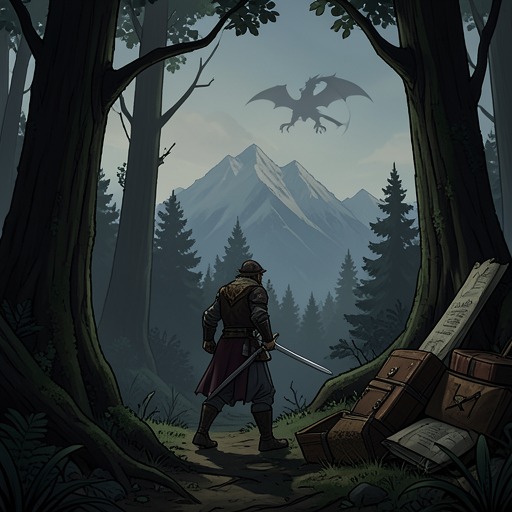
The Ballad of the Last DragonThe Dragon is not a surviving member of the dragon species but the self-styled architect of a centuries-old legend: a dying man who impersonated the monster, filled a mountain cave with lethal mechanisms and treasure, and transformed his approaching death into an elaborate test. His scheme gives Aeron Fowler’s quest its apparent destination and its terrible cost, then, when exposed, forces Sylvaine Abelan and her companions to decide whether a story can preserve honor without preserving the lie that created it.
Identity and Motive
The Dragon’s identity emerges through a letter found at the end of the expedition. He had spent three years being “the dragon” while his lungs slowly failed, after a physician advised him to enjoy whatever leisure remained. The role was therefore both performance and terminal project: he used the time left to him to construct an experience that would outlive his body. His illness makes the legend’s theatricality inseparable from mortality. The cave is a stage designed by someone who knows that he will soon disappear, and the dragon persona is a mask intended to remain after the face beneath it has been forgotten.
His motive is explicitly bound to social exclusion and legacy. He explains that he had no heirs and no desire to leave his wealth to a kingdom that would not grant him a title without noble blood. Instead, he forged his own title and a legacy that no one would soon forget. The false dragon thus answers one deprivation with another kind of authorship: denied inherited status, he invents a lineage of terror, treasure, and fame. His hoard is not merely accumulated wealth but the material proof of a name he has manufactured for himself.
The Cave as a Lethal Performance
The Dragon’s creation combines riddling adventure with real bodily danger. He deliberately made the map difficult to translate, knowing that many seekers would fail the trials before reaching the center of the cave. The journey was intended to be selective, secretive, and difficult enough to turn survival into evidence of worth. Yet the test is also cruelly unstable: its participants are not simply solving a puzzle but entering a system designed by a dying man for his own amusement and remembrance.
The most dangerous mechanism is the dragon-fire formula hidden in the top-right drawer. The Dragon could have sold the alchemical knowledge to a nation seeking an incendiary weapon at sea, but he regarded gold as useless when he would not live long enough to spend it. Instead, he arranged for the mixture to react with steam sent through pipes in the cave, setting fire to anyone who ventured inside. The supposed supernatural threat is therefore an engineered conjunction of chemistry, machinery, and secrecy. What appears to be a dragon’s power is the delayed action of a human designer.
The expedition’s survival depends partly on historical decay rather than on the fairness of the trials. Sylvaine Abelan concludes that a component of the formula has probably become inactive over time, explaining how the group lived through dangers that had killed earlier seekers. The cave’s corpse-eaters served as an additional barrier, discouraging investigation and helping the story fade from remembered history into myth. The Dragon’s design consequently operates across generations: mechanisms kill in the present, while uncertainty and lost directions protect the legend in the future.
Discovery and Exposure
The letter changes the meaning of the entire quest. Dated First Fruits Day, 8:54 Wolf, it was written more than one hundred and fifty years before Sylvaine Abelan reads it. The writer congratulates survivors of the tempest trials, announces that he has already succumbed or expects to succumb to his failing lungs, and presents the treasure as a reward. The theatrical sign-off, “The Dragon, First Fruits Day, 8:54 Wolf,” preserves the chosen title while revealing that the title belonged to a mortal man rather than an immortal beast.
The revelation turns the expedition’s central mystery from supernatural pursuit to historical fraud. Aeron Fowler had found an old map through a traveling merchant, and the company followed it until the repeated danger made belief in the dragon feel emotionally necessary. Sylvaine Abelan recognizes that faith had offered comfort when everything seemed lost, even though the map was ultimately a false trail and the dragon only a story spun by a dying man. The discovery does not erase the reality of the journey; it relocates its source of meaning from dragon-slaying to the human consequences of trusting a legend.
The revelation also exposes the scale of the deception’s damage. The Dragon admits that many people attempted the trials and failed, while Sylvaine Abelan understands that the corpse-eaters, traps, fire, and obscured directions may have claimed lives long after the maker’s death. His private entertainment has become an inherited apparatus of death. The legacy he wanted is therefore morally double-edged: he succeeds in being remembered, but remembrance arrives attached to the suffering of strangers who were drawn into his invention.
Legacy, Secrecy, and Aeron Fowler’s Memorial
After finding the treasure, the survivors burn the dragon-fire formula and plan to burn Aeron Fowler’s map and Sylvaine Abelan’s translations. They collapse the cave entrance with blackpowder, burying the furnishings and mechanisms behind rubble and fallen rock. The action denies future seekers access to both the hoard and the knowledge that made the cave dangerous. It is also a rejection of The Dragon’s claim over the future: the survivors take the wealth but refuse to let the performance continue consuming lives.
The group nevertheless creates a new version of the legend. They agree to say that Aeron Fowler felled the dragon, that the collapsing body brought down the cave, and that Aeron received the killing blow before being carried outside to see the sky one last time. The tale transforms Aeron’s death into a heroic conclusion to the quest, while the dragon tooth in Sylvaine Abelan’s satchel remains a physical reminder of the concealed truth. This falsehood is not identical to The Dragon’s original deception, but it inherits its central mechanism: a material remnant supports a narrative that will be easier for the world to remember than the complicated reality.
Sylvaine Abelan’s decision to continue Aeron Fowler’s quest makes The Dragon the absent antagonist of a second journey. She promises to complete the expedition so everyone can be paid, to preserve the possibility of helping Jaromir’s sister-in-law and nieces, and to bring eternal glory to Aeron Fowler’s name. She later declares that she will honor Aeron and fight his dragon. The promise is fulfilled in an ironic form: the group reaches the cave, defeats the dangers associated with the legend, and discovers that the dragon cannot be defeated as a living beast because he was never there in that form.
Narrative Significance
The Dragon functions as a shadow, a threshold guardian, and an author within the story. He creates the threshold that the living characters must cross, but he does so from beyond the ordinary span of the plot, leaving behind a map, a cave, a formula, a hoard, and a role. His power lies less in physical strength than in controlling what others expect to find. The expedition begins as a quest for a last dragon and ends as an encounter with the consequences of narrative construction.
His deception also establishes a structural contrast with Sylvaine Abelan’s ballad-making. The Dragon uses story to lure people toward death for sport and self-glorification; Sylvaine Abelan uses story to protect Aeron Fowler’s memory, reward the living, and give meaning to an unfinished journey. She adds verses about the arachnida fight, emphasizing Aeron’s courage with nothing but river rocks and refusal to accept defeat, while recognizing that the same events sound different depending on who is placed at the center. The contrast does not make her invention wholly innocent, since she too conceals facts, but it distinguishes stories that exploit belief from stories that carry communal grief.
The final irony is that The Dragon achieves the immortality he wanted, though not the form of glory he imagined. His title survives because the survivors must explain the cave, the treasure, and Aeron Fowler’s death; at the same time, they deliberately destroy the formula, map, and entrance that could perpetuate his deadly game. His legacy remains as a warning about the power of stories to manufacture status, convert private fear into public myth, and make a dead person’s performance govern the choices of the living.