The Dragon’s Hoard
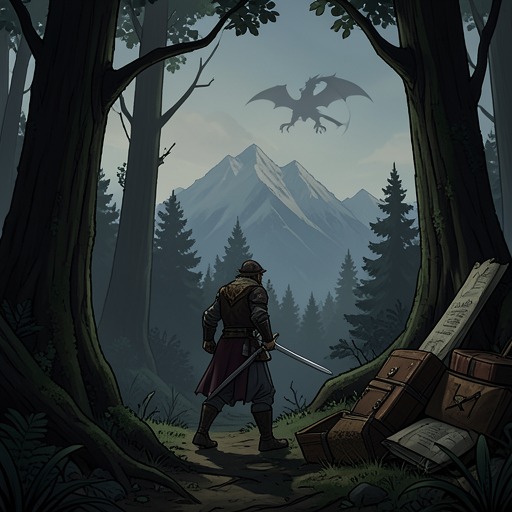
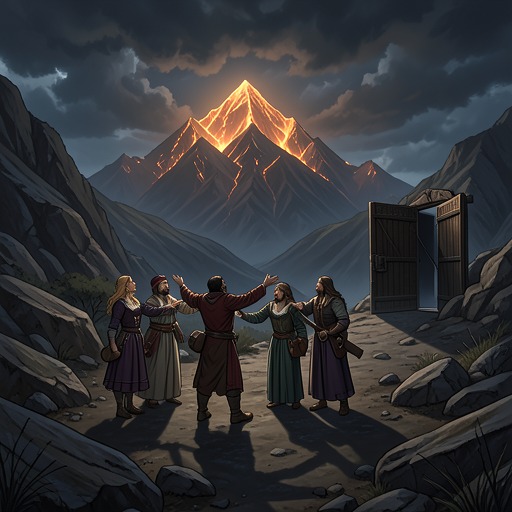
The Ballad of the Last DragonThe Dragon’s Hoard is a rumored cache of immeasurable wealth hidden in an unnamed mountain, where the last dragon of the age supposedly guards the entrance. Its decisive importance lies not only in the riches themselves but in the legend attached to whoever reaches them: the successful dragon-slayer will be remembered long after death. The hoard therefore becomes both the expedition’s practical objective and the imaginative center of a story about risk, belief, and the power of narrative to make a person immortal.
Legend and Uncertainty
The hoard first reaches Sylvaine Abelan through fragments of tavern conversation. Jaromir speaks of a dragon, then leaves abruptly when pressed by the subject, and his evasiveness makes the claim more suspicious rather than less. Sylvaine knows that no dragon has been sighted for more than a century. The old tales belong to the dark times, when dragons were said to prowl the land and soar through the skies, and she understands that Dragons have long been hunted to extinction. Against that historical knowledge stand travelers’ rumors of a lost hoard, along with the commonplace warning that forged maps are readily made for deception.
This tension keeps the hoard suspended between folklore and fact. Sylvaine wonders whether the dragon might be merely a moniker or a code for something else, yet her instinct as a storyteller makes the uncertainty irresistible. If the tale is real, it deserves to be preserved; if it is false, the manner in which its keepers conceal the truth still suggests a story worth pursuing. The hoard thus begins as an object of doubtful existence whose power comes from the gap between what the world remembers and what its adventurers claim to know.
Aeron Fowler’s Account
Aeron Fowler gives the rumor its fullest shape. He describes fathomless wealth buried deep in an unnamed mountain and says that every seeker who has tried to reach it has perished, consumed by flame, because the last dragon guards the entrance. Few people still dare to believe that such a place exists, but Aeron insists that it is real. His account transforms scattered hearsay into a quest with a defined prize, a lethal guardian, and a reward extending beyond possession.
The promised reward is remembrance. Whoever defeats the dragon and claims the treasure will be immortalized as a legend long after he is gone. That claim matters especially in Sylvaine’s presence, because she measures events by their dramatic force and notices the weakness in Aeron’s first telling: he supplies the essential facts, but not the vivid detail that would make the scene live. The hoard consequently operates on two levels. Within the expedition, it is a destination and a possible fortune; within Sylvaine’s imagination, it is raw material for a story whose lasting value may exceed the gold.
Map, Route, and Materialization
The hoard becomes more credible when Sylvaine translates the map that Aeron cannot understand. Its directions lead through Glas Fían, now known as The Veridian Wilds. The travelers are instructed to keep the sun on the left shoulder until midday for three days, leave the road, cross the river, and continue to the base of a mountain pass. The map names the valley Bealucwelm, although that name has since changed among humans. From there, the route does not use the pass: the expedition must climb the western peak to reach the cave where the dragon waits.
These instructions give the legend a physical grammar. A vague mountain treasure becomes a sequence of bodily demands—riding, crossing, climbing, and enduring a route whose old names no longer align neatly with the present landscape. The map also links the hoard to lost or transformed history: its language preserves places under names that the modern world has forgotten. Sylvaine’s translation is therefore not a minor convenience but a crucial act of recovery, allowing the expedition to move from rumor toward a geographically imaginable destination.
The Quest’s Continuing Pull
The hoard remains powerful even when the journey becomes painful and the settlement of Hollowden appears loathsome to Sylvaine. When Jaromir asks where she would rather go, her quickest answer is that she would continue the quest to find the dragon. The response produces an immediate sense of rightness, leading her to seize her lute and return to the questions gathering in her mind. The hoard’s importance is revealed here through choice rather than description: despite discomfort, uncertainty, and the physical strain of travel, the quest still feels like the direction in which her life should move.
Aeron also sustains the hoard through repetition. While recounting how a traveling merchant came to town selling old maps, he reopens the chain of rumor and possibility. The story is not simply a single promise made at the beginning of the expedition; it is repeatedly told, translated, and reconsidered. Each retelling keeps the absent treasure present, while each practical detail tests whether the legend can survive contact with roads, rivers, renamed valleys, and exhausted bodies.
Narrative and Thematic Significance
As a quest object, The Dragon’s Hoard combines the classic attractions of treasure, discovery, and mortal danger, but the book places unusual emphasis on the fame attached to its recovery. The hoard promises wealth, yet Aeron’s decisive formulation is that the victor will become a legend. Material riches and artistic immortality therefore converge: the treasure is something to claim, while the story of claiming it is something Sylvaine can preserve.
The hoard also mediates between extinction and continued presence. Dragons are believed to have vanished from the world, but the possibility of one surviving in a mountain cave keeps the older age from being entirely closed. Its route is recorded in an old map, its location survives in rumors, and its guardian is spoken of as the last dragon of the age. Whether understood as literal treasure or as the narrative promise that makes danger meaningful, the hoard turns absence into pursuit. It gives Aeron’s expedition a destination, gives Sylvaine a story she cannot ignore, and makes the question of what survives after death part of the quest itself.