The Great Loss
The Ballad of the Last DragonThe Great Loss, also known as The Unification or An Call Mòr, is the foundational historical catastrophe behind the anti-elf order of Targgein. Remembered differently by humans, dwarves, and elves, it united former enemies, destroyed elven cultural institutions, and made displacement appear lawful. Its decisive significance lies in its afterlife: the war ended, but its hierarchy endured through inherited stories, exclusionary statutes, licensed violence, and the persistent fear that elves might once again become powerful.
Historical Meaning and Competing Memories
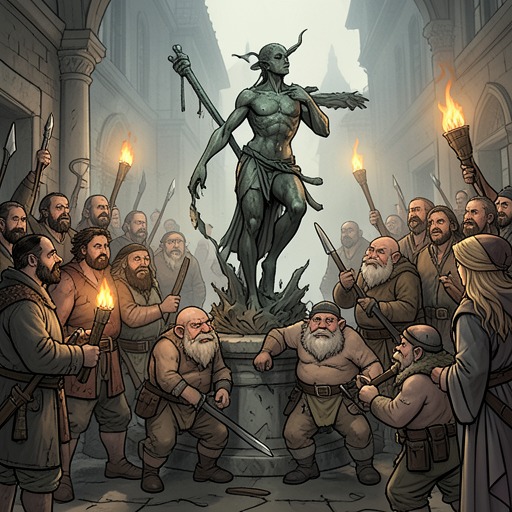
The event carries opposed names because it produces opposed histories. For human and dwarven communities, the alliance during The Unification is preserved as a victory in which they stood against the ancient elves, beings depicted in archived histories as powerful and malicious. Among elves, the same period is remembered as The Great Loss, a phrase that gathers military defeat, cultural destruction, political subordination, and the severing of communities into one collective wound.
Dwarven participation was not uniform. There was dissent and infighting among the dwarves, but those who took up arms were rewarded with land and minor titles in Targgein. The settlement therefore did more than decide a war: it distributed material benefits to collaborators and helped make the new order durable. Human and dwarven records, preserved across generations, continued to cast the victors as heroes while reducing the ancient elves to a threatening legend.
The elven counter-memory had fewer physical safeguards. Elven texts were destroyed, as were the most sacred structures and temples of elven design. A black prayer stone preserved in a magistrate’s hidden collection recalls what was lost: such stones once served as conduits of prayer and reverence to the goddess and Welkin’s guardians, but the temples that housed them were sacked and destroyed more than a century earlier. Because the written archive was broken, elven history survived chiefly through spoken word. The knowledge of the ancient elven alphabet and the old history passed down by Sylvaine Abelan’s father is consequently presented as an act of rebellion in itself.
From Postwar Peace to Persecution
The Great Loss did not produce immediate, uninterrupted violence. Afterward, elves fell to the lowest rank of society, while an uneasy peace settled over the land. For generations, however, distrust accumulated around stories of elven magic. Ancient elves were believed to have possessed immense power, even though no comparable power had reached the elves of the present day. Human tales nevertheless claimed that elves could control thoughts through their voices or drink the blood of human children. These accusations were irrational, but their repetition prepared the ground for political action.
The first practical fractures appeared in land disputes. Town magistrates could favor a human’s testimony over an elf’s because elves were forbidden to speak in official councils, supposedly to prevent them from using magic to sway minds. Commercial and sexual accusations then translated superstition into legal credibility: an elf could be said to have hypnotized someone into intimacy, or to have used magic to justify an unfair bargain. Once such claims became socially acceptable, an elf’s testimony, property, and bodily autonomy could all be treated as suspect.
The raids followed this long preparation rather than emerging from nowhere. Elves lost the right to hold titles, including land. Those who refused to surrender property and move into cities, where searches and curfews controlled their lives, were branded fugitives. Humans could pay a taxation fee to receive licenses to hunt fugitive elves for sport, turning persecution into an authorized activity and making the victims responsible for the danger imposed upon them. Some hunters wore severed elven ears on chains as trophies, an image that exposes the intimacy between bureaucratic permission and spectacular cruelty.
Displacement and Inherited Fear
For elves, land was not merely an economic asset. It held memories, generations of ancestors, and the material continuity of belonging. Once titles were revoked and homes could be searched or seized, the ancestral landscape ceased to function as home even before every family had physically departed. Those able to leave fled toward safer shores, but transport to the continent was scarce and expensive.
Sylvaine Abelan’s childhood memory gives this history its most intimate form. She remembers the forests of Smarighad as a place of enormous trees and giant oyster mushrooms broad enough to climb, a landscape of freedom and enchantment. Then people began to disappear: friends, neighbors, and others she had known left without goodbyes or explanations. Her parents tried to shield her, but the child experienced the raids as if something had drawn whole communities into the sky. The contrast between open play and fearful concealment shows how political violence becomes a change in the basic meaning of the environment itself.
Her family could afford only one boarding pass. Sylvaine left her parents behind, knowing that imprisonment or something worse awaited them. The catastrophe therefore separated not only a people from its land but children from parents, survivors from the dead, and emigrants from the ordinary possibility of farewell. In the safer region where she later lives, anti-elf hatred is less blatant, yet safety remains conditional: before every performance she checks that her cap covers her ears, uncertain how far the old fear has traveled or when it might return.
Weapons, Monsters, and the Persistence of War
The Great Loss also survives in the material culture of violence. Saltpeter was outlawed after the dwarven alliance with humans because black powder had been used to win the war against the elves and the resulting damage was later judged inhumane. Yet the prohibition does not erase the weapon’s presence. Four barrels of black powder remain hidden alongside aged dwarven whiskey and wine from the Western Isles in a room connected to a network of pulleys, cables, pressure plates, and traps. The concealed stockpile makes the past tangible: a weapon condemned in public can remain available in private, embedded in the machinery of later danger.
The event’s legacy also shapes the story’s language of monstrosity. Elves were once represented as terrifying beings of power and malice; later, the stories used to frighten children are echoed by the gray, almost humanoid corpse-eaters prowling on all fours at the forest’s edge, fighting over a deer carcass and displaying large jagged teeth and black eyes. The creatures are real, unlike the old allegations about elven magic, but the parallel reveals how communities manufacture categories of threat. Fear can turn a persecuted people into monsters in collective memory, while genuine monsters emerge amid landscapes already marked by death and abandonment.
Resistance, Mercy, and Repair
The catastrophe’s moral pressure appears in the choices made by those who inherit its consequences. When Sylvaine Abelan gains power over an assailant, she can place a blade at his pulse and recognize that, for a fleeting moment, fear has changed hands. Yet she stops. She refuses to keep his death as a constant companion and distinguishes herself from the human violence that has made elves fear men like him. Her declaration that she is not human and does not want to be is not a rejection of moral agency; it is a refusal to reproduce the logic that equates power with domination.
The same history is confronted through institutional reform. Jaromir explains that his nominal engagement to Rhosyn exists to protect her claim to the home and farm built by her deceased husband, Damir. Under Kalinia’s archaic inheritance law, property passes to the town in the absence of a suitable male heir, leaving Rhosyn and her daughters vulnerable despite their family’s long relationship to the land. Rhosyn therefore demands that Magistrate Ridion abolish the antiquated rule and adopt Queen Dhara’s inclusive land and title policies so that no person can be expelled from a home after family tragedy. Sylvaine supports the demand through a written legislative document and the threat that her performance will expose the magistrate’s conduct.
Rhosyn’s own explanation clarifies that she does not want to marry Jaromir for romance. She wants to preserve the house because Damir’s presence remains in its floorboard, its unfinished nail, and the structure surrounding their daughters. Her position parallels the elven understanding of land as memory and inheritance rather than mere property. In both cases, dispossession attacks continuity itself. Reform thus becomes a form of repair: it cannot undo The Great Loss, but it can prevent another family from being made homeless by a legal system that treats vulnerability as an opportunity for seizure.
The possibility of repair extends beyond law. When Sylvaine learns that a vessel is rescuing elves, she asks what the passengers are charged for transport and receives the answer that they are charged nothing. Her relief comes from discovering that escape is being treated as assistance rather than exploitation. Against the old economy of hunting licenses, confiscation, and expensive passage, free rescue offers a small but concrete reversal: people fleeing death are helped instead of made to pay for their desperation.
Narrative and Thematic Significance
The Great Loss functions less as a single closed battle than as a continuing structure. Its immediate destruction is followed by a slow accumulation of prejudice, legal exclusions, confiscations, raids, forced movement, and self-protective silence. The event’s victims lack equal access to archives and official speech, so its truth must be carried through family teaching, bodily memory, guarded performances, and the objects left behind in ruined or hidden spaces.
Its central irony is that the victorious societies preserve a heroic account of unification while the defeated people preserve loss in fragments. The human and dwarven archive claims order and heroism; the elven spoken tradition records disappearance, fear, and exile. The novel does not treat these as equally neutral versions of the past, because the supposedly authoritative history is supported by destroyed texts, silenced testimony, and laws that continue to privilege its victors.
At the same time, the legacy is not presented as unchangeable. Mercy interrupts retaliatory violence, Rhosyn’s demand challenges local law, a written reform counters a magistrate’s inertia, and an unpaid rescue route offers displaced elves a future. The Great Loss therefore defines the world’s deepest injury while also establishing the measure of its possible healing: not a return to a vanished past, but the recovery of voice, home, memory, and protection through choices that refuse to let inherited fear dictate the next act.