The Show Must Go On
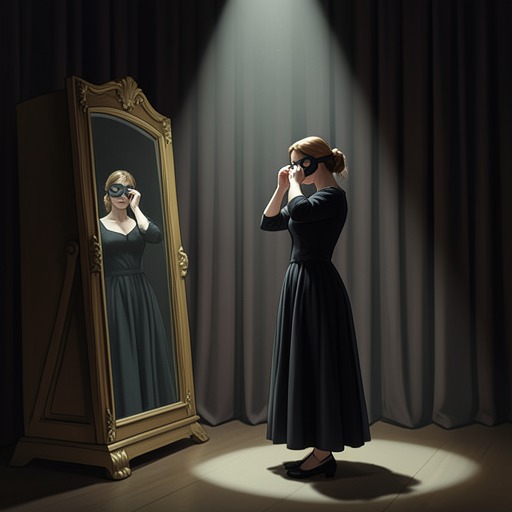
The Ballad of the Last DragonThe Show Must Go On is both a performance principle and a defining refrain of Sylvaine Abelan’s artistic identity. In Hollowden, where the audience is sparse and her employer, Kingsley, is poorly positioned to appreciate the performance, she nevertheless treats the act of playing as a duty to the work itself. Later, when illness or bodily collapse threatens to stop her, the same words become an act of resistance: the performance continues not because conditions are favorable, but because abandoning it would surrender the dignity and purpose she has claimed through art.
Meaning in Hollowden
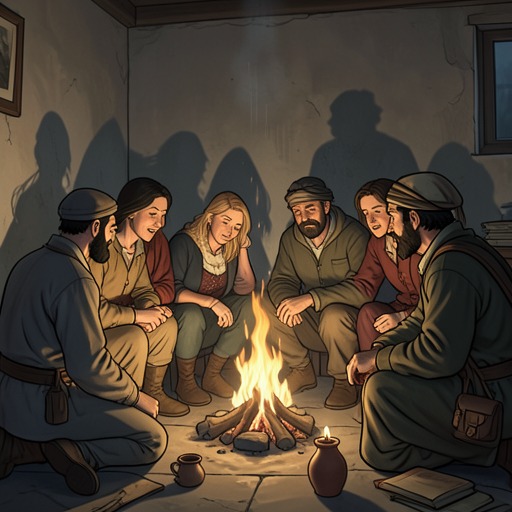
The expression first appears against the unglamorous reality of Sylvaine Abelan’s working life. Summer nights ordinarily bring travelers and traders to the tavern, but this particular evening offers no crowd to reward her efforts. Kingsley is her employer, while Petey, the regular who might have served as an audience member, is already well into his cups. The sparse room makes the maxim quietly ironic: there is little external reason to perform, yet Sylvaine Abelan refuses to measure the value of her music by the size or attentiveness of the audience.
Her lute becomes the concrete instrument of that refusal. Its smooth surface lies beneath her hands as her fingers move through melodies learned by rehearsal, allowing technical discipline to outlast the room’s indifference. She contrasts Hollowden with Lindale, where bards are treated almost like nobility and prosperity seems to follow artistic recognition. Hollowden offers none of that prestige; its people are described as plain and suspicious of her strangeness. Even so, Sylvaine Abelan takes pride in entertaining them, presenting art as something that must reach ordinary people rather than exist only where it is already celebrated.
Repetition Under Physical Threat
The expression returns in a far more severe circumstance. Sylvaine Abelan can no longer feel her hands, and everything around her has gone cold. As the floor seems to fall away, she can only hope that her fingers continue to move over the lute’s strings. The performance maxim therefore shifts from professional perseverance to a bodily ordeal: the very hands on which the music depends may be failing, but the obligation to continue remains.
Before launching into the next passage, she forces a smile and steadies a voice with strength she does not possess, addressing the people before her with the declaration, “My good people, we make history.” She then begins a forceful strum in a major key, pouring her remaining emotion into the music. The crowd answers with cheers and applause so loud that they overwhelm the roar in her ears. The response does not erase her condition, but it changes the immediate value of the scene: private physical collapse is met by public recognition, and the threatened failure of the performance becomes a moment of shared occasion.
The refrain follows this reversal directly. After the applause, Sylvaine Abelan repeats the principle that the show must go on, even though her flushed cheeks remain hot, every breath hurts her chest, and her feet are numb beneath her as she dances around the room. Her movements imitate the merriment promised by the tune while her body supplies contrary evidence. The expression thus holds together two truths that cannot be reconciled physically: the performer is suffering, and the performance is successful.
Art, Insult, and Professional Discipline
The later scene also places the maxim beside casual cruelty. Between renditions of While the Fisherman’s Away and What’s in a Dwarven Whiskey, Sylvaine Abelan thinks she hears someone call her a “filthy whore.” The insult is quickly silenced and does not interrupt the music. Her response is not presented as proof that the abuse is harmless; rather, it shows how thoroughly public hostility has become part of the environment in which she works. She has been called worse and claims not to notice anymore, preserving the performance by refusing to let an unidentified heckler control its rhythm.
This gives the expression a social as well as physical force. It does not mean that obstacles disappear, that the audience becomes uniformly kind, or that artistic labor is rewarded fairly. It names a decision made under adverse conditions. In Hollowden, the obstacle is indifference and suspicion; later, it is pain, numbness, and an insult from the crowd. Each time, Sylvaine Abelan keeps the music moving, converting endurance into a visible professional ethic.
Narrative and Thematic Significance
The expression’s two appearances establish a progression from principle to proof. In the earlier scene, Sylvaine Abelan chooses to perform despite a nearly empty room, defending art against neglect. In the later scene, the same maxim is tested by a body that may no longer sustain the act. Its repetition gives the words accumulating force: what first sounds like a familiar entertainer’s slogan becomes a compact account of how Sylvaine Abelan survives as an artist.
The phrase also creates an irony between spectacle and reality. Onstage, she dances as if she were merry; outside the performance’s surface, her chest aches and her feet are numb. The major key and the crowd’s applause produce the sound of triumph, while the narration preserves the cost beneath it. The show’s continuation is therefore not simple optimism. It is a form of revolt against the conditions that would make her stop, and a claim that artistic meaning can persist even when recognition is uncertain and the performer’s own strength is nearly gone.