Western Isles
The Ballad of the Last DragonThe Western Isles are a region of rolling moors and rocky cliffs whose beauty is inseparable from the force of its traditions. In the narrative, the Isles are not merely a homeland or scenic reference: they are a social order in which birth determines duty, women are denied political and property rights, and elven culture survives only as a rare and contested remnant. The region’s influence is most clearly embodied in Neith, whose escape from an advantageous marriage becomes part of her larger refusal to let inherited convention dictate her life.
Landscape and Social Order
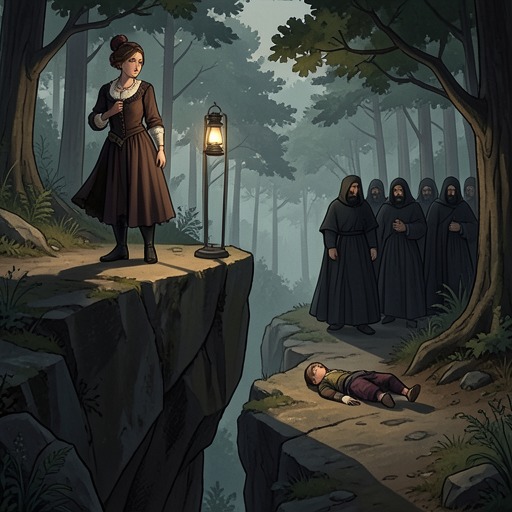
The Western Isles are remembered as a beautiful land of moors and cliffs, and their natural features are associated with the magic of old ballads and deeply rooted tradition. That beauty, however, exists beside confinement. Neith explains that birth order determines a person’s role, making family position a mechanism of social assignment rather than a private fact. Tradition therefore functions as a kind of enclosure: it gives the Isles continuity and identity while restricting the choices available to those born into the wrong position.
The gender hierarchy is especially severe. Women in the Isles are not regarded as holders of titles and are scarcely considered citizens. Their prescribed obligations pass first to their fathers and then to their husbands, leaving them without recognized authority over their own public or economic lives. This system contrasts with Targgein, where women are landowners in some regions that have abandoned older customs. Under Queen Dhara, each city’s magistrate may choose whether to preserve or reject those traditions, so Targgein contains a limited possibility of reform that the Isles largely deny.
Neith’s Birth and Departure
Neith’s position within this order is defined by her birth as the eldest daughter. Because birth order determines role, being the eldest daughter carries consequences beyond family seniority: it places her within a structure that expects obedience and uses marriage to secure the family’s interests. Her advantageous marriage was planned from birth, turning her future into an arrangement made before she could consent to it. The bitterness in her account conveys not only dislike of the proposed husband but the accumulated weight of a lifetime treated as a family resource.
Neith left the Western Isles ten summers before the training scene in which she recounts this history. The narrative does not present her departure as a casual change of residence. It is the decisive act by which she separates herself from the role assigned to her, including the marriage prepared for her since birth. Her later competence with weapons gains added meaning from this background: she says that she largely taught herself because no one was available to train her, and she links that isolation to failing to meet her family’s expectations. The self-taught fighter is therefore also a survivor of a society that offered her few legitimate ways to become self-determining.
Elven Memory and Material Remnants
The Western Isles are also connected to the suppression of elven culture. Neith describes elven designs as rare commodities there, worn only by elites wealthy enough to purchase such luxuries. Their scarcity is not presented as natural fashion or simple market preference. Even the artisans of Smarighad were forced into hiding, making elven craftsmanship difficult to find and transforming surviving designs into markers of status, danger, and historical erasure.
Neith wears an elven necklace that carries this history in material form. She chose it because her mother hated it and because it was the most expensive piece available to her. The necklace thus begins as an act of defiance within the family and becomes, over time, a reminder of the path Neith chose. She eventually understands it as something that was meant to find her, a sign urging her to follow her true course despite the pain involved. The object links personal memory to the broader disappearance of elven artisans and gives Neith’s rejection of the Isles’ expectations a tangible emblem.
The Isles’ history also intersects with the political violence surrounding The Great Loss. In a hidden room associated with the dragon-cave mechanisms, barrels hold wine from the Western Isles alongside dwarven whiskey and black powder. The presence of the regional wine places the Isles within the network of trade and stored provisions surrounding the expedition, while the black powder recalls the prohibition on saltpeter after the dwarven alliance with humans. That explosive material had been used in the war against the elves, and its later condemnation as inhumane preserves the connection between military power, elven destruction, and the legal restrictions that followed.
Outsiderhood and Continuing Influence
The social logic associated with the Western Isles resonates beyond their borders. Sylvaine Abelan encounters open anti-elven contempt when a tavern patron calls her a “knife-ear” and tells her she is lucky to have been allowed inside. Later, Magistrate Ridion dismisses her as an elf who thinks she is more than “gutter refuse.” These incidents occur outside the Isles, but they echo the same structure of exclusion: identity determines who is granted dignity, access, and protection before any individual action is considered.
The danger is intensified by gender and economic vulnerability. Sylvaine Abelan is a performer who travels with a lute, and she has learned not to be alone in distant fields because groups of loud men place her on edge. When three tavern patrons approach her at night, she hides in a tree and keeps both Neith’s short sword and a shepherd’s sling ready. During the ensuing assault, her lute is broken beneath her and used as part of the physical scene of restraint. The parallel with Neith’s history is not that their experiences are identical, but that both women must create their own means of defense in societies where formal belonging does not guarantee safety.
The Western Isles consequently operate as both a real place and a model of inherited power. Their moors and cliffs nourish song and memory, while their birth-order customs, arranged marriages, gender exclusions, and scarcity of elven culture reveal the cost of treating tradition as unquestionable law. Neith’s departure turns the Isles from a fixed destiny into a point of departure: the place that attempted to define her becomes the background against which she claims the right to choose her own path.