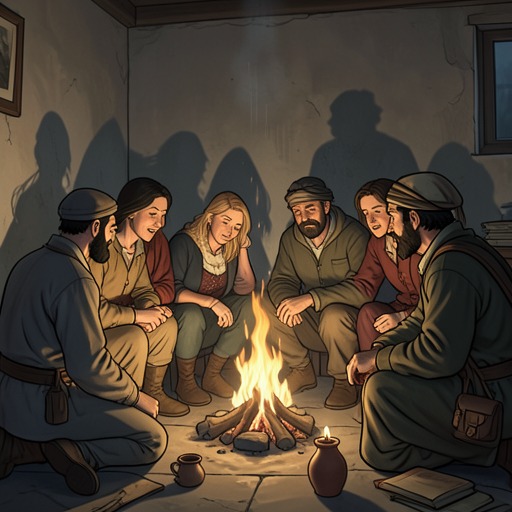
Where stories end, they begin anew
The Ballad of the Last Dragon“Where stories end, they begin anew” is the central consoling expression in the book’s farewell song: it refuses to make an ending equivalent to erasure. Spoken alongside a promise to meet once more, it converts grief into continuation and gives departure the form of hope.
Meaning and Form
The expression directly redefines farewell. The surrounding lyric insists that farewell is not, in the end, farewell, but a promise to meet once more. Its force comes from this reversal: an apparently final separation is recast as an interval rather than a termination. The wording therefore carries both sorrow and reassurance, acknowledging loss without allowing loss to become the last meaning of the relationship.
The expression also links personal parting with the structure of storytelling. A story may reach its close, yet the end opens another movement rather than sealing the world shut. “Where stories end, they begin anew” is thus both a statement about narrative and a vow addressed to another person. It gives the conclusion a forward direction while preserving the emotional weight of what has ended.
Use in the Farewell
The line appears at the point where the speaker is preparing to say goodbye. Instead of treating farewell as a completed act, the speaker promises another meeting and explicitly chooses the expression over a conventional farewell. The lyric’s sequence makes the choice consequential: the speaker moves from the idea of parting, through the promise of reunion, to the claim that endings generate new beginnings, and finally to the assurance, “Until we meet again.”
The emotional result is deliberately mixed. After the farewell is spoken, the speaker feels a joyful buoyancy together with a glimmer of grief. The expression does not cancel mourning or pretend that separation is painless. Rather, it gives grief a form that can coexist with expectation, allowing the speaker to leave with lightness without denying the sadness that remains.
Narrative and Thematic Significance
As a recurring closing expression, “Where stories end, they begin anew” provides the book with a compact philosophy of continuation. It frames an ending not as the disappearance of people, bonds, or meanings, but as the point from which another telling, meeting, or phase of life may begin. The phrase consequently supports the book’s larger investment in stories as vessels of memory and as means of carrying relationships beyond immediate loss.
Its repeated appearance also turns the line into a refrain of return. Repetition does not merely restate the sentiment; it strengthens the promise by placing it again at the edge of conclusion. The words become a verbal bridge between the completed story and whatever follows, preserving an open future while leaving the past intact.
Relation to the Book’s Ending
At the book’s close, the expression supplies an alternative to finality. The speaker does not deny that one story has ended, but refuses to regard that ending as the end of all stories. The farewell therefore becomes an act of continuity: the relationship is carried forward through the promise of meeting again, and the narrative remains open to renewal.
The phrase’s decisive significance lies in its balance. It is neither a claim that nothing has been lost nor a surrender to permanent separation. It holds grief and joy together, then gives their tension a future-facing form. In that sense, “Where stories end, they begin anew” functions as both farewell and beginning, a final line whose meaning depends on what may still come after it.