anti-elf persecution
The Ballad of the Last Dragonanti-elf persecution is not a single episode but a social order built from historical memory, fabricated superstition, discriminatory law, and repeated everyday violence. In Targgein, it determines where elves may live, how safely they may work, whether their testimony is believed, and whether their history can be preserved. The experience of Sylvaine Abelan makes that structure intimate: she hides her ears beneath a velvet cap while performing for coins, endures the slur “knife-ear,” suffers panic when men threaten her, and ultimately answers inherited violence by refusing to become its next perpetrator.
Historical Origins and Cultural Memory
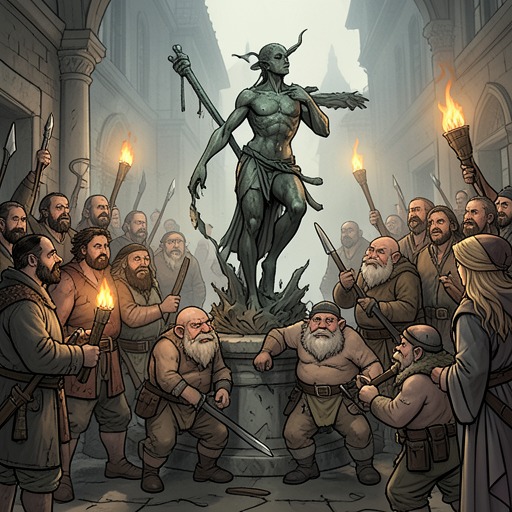
The persecution is rooted in the conflict remembered by elves as The Great Loss and associated with the alliance between Hawthok and humans during The Unification. Human and dwarven histories preserve a heroic account in which humans and dwarves defeated ancient elves described as beings of power and malice. Dwarves who took up arms were rewarded with land and minor titles in Targgein, giving political privilege a historical connection to anti-elf victory. The result is a public past in which elven power is remembered more vividly than elven suffering.
The old stories sustain fear long after the ancient elves have disappeared. Humans repeat claims that elves can control minds through their voices or drink the blood of human children, although Sylvaine identifies these beliefs as absurd and notes that no such echoes of ancient power have reached present-day elves. What begins as superstition becomes a political resource when repeated dissent replaces the uneasy peace that had lasted for more than a century. The persecution therefore operates through narrative as much as through force: stories make exclusion appear prudent, and prejudice appear like common sense.
The destruction of elven texts and sacred structures during the raids deepens that imbalance. Elven history survives chiefly through spoken word, because written records and sacrosanct places were destroyed. Sylvaine’s father passing down the ancient elven alphabet and their history is consequently more than family education; preserving knowledge becomes an act of rebellion against a society that has attempted to erase the people who created it.
Law, Land, and Displacement
Institutional discrimination turns suspicion into procedure. Elves are forbidden to speak in official councils because authorities fear that they might sway human minds with magic. In land disputes, town magistrates can therefore favor a human’s word over an elf’s before the dispute is even heard on equal terms. The law does not merely reflect prejudice; it manufactures unequal credibility and gives administrative power to the stories used against elves.
The raids bring a more direct dispossession. Elves lose the right to hold titles, including land. Those who refuse to surrender their property and move into cities subject to searches and curfews are branded fugitives. Humans may then pay a taxation fee to obtain a license to hunt those fugitives for sport, while some hunters wear severed elf ears on chains as trophies. The combination of property seizure, surveillance, criminalization, and licensed hunting transforms belonging to an ethnic group into grounds for pursuit.
Displacement follows even where the land remains bound to elven memory and ancestry. For elves, generations of ancestors and memories make the land a home, yet persecution makes that home uninhabitable. Those able to flee seek safer shores, but transport is scarce and expensive. Sylvaine’s family can afford only one boarding pass, forcing her to leave her parents behind while knowing that imprisonment, or something worse, may await them. Migration is thus not free escape but a choice produced by coercion, poverty, and the unequal distribution of safety.
Everyday Enforcement and Embodied Fear
The system remains visible in ordinary spaces. Sylvaine keeps her ears hidden during performances because elven appearance is poorly received even in places where audiences have gradually accepted that she will not use “evil she-elf magic to bewitch them.” Concealment improves her reception and her chances of earning coin, making the cap both stage costume and protective device. Her red crushed-velvet cap with its black plume can express beauty and theatrical confidence, but it also covers the physical feature most likely to expose her to hostility.
The tavern reveals how quickly social prejudice becomes physical coercion. A patron yanks Sylvaine by the shoulder, calls her “knife-ear,” tells her she is lucky to be allowed inside, and threatens to show her what her kind deserves. Her prepared retort fails as panic numbs her legs and constricts her chest; Jaromir intervenes before the assault escalates. The scene joins racial insult, gendered vulnerability, economic dependence, and public space: Sylvaine is working for drinks and wages, yet the men treat her presence as a favor they may revoke.
The same threat follows her beyond witnesses. Hearing three rowdy men approach while she is alone in a field, Sylvaine climbs a tree rather than risk being seen, carrying the lute on her back, a short sword insisted upon by Neith, and a shepherd’s sling. When one man recognizes her and looks up into the branches with a widening grin, the language of casual tavern entertainment gives way to anticipated danger. Her fear is not irrational sensitivity but learned knowledge of what men protected by anti-elf hostility may do when no one is watching.
The assault confirms that danger. The men break her lute, strike her, force her to the ground, stuff her cap into her mouth, and hold her wrists and legs while one man tries to overpower her. The damaged instrument and the stuffed cap make the violence symbolically precise: the objects associated with her livelihood, voice, and public identity are turned against her. Anti-elf persecution here intersects with sexual violence, showing how ethnic dehumanization can authorize control over an elf woman’s body as well as her property and speech.
Even apparently minor remarks reproduce the same hierarchy. A tavern patron says that he thought elves were supposed to be pretty, reducing an entire people to an aesthetic expectation while treating deviation from it as grounds for comment. Another conversation praises “elfy leather pieces” only while objectifying the elven armorer who made them. Such remarks may seem less dramatic than raids or assault, but they keep elves visible as curiosities, commodities, or bodies rather than as full participants in public life.
Monsters, War Legacies, and Unequal Risk
The narrative connects anti-elf persecution to wider histories of violence rather than presenting prejudice as an isolated human failing. The dwarven alliance with humans during The Great Loss leads not only to rewarded land and titles but also to the outlawing of saltpeter after explosive weapons helped win the war against the elves. In the hidden room beneath the dragon’s cave, four barrels of black powder remain beside aged dwarven whiskey and wine from the Western Isles. The material legacy of war survives in concealed mechanisms, pressure plates, and traps even after its public use has been declared inhumane.
The same pattern of unequal danger appears in the landscape. At the edge of the forest, Sylvaine encounters corpse-eaters with mottled gray flesh, almost humanoid bodies, jagged teeth, and black eyes, feeding and fighting over carrion. Her terror is immediate, but the episode also distinguishes supernatural threat from the social threat she has learned to anticipate from men. The monsters are visibly monstrous; anti-elf persecution is more insidious because ordinary institutions and ordinary people can make cruelty appear legitimate.
Resistance, Mercy, and Structural Repair
Resistance begins with refusing the demand that survival require silence or self-erasure. Sylvaine preserves forbidden history, continues to perform despite prejudice, and claims multiple forms of authority: bard, defender of written and spoken word, acting notary, stone-slinger, and guide. When Magistrate William M. Ridion insults her as an elf who thinks she is more than gutter refuse, Jaromir physically restrains him, while Sylvaine remains present as the person whose language and legal skill will help determine what happens next.
Her most decisive resistance is ethical as well as political. After the pasture assault, Sylvaine holds a sword at the attacker’s pulse and recognizes that she finally possesses the power to command fear. She could kill him, but she stops because she does not want his death to become a permanent companion. Her declaration, “I’m not human,” is not an acceptance of the persecutors’ definition of humanity; it is a refusal to become like the men who harmed her or to let their violence dictate her identity. Mercy does not erase the assault, but it prevents revenge from reproducing the same logic of domination.
The narrative then moves from individual restraint to institutional change. With Jaromir and Rhosyn, Sylvaine confronts Magistrate Ridion and helps force reform of the inheritance law that can cast a person from a home after family tragedy. Rhosyn demands that the magistrate serve vulnerable people rather than profit from their dispossession, and that he adopt Queen Dhara’s inclusive land and title policies so any person can build a life in Kalinia. Sylvaine has already drafted the legislative document and can witness the signature as a notary, turning the skills once needed merely to survive into instruments of legal repair.
A final contrast appears in the treatment of fleeing elves. When Sylvaine asks whether a vessel rescuing elves charges them for transport, the answer is that it charges nothing. Her relief recognizes the moral difference between exploiting displaced people and helping them escape death and dismemberment. Against a history in which movement is restricted, expensive, and hunted, free rescue offers a practical form of solidarity: not a speech about tolerance, but safe passage made available to those whom the dominant order has abandoned.
Narrative Significance
anti-elf persecution gives the book’s personal dangers their historical depth. Sylvaine’s hidden ears, panic, defensive weapons, broken lute, and reluctance to trust men are not isolated character traits; they are bodily responses to a political world that has made elven identity punishable. The concept also explains why preserving language, telling stories, drafting laws, and helping refugees carry comparable weight. Cultural memory contests erasure, performance contests the authorized image of elves, reform contests dispossession, and rescue contests the economics of exclusion.
At the same time, the narrative refuses to reduce persecution to a conflict between individual villains and individual victims. Ridion’s insult, the tavern’s slur, the hunters’ trophies, the legal ban on elven testimony, the loss of titles, and the scarcity of transport form a continuum. Anti-elf persecution is strongest when these mechanisms reinforce one another, but the book imagines its undoing through equally connected acts: solidarity in dangerous spaces, mercy after violence, legal recognition of equal ownership, preservation of endangered history, and material assistance to displaced people. Its decisive significance lies in showing that prejudice is inherited through stories and institutions, yet can be challenged by changing both the stories people believe and the structures that make those beliefs consequential.