dragon legend
The Ballad of the Last DragonThe dragon legend is the story that sends Aeron Fowler’s expedition toward a supposedly surviving dragon and its hidden hoard, then becomes the means by which the survivors interpret, conceal, and perpetuate what they actually find. Its decisive significance lies in the collision between supernatural expectation and human design: the dragon is not a living monster in the form the travelers imagined, but the legend’s consequences are real, having drawn people into lethal trials and later giving Aeron a heroic identity that outlives the truth.
The Legend as a Quest
The legend governs the expedition’s final movement. On the night before the company reaches the fabled lair, Sylvaine Abelan understands that only one more night separates the travelers from the last leg of Aeron Fowler’s dragon quest. The destination is imagined as the lair of Aeron’s dragon, and the journey promises two kinds of culmination at once: Jaromir can eventually return to the life awaiting him, while Sylvaine can claim a place in history. The dragon therefore functions not merely as a creature to be hunted, but as the endpoint that organizes private sacrifice, public ambition, and the group’s sense of destiny.
That expectation remains active even when the company encounters the creatures inhabiting the cave. Sylvaine wonders why the dragon allows their presence, a question that shows how completely the expedition has accepted the legend’s implied world: if a dragon rules the lair, every dangerous being within it ought to belong to its design. The answer instead identifies the beasts as fast, strong, unpredictable, and irreducibly nonhuman. The warning that hesitation will be fatal intensifies the legend’s atmosphere of threat, yet it does not confirm the dragon’s existence. The cave continues to sustain uncertainty by presenting genuine monsters around an absent or concealed master.
The Human Origin of the Dragon
The decisive explanation arrives in a letter addressed to whoever survives the tempest trials. Its writer congratulates the reader from beyond the grave and explains that he expects to have died from a collapsing lung. He had spent three years being “the dragon” while his illness advanced, turning his medical prognosis into the timetable for an elaborate performance. His physician had advised him to enjoy the leisure available to him, and he treated the invention of the dragon and its trials as a diverting final project.
The letter reveals that the trials were intentionally difficult and that many people failed to survive them. The map was made difficult to translate, and the writer admits that perhaps he had made the obstacles too hard. This transforms the expedition’s apparent heroic passage into the latest instance of a repeated, deadly experiment. Survival does not prove that the dragon was real; it proves only that the travelers passed through a system designed by a dying man who wanted his creation to endure.
The legend’s most dangerous mechanism is the dragon-fire formula. The writer could have sold it to a nation seeking an incendiary weapon for use at sea, but he had no practical reason to accumulate money he would not live long enough to spend. Instead, he arranged for the formula to react with steam sent through pipes in the cave, igniting anyone who entered. The supposed dragon’s fire was therefore an alchemical and mechanical trap, not the breath of a living creature. The cave’s supernatural appearance was manufactured from chemistry, architecture, secrecy, and the willingness of later visitors to believe.
Revelation and the Collapse of Belief
The date on the letter places the deception more than a century and a half in the past, in the Age of the Wolf. Sylvaine concludes that the dragon is not real, at least not in the way the expedition believed. It was a clever trick devised by a dying man seeking a lasting legacy. The corpse-eaters served as an additional barrier against investigation, while time allowed the original circumstances to disappear and the story to harden into myth.
Aeron Fowler’s map becomes part of this chain of transmission. He had found an old map from a traveling merchant, a false trail to everyone else, but one that led the company far enough into danger for the travelers to begin believing in the dragon themselves. The legend works because it offers faith when everything else seems lost. Its emotional force does not depend on factual truth; the travelers’ fear, hope, exhaustion, and longing supply the belief that the map alone cannot create.
The revelation also exposes the scale of the hoax’s consequences. The cave’s maker may have intended an entertaining legacy, but his amusement claimed lives long after his own death. The realization becomes so overwhelming that Sylvaine breaks into hysterical laughter, laughing until tears run down her cheeks and the weight of the discovery presses painfully against her ribs. That response captures the legend’s grotesque doubleness: the machinery is ingenious enough to inspire wonder, yet the knowledge that it killed so many people makes the ingenuity appalling.
Hoard, Concealment, and the New Version of the Story
The company leaves the cave with bags filled with gold, saddlebags heavy with coins, and an ancient elven prayer stone among the recovered treasure. The hoard gives the legend a material foundation even after the dragon has been exposed as false. The travelers do not return to the cave. After taking its wealth, they use blackpowder to collapse the entrance, burying the furnishings and mechanisms in rubble and fallen rock. The act destroys the physical theater that sustained the myth and prevents the site from continuing to consume adventurers.
Sylvaine and her companions also decide to burn Aeron Fowler’s map and her own translations. Their aim is not simply to erase a dangerous route, but to keep the cave hidden behind the appearance of a corpse-eaters’ nest and a destroyed passage. The decision creates a deliberate contradiction at the heart of the legend: the material evidence is suppressed while the story is preserved. The original falsehood is denied as history, yet a new falsehood is prepared for public memory.
That replacement story claims that Aeron Fowler killed the dragon with his blade and died in the same confrontation. According to the account, the giant body collapsed and brought down the cave; the company had already robbed the hoard before the beast awoke; and the mortally wounded Aeron was dragged outside so that he could see the sky once more before dying. The dragon tooth carried in Sylvaine’s satchel becomes a physical token of this invented version, sharp enough to jab her thigh and remind her of both the real expedition and the tale she intends to tell.
The lie troubles Sylvaine more deeply after the revelation. She had once been able to treat the fabricated circumstances of Aeron’s death as a necessary instrument, but guilt now gnaws at her because the deception is no longer protecting a straightforward heroic truth. The dragon never killed Aeron. Nevertheless, she decides that if the story immortalizes his name, the cost may be worth paying. The legend thus changes ownership: first it belonged to the dying architect of the cave, then to the people who survived his design and use it to honor their dead companion.
From False Dragon to Lasting Ballad
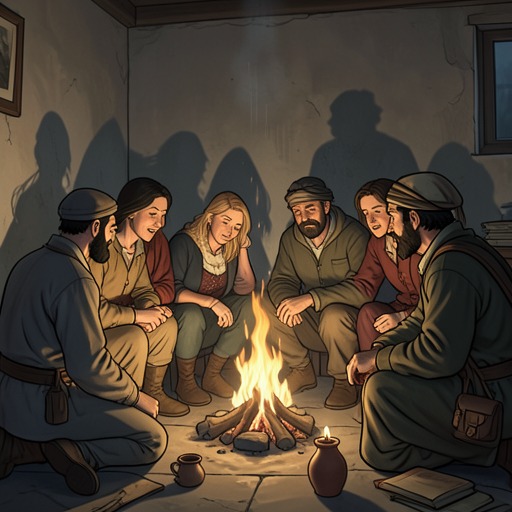
The legend reaches its final form in Astervale, the expedition’s last stop and the place Aeron Fowler had reached before his death. Sylvaine, Cadoc, Neith, and Jaromir gather in the tavern while she prepares to perform the ballad of the last dragon and the ballad of Sir Aeron. The return to Astervale gives the narrative a circular structure: the company comes back to a place associated with Aeron, but now carries a completed story rather than an unanswered quest.
The seasonal setting marks the transition from expedition to commemoration. First Fruits Day and summer have passed; burgundy fabrics, pumpkins, and gourds anticipate Harvest Day, while the tavern’s warmth and camaraderie create a sense of belonging rather than simple farewell. Against that changing season, Sylvaine plays the familiar tune she has repeated in taverns, inns, and around campfires throughout the journey. Repetition converts private grief into public tradition.
The final ballad does not restore the historical truth of the dragon. It gives the expedition a form that listeners can remember and gives Aeron a heroic place within a legend he did not create. The false dragon remains a warning about stories built from manipulation, lethal spectacle, and misplaced faith; the new dragon legend becomes an act of loyalty, preserving Aeron Fowler through music even as it conceals the circumstances of his death. The book therefore treats myth as neither simply false nor simply true. A legend can be born from a fraud, cause irreparable harm, and still become a vessel for love, mourning, and artistic immortality.