home and belonging
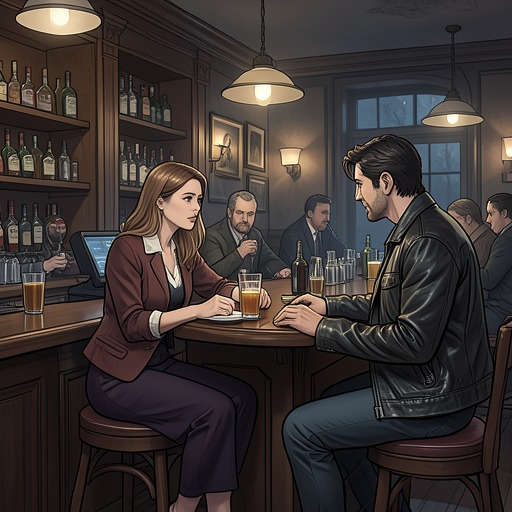
The Ballad of the Last DragonHome and belonging is a recurring concept through which the narrative examines displacement, responsibility, prejudice, and chosen attachment. It is presented not as a stable place that people can simply return to, but as a contested condition: Sylvaine Abelan has been driven from Smarighad and fears returning to Hollowden, while Jaromir understands home through obligations to the family left behind after Damir’s death. Their exchange turns the idea of home from a geographical fact into a question of who has the right to claim safety, recognition, and attachment.
Displacement and the Loss of Origin
Sylvaine’s history makes belonging inseparable from forced movement. She tells Aeron Fowler that she has spent nearly two years at the Rusty Nail, originally came from Smarighad, and was displaced when elven raids drove thousands from their homeland. Her subsequent life is a chain of provisional settlements rather than a settled migration toward a known destination: she stowed away on a merchant vessel, lived for the better part of five years in Bridgebarrow, traveled through Mysture, spent time in Elmwood and Birchfield, and then settled temporarily in Hollowden before considering a move toward Lindale. The sequence gives her identity a geographic breadth, but not security. Each place is a refuge, a workplace, or a pause in motion; none automatically restores what was lost.
Her account also shows how displacement is managed through performance. Sylvaine keeps a cheerful manner while pushing childhood thoughts aside, and describes Hollowden as a temporary reprieve needed to refill her artistic well. The language of artistic renewal allows her to make movement sound chosen, yet the history beneath it remains one of exile and survival. Home is therefore not simply absent because she has traveled widely; it is difficult to locate because every apparent settlement carries the knowledge that it may be temporary and that her original home was taken from her people.
Jaromir’s Home as Obligation
Jaromir’s relation to home is shaped by return rather than exile, but return is no less complicated. After Aeron’s death, he proposes turning back and taking Sylvaine home, then says that the group must return to whatever they left waiting for them. When Sylvaine asks who awaits him, he identifies his brother’s wife and two nieces. His answer reveals that home is populated by dependents and defined by responsibility rather than comfort or personal freedom.
That responsibility is rooted in Damir’s death. Jaromir explains that the journey was intended to provide for Damir’s wife and daughters after their loss, even though the reward would not have covered the debt completely. He sees the expedition as a practical attempt to lessen their burden and describes the loss as one suffered at his hands. His homeward orientation is thus inseparable from survivor’s guilt: returning means facing a family whose needs have become his duty, while continuing the quest would mean delaying that obligation. Home functions as an ethical summons, not merely a place of rest.
Sylvaine recognizes the generosity and pain within this position. She tells Jaromir that Damir’s death was not his fault and that he has already done right by the family. Her reassurance challenges the idea that belonging must be earned through endless repayment. Jaromir’s family gives him a reason to return, but the same bond also keeps him inside guilt. The concept holds both shelter and burden at once.
The Refusal of an Imposed Home
The sharpest statement of the concept comes when Jaromir explains that Sylvaine must be taken back because Hollowden is her home. Sylvaine rejects the claim. She misses Kingsley and Brigitta intensely, but fears returning to the village as its oddity, marked by the sharpness of her ears and lacking the public recognition she wants to earn as an artist. Hollowden may be familiar, yet familiarity does not make it safe or affirming. In her experience, a birthplace can remain a site of exclusion.
Her refusal distinguishes emotional attachment from social belonging. Sylvaine does love people in Hollowden, and the prospect of leaving them has been harder than expected, but she cannot accept a return to the role imposed on her there. Until she becomes known for something larger than her elven identity, she believes the village has no place for her, and she doubts that it ever will. The statement makes belonging conditional on dignity: a community that reduces a person to a despised category cannot claim that person merely because it is the place she once lived.
Jaromir’s gesture complicates the disagreement. When Sylvaine hides her pointed ears beneath her hair, he gently removes her hand and tucks the hair behind the ear, asking where home is. The touch is intimate precisely because it does not treat her difference as something to conceal. Her answer, that she will say when she finds home, leaves the concept open rather than resolving it through a map. Home becomes a future discovery, possibly a place or relationship in which she need not disguise the feature that has made her vulnerable.
Belonging Under Threat
The narrative repeatedly demonstrates why Sylvaine cannot treat belonging as an abstract promise. In the tavern, a hostile patron yanks her by the shoulder and calls her a “knife-ear,” telling her that she is lucky to have been allowed inside and ordering her to fetch drinks before he shows her what her kind deserves. The insult converts her elven identity into a justification for control and threatened violence. Her body responds with numb legs, a spinning head, and the onset of panic before Jaromir intervenes. The public space that should offer temporary shelter instead reproduces the exclusion she fears at home.
The attack in the pasture makes the danger more severe because it removes even the limited protection of witnesses. Hearing three men approach, Sylvaine climbs a tree and hides among the leaves, carrying her lute, a short sword insisted upon by Neith, and a shepherd’s sling. Her precautions reveal a life organized around the possibility of assault: she normally avoids being alone and far from witnesses, a necessity that fills her with bitterness. When the men find her, they overpower her despite her resistance. She bites one attacker hard enough to draw blood, is struck across the face, has the broken lute pressing into her back, and is restrained by several hands.
These episodes show that belonging is also a question of bodily security. Sylvaine is not merely denied symbolic acceptance; she must calculate whether a tavern, road, field, or village will expose her to violence because she is an elf and a woman traveling with limited protection. Her desire for home consequently includes the right to move through ordinary spaces without having to hide, climb, arm herself, or anticipate assault.
Chosen Recognition and Shared Space
Sylvaine’s later self-presentation to Magistrate Ridion offers a defiant alternative to imposed marginality. She introduces herself as a bard, defender of written and spoken word, acting notary, formidable slinger of stones, and guide for a better tomorrow. The declaration assembles several forms of competence into an identity that cannot be reduced to ancestry. It is a performance, but not an empty one: her art, legal usefulness, and practical skill become grounds for membership in the civic world.
Ridion answers by calling her an elf who thinks she is more than gutter refuse. His contempt confirms that the social order she confronts is prepared to deny belonging even when she demonstrates talent and service. Jaromir’s immediate physical defense, gripping the magistrate’s throat and warning him to watch his tongue, makes the stakes personal, but Sylvaine’s introduction has already performed its own resistance. She names herself before the official can define her.
Across these scenes, home and belonging develop as competing systems of recognition. Jaromir is drawn toward an inherited household because others depend on him; Sylvaine searches for a chosen place in which affection, artistry, and dignity can coexist. Neither position is simple. Home can call someone back through love and duty, yet it can also conceal the persistence of grief or prejudice. Belonging can be offered by familiar people, but it becomes genuine only when the person being welcomed is allowed to remain fully visible.