
The Grave and the Unrecoverable Past
The Beast in the JungleThis flow follows the cemetery’s changing meaning as a place of silence, consolation, memory, and final recognition.
increasing Bearing strength in each event
 decreasing
Bearing strength in each eventdecreasingThe First Farewell
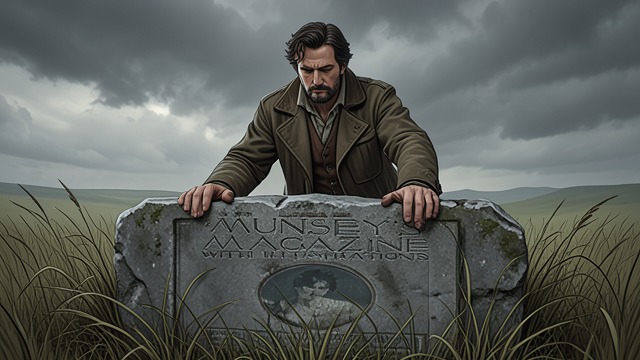
The First Farewell
A Visit for Answers
Marcher goes to May’s grave after her death, expecting perhaps that the place will help him understand her words. He studies the inscription and waits for some meaning to emerge.
The stones keep their secret. May’s name gives him a fact of loss, not the explanation he seeks.
Silence as Barrier
The grave establishes the limits of Marcher’s attempt to recover knowledge through memory alone. He has lost the person who could have interpreted the past.
A Year of Distance

A Year of Distance
The Grave Remains Central
Marcher travels through Asia, but the memory of May’s grave persists as the most significant place in his private world. Great temples and royal tombs cannot displace it.
His journey fails to give him the distinction he has lost. The London cemetery remains his strongest link to the life he once shared with May.
A Narrowing World
Distance does not release Marcher from the past. Instead, it makes the grave more central by revealing how little else supplies meaning.
The Grave as Property
The Grave as Property
A Place of Belonging
Marcher returns to May’s grave and feels that it recognizes his connection. He begins to visit monthly, treating the place as a resource and a point of orientation.
The grave gives him a fixed ground on which he can feel important to himself. He reads the inscription as an open page of his own past.
Living Through Memory
The cemetery supports Marcher’s identity by allowing him to revisit what he once had. It comforts him without revealing the truth that the memory contains.
The Stranger’s Grief
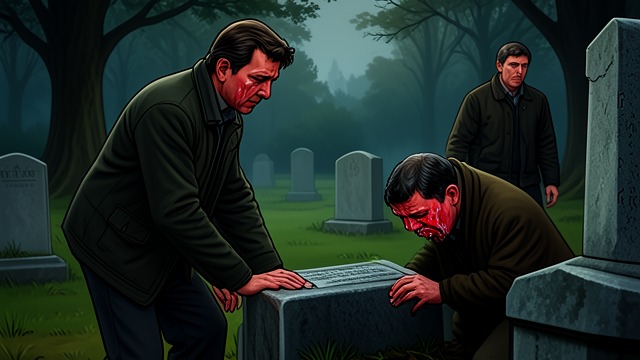
The Stranger’s Grief
A New Presence
During a cemetery visit, Marcher notices another man grieving at a nearby grave. The stranger’s visible pain interrupts Marcher’s familiar absorption in May’s tomb.
As the man passes, Marcher sees the depth of his loss. The encounter turns another person’s private sorrow into a lesson about emotional experience.
A Mirror at the Grave
The stranger’s grief makes Marcher question what he himself has lost. The cemetery shifts from a place of consoling memory to a setting that exposes his emotional emptiness.
The Tomb as Final Witness
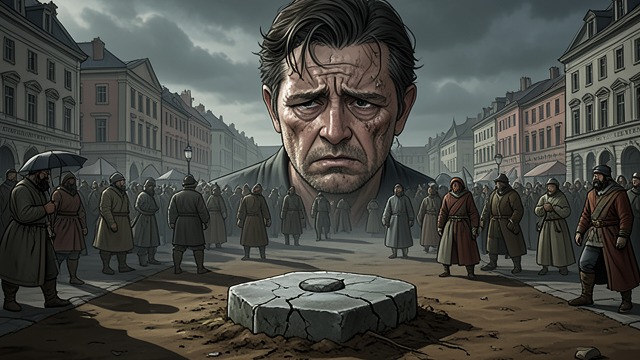
The Tomb as Final Witness
The Past Read Clearly
Marcher looks at May’s name and finally understands that she was what he had missed. Her grave becomes proof of the love he failed to recognize while she lived.
The setting that once seemed to preserve an open question now gives a devastating answer. The past is no longer merely hidden; it is understood as irrecoverable.
The Last Collapse
Marcher sees the Beast in the truth of his wasted life and flings himself onto the tomb. The grave is both the witness to May’s absence and the place where his own illusion ends.
Before Marcher leaves London after May’s funeral
During Marcher’s year in Asia
After Marcher’s return from Asia
An autumn day at the cemetery near the ending
The final moments of the story
