A Spring Day in April
The Beast in the JungleA Spring Day in April is a late-April visit in which the season’s fresh light sharpens John Marcher’s fear that May Bartram has reached an answer he still lacks. May reassures him that she remains with him, but when she seems ready to offer something further, she falters and returns to her chair. The day’s decisive movement is therefore not a revelation completed but one suspended: Marcher sees the signs of a disclosure without receiving its meaning.
Season, Light, and Room
Marcher visits late in the day, while evening has not yet settled. The week has been warm, and spring is understood to have begun early; May sits without a fire for the first time that year. To Marcher, the waning April light carries a sadness sharper than autumn’s grey hours. The room’s fireless brightness seems to give the scene an air of finality, as if it knows it will never see a fire again. That impression belongs to his vision of the moment, not to any certainty the scene confirms.
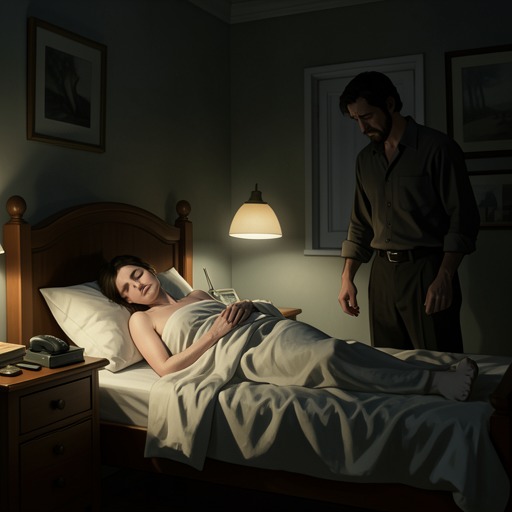
May’s appearance intensifies his sense that time has already moved on without him. Her face is almost wax-white, its fine marks seeming etched there; soft white draperies and a faded green scarf frame her delicate figure. Marcher sees her as both a serene, impenetrable sphinx and an artificial lily preserved beneath glass: exquisite and carefully kept, yet faintly drooping and creased. The contrast between this careful finish and her visible weakness makes her seem remote, as if she has entered a stillness he cannot share.
The rooms, always marked by household care and polish, now appear to Marcher as though everything has been wound up and put away. May sits with folded hands, apparently with nothing left to do. He imagines her as already resting on another shore, her part in their long watch completed. The orderly room thus becomes more than a setting: in Marcher’s anxious perception, it gives physical form to the possibility that May has finished waiting while he remains caught in expectation.
The Question and May’s Reassurance
Marcher has previously accused May of knowing something she keeps from him, but he has not dared press the point again. He fears that the wrong word could turn their closeness into disagreement, and would rather have the missing knowledge descend upon him by its own weight. Instead, he approaches the uncertainty indirectly, asking what she regards as the worst thing that could happen to him. Their conversations have returned to this question over the years, with old allusions disappearing during cool intervals and then emerging again as if new.
May meets the inquiry patiently. She recalls having considered dreadful possibilities but says that she could not choose among them; Marcher, she suggests, must have done the same. When he tells her that her belief is enough for him and that withholding further light would mean abandoning him, she rejects that conclusion. She rises despite the effort it costs her and shows herself standing before him, a rare exertion in her present weakness. Her assurance that she has not forsaken him is generous in its effort, and Marcher receives it as evidence that she can still help him. For a moment, her cold charm seems to restore her youth, though he also feels that her light could go out at any instant.
A Promise and an Interrupted Disclosure
The question Marcher finally asks is whether he will consciously suffer. May shakes her head and answers that he will not. Her prompt certainty confirms the authority he has placed in her judgment; he even wonders whether an outcome without conscious suffering could be called the worst. Yet the reassurance does not resolve his deeper uncertainty. May insists that whatever the reality may be, it remains real, and that the door is open. When he asks whether something is still to come, she tells him that it is never too late.
May then moves closer. Beside the bare chimney-piece, whose only ornaments are a small old French clock and two pieces of rosy Dresden, she grasps the shelf as if for support and encouragement. Her pause, movement, and shining expression lead Marcher to understand that she has something more to give him. The face he has regarded as exhausted now seems to hold a truth, presented with a softness that confounds the conversation’s language of dread. For several minutes neither speaks: May’s presence presses upon him, while his gaze remains kind and expectant.
The disclosure never arrives in words. May closes her eyes, gives way to a slow shudder, turns aside, and returns to her chair. Marcher keeps staring, harder rather than understanding more; afterward, his attention remains fixed on the interruption itself. The scene establishes a sharp difference between seeing that May has something to communicate and comprehending what she means to communicate. Its suspense is carried by bodily signs and silence, and the visit ends with Marcher still waiting for an answer that seemed, for a moment, almost within reach.
Significance of the Day
The April setting places renewal beside the scene’s suggestions of exhaustion: spring is young, the week has been warm, and yet May appears to Marcher as if her work were over. The seasonal brightness does not dispel his fear; it gives that fear a clear, quiet setting. His interpretations of the room and May’s appearance repeatedly turn observable details into signs that she has reached a conclusion about their shared question.
The visit also reverses the apparent direction of their dependence. Marcher comes seeking May’s judgment, receives her assurance that she remains beside him, and then witnesses her attempt to approach a more intimate truth. But he does not recognize or receive that truth in the moment. The day is therefore significant as a near-disclosure shaped by hesitation: May’s movement and expression make the possibility vivid, while her silence leaves Marcher’s expectation intact.