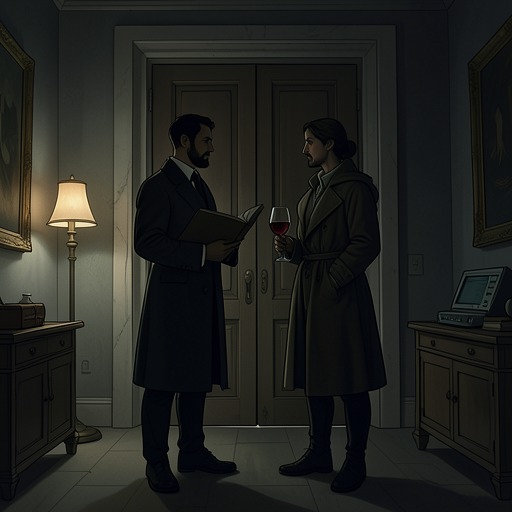
John Marcher
The Beast in the JungleJohn Marcher’s defining conviction is that some extraordinary event has been reserved for him: a rare, possibly terrible fate that will one day overwhelm him. That expectation shapes his relations with other people and his understanding of his own past. When the truth finally becomes clear, he recognizes not a spectacular event that happened to him, but the life he failed to live: he waited for his destiny while overlooking May Bartram’s love and the possibility of loving her in return.
Identity and Governing Expectation
Marcher describes his belief as something he has carried from his earliest time, a deep foreboding that something strange and possibly prodigious is waiting to happen. It is not merely a prediction about one future event. He treats it as the most important fact about himself, a private law that gives shape to his sense of being set apart and makes ordinary experience seem provisional.
The expectation also governs what he can notice. At Weatherend, in the course of an October afternoon, he finds himself drawn toward May Bartram, whose face seems both familiar and not quite remembered. Their renewed contact feels to him like a continuation whose beginning he has lost. He senses that she remembers the connection better than he does, but does not recover its meaning by himself. The scene establishes a pattern that will define their relationship: May holds knowledge of their shared past, while Marcher needs her to supply what his own attention has failed to retain.
Weatherend and May Bartram
Marcher imagines May’s place at Weatherend as that of a poor relation, perhaps someone who helps show the house and explain its contents to visitors. His impression is uncertain, and the contrast between his guesses and her actual circumstances matters: he can tell that she is not there merely on a brief visit, and he senses that the intervening years have been difficult for her, but he does not know what she has endured. He remembers her less fully than she remembers him.
Their earlier conversation on the Sorrento boat had disclosed the central fact of Marcher’s inner life. May recalls that he told her he believed himself kept for something rare and strange, perhaps terrible, that would sooner or later happen to him. She says that his account seemed simple because, as he spoke, she felt she understood it. Her understanding becomes the basis of a bond Marcher had not properly acknowledged. On their reunion, he realizes that she has been interested in him and that his disclosure had asked something of her: at first, simply that she not laugh at him. For ten years, she had kept faith with that request. Marcher now sees that he had not remembered, or returned in spirit, the trust she had given him, and feels he has a debt of gratitude to make up.
The Failure to Recognize Love
The bond Marcher reconstructs is shaped by an imbalance. May has remembered him and the meaning of their earlier exchange; Marcher has treated her presence chiefly as a means of pursuing or interpreting his own expectation. His belated account of their relation makes the cost of that imbalance explicit: she loved him for himself, while he had thought of her in terms of her use to him and his private preoccupation.
This failure does not arise because Marcher has no access to May. She is his companion in the vigil, and, at a decisive moment, she offers him a chance to escape the life he has made. But he does not understand what she is offering. Later, he sees that loving her would have meant truly living, while his habit of waiting kept him at a distance from the very relationship that could have given his life substance. May’s love is therefore not simply a feeling he discovers too late; it is an available human attachment that his self-absorption prevented him from answering when it might have changed his life.
Recognition at the Tomb
Marcher’s understanding is triggered by a stranger at another grave. As the man passes, Marcher sees the ravage of grief in his face and imagines the wound of losing someone deeply loved. The stranger’s actual story is not supplied; what matters is the force of Marcher’s reading of his expression. For the first time, Marcher envies another person’s suffering. He understands that such grief testifies to having possessed a love that his own life lacked.
The sight makes him measure his experience against the stranger’s. He has survived, waited, and pined, but has never been marked by the passion that leaves a mourner visibly wounded. Turning toward May Bartram’s tomb, he understands that she was what he missed. The truth gathers his past into a single explanation: the fate he feared had not taken the form of some external catastrophe. His portion was the wait itself, and May had once offered a way to defeat its emptiness by loving her. He had stared stupidly at that possibility instead of accepting it.
Change and Narrative Significance
Marcher’s recognition arrives only after May’s death, when it cannot restore the choice he failed to make. He remembers her pale, ill, wasted condition in the cold April when she rose from her chair and stood before him, perhaps still recoverable, while he failed to guess what she was offering. He now sees that the Beast he had anticipated had indeed sprung: not as the strange event he imagined, but through his blindness and the irrevocable loss of May. His long vigilance had not protected him from a fate; it had constituted that fate.
The revelation gives Marcher knowledge but no recovery. He tries to hold the truth and feel its pain, briefly finding in that bitterness something like the taste of life, before it sickens him. As the Beast rises in his vision, he turns instinctively and flings himself face down on May Bartram’s tomb. His collapse completes the reversal at the center of his story: the man who spent his life waiting for something to happen finally understands what happened, but only when the understanding can no longer become a life with May.