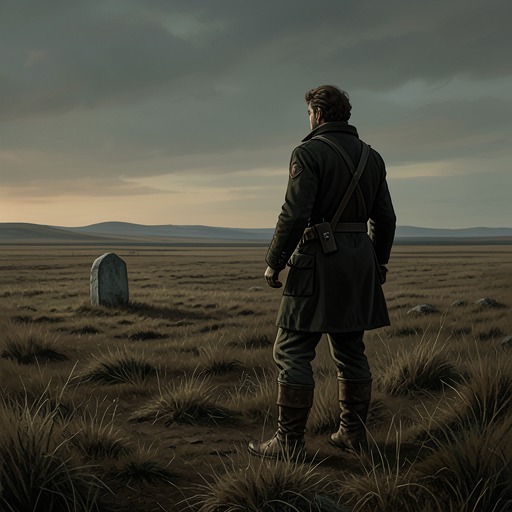
Marcher Recognizes His Fate at the Cemetery
The Beast in the JungleThe cemetery recognition is the decisive reversal in John Marcher’s long vigil: a stranger’s grief makes him understand that the fate he feared was not an extraordinary catastrophe, but a life in which nothing had truly happened because he never loved May Bartram. The insight arrives only after her death, and the very clarity that makes his past intelligible also exposes how irretrievably he has missed his chance to live.
Setting and Immediate Crisis
The encounter takes place on a gray autumn afternoon, among cemetery paths thick with fallen leaves. John Marcher has come to the low stone table bearing May Bartram’s name, a place that has served as the endpoint of his visits and the focus of his vigil. At a nearby, apparently fresh grave, he notices a middle-aged man in mourning, bent over in grief. At first, the man’s presence is only a detail in the cemetery; the sorrow it makes visible will become the force that changes the meaning of Marcher’s own history.
Marcher is already in an unusually depleted state. His earlier conviction that the cemetery offered surroundings in which he could revive has failed him on this visit. He rests heavily on May Bartram’s stone and feels unable to move, as though an inner spring has broken. He imagines lying on the slab as if it were prepared for his last sleep, and wonders what remains for him to stay awake for. The question establishes the emotional crisis before the stranger approaches: Marcher’s old expectation has not given his life purpose, and he can no longer draw support from it as he once did.
The Stranger’s Grief
When the mourner leaves the other grave and walks along a path toward a gate, he passes close enough for the two men to face one another. Marcher recognizes in his expression the unmistakable ravage of profound loss. The stranger does not explain himself; his grief is communicated through his face and the force with which he displays it. Marcher senses that the man may be responding, consciously or not, to the contrast between his own sorrow and Marcher’s smooth, emotionally untouched manner.
After the stranger has passed, his grief remains vivid in Marcher’s mind. Marcher pities the unknown wound that has left the man so visibly stricken, but pity gives way to envy. He asks himself what the stranger must have possessed to be so wounded by its loss. The encounter does not provide Marcher with new information about the stranger’s life; instead, the stranger’s visible suffering becomes evidence against Marcher’s own. For the first time, Marcher understands passion through its consequences in another person: to lose someone in this way is proof that the person had been loved.
Recognition of the Missed Life
The stranger’s grief gives Marcher a sudden answer. What the other man had lost, and what the depth of his grief revealed, was something Marcher himself had never possessed: a passionate attachment. Marcher sees that he has endured, brooded, and waited, but has never suffered the ravage of love. The realization comes from outside his own experience, by chance, rather than through a discovery he has made within himself. Its force lies partly in that belatedness: he has spent years treating the unknown future as the event that would define him, while the evidence of what his life lacked has been present in his own past.
Turning back to May Bartram’s name on the stone, Marcher understands that she was the person he missed. The name makes the stranger’s lesson personal: the woman whose grave he visits was not merely his companion in waiting, nor simply someone whose usefulness had helped sustain his vigil. She had loved him for himself. Marcher, by contrast, had thought of her chiefly through the part she played in relation to his obsession. His recognition thus changes the meaning of their shared years. What he had regarded as a life held in suspense was also a life in which love was offered and not returned.
He now identifies his long-awaited fate as the emptiness of having lived without passion. The Beast in the Jungle had not been an external calamity waiting to strike; in his understanding, its decisive action was the failure that had already occurred. Marcher had waited for a singular event to arrive, but the waiting itself had become his portion. May Bartram had seen this before he did and had offered him a chance to break its hold. When she told him that his fate had already come down, he had stared stupidly at the possibility of escape without recognizing what it meant.
The Earlier Offer and Its Consequence
The escape, Marcher now understands, would have been to love May Bartram. If he had answered her love, he would have lived in the sense that matters to him at the moment of recognition. She had already lived through loving him, though he can only wonder at the passion she felt; he had remained enclosed in egotism, valuing her for her use to him rather than seeing her as a person he might love. His failure was not an abstract defect discovered apart from their relationship. It was enacted in the particular moment when she stood before him, ill and wasted but still beautiful and perhaps recoverable, and he failed to guess what she was offering.
The scene returns in his mind as the point at which the Beast sprang: May Bartram rose from her chair in the cold April twilight, and Marcher did not understand. She turned away from him hopelessly; by the time he left her, the consequence of his failure had taken shape. The autumn cemetery encounter therefore links two moments separated in time: the earlier missed offer and the later recognition. What had seemed to Marcher like the deferred arrival of a danger becomes, in retrospect, the exacting fulfillment of his own fear. He had been right that something awaited him, but wrong about what it was—and his expectation helped keep him from seeing the life already before him.
Collapse and Significance
Marcher remembers that May Bartram had prayed he would never know. Now knowledge arrives as horror rather than consolation. Even his tears seem to freeze beneath it, although he tries to hold the recognition before him and feel its pain. For a moment, that pain has something of the taste of life, precisely because it is a feeling he can no longer dismiss or mistake for suspense. Then its bitterness overwhelms him. He sees his life as a jungle and the Beast rising for its final leap; instinctively, as if to avoid it, he flings himself face down on May Bartram’s tomb.
The ending gives the recognition a bodily consequence without undoing what it reveals. Marcher finally experiences an intensity of feeling, but only after the person who might have shared his life is dead and the opportunity to answer her love has passed. The movement from immobility on the stone to his final collapse marks the complete reversal of his vigil: he can no longer wait for an unknown fate, because he now recognizes the loss that waiting concealed. The stranger’s grief has awakened him to the value of love, but the awakening comes too late to transform his life into one he can live with May Bartram.