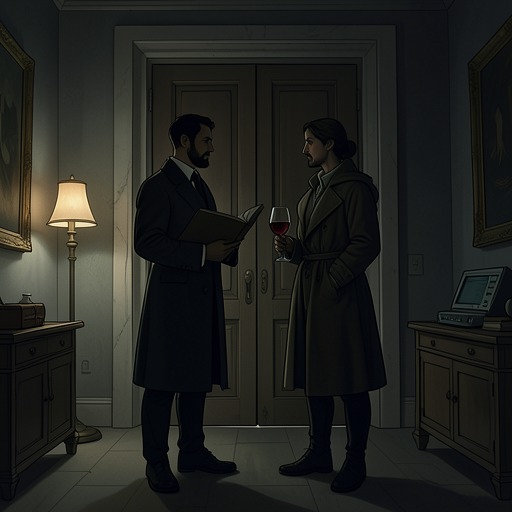
Marcher and May’s Agreement to Watch and Wait
The Beast in the JungleJohn Marcher and May Bartram’s agreement to watch and wait makes Marcher’s private conviction that a catastrophe may await him the basis of a lasting companionship. May agrees to observe the possible danger with him, but the pact offers no explanation of what will happen or when; its force lies in the promise to keep watch together, and its lasting consequence is an intimacy whose meaning Marcher only partly understands.
Formation at Weatherend
The agreement takes shape during a conversation about Marcher’s obsession and the possibility that it corresponds to a real event. May distinguishes between knowing why he is present and being there when the catastrophe occurs, bringing their attention from the secret itself to what they might do if it came to pass. For a moment, their lightness gives way to gravity, and the long look they exchange seems to bind them together. Marcher is told that the outcome will depend on whether he allows May to watch with him.
May asks whether he is afraid. Marcher does not give her a settled answer: he recalls that he said nothing about fear at Naples, then admits that he does not know and would like to know. He makes May the prospective judge of his response, telling her that if she watches with him, she will see. The pact thus begins in uncertainty rather than reassurance: neither of them can name the danger, and Marcher cannot yet say what it will make him feel.
Terms of the Pact
Marcher presses May to confirm that she will watch with him. She pauses, asks once more whether he is afraid, and then accepts. Before they leave the room, they stop at the door as if giving their understanding a final form; May’s promise is explicit: “I'll watch with you.” The exchange establishes the agreement as reciprocal in presence, but not in knowledge: Marcher asks May to observe and tell him what she thinks, while the feared event remains undefined.
The promise is consequently less a plan for averting catastrophe than a commitment to witness it together. Marcher’s formulation places the emphasis on what May will be able to see in him, and her renewed question about fear leaves that uncertainty open. The pact supplies companionship in the face of an anticipated but unidentified event; it does not supply a timetable, a test, or a resolution.
A Shared Vigil Over Time
The agreement outlasts the original encounter. As Marcher and May grow older together, May continues to watch with him, and the association gives shape and color to her own existence. What began as a response to his private secret becomes an organizing condition of their companionship, not merely a promise recalled from one afternoon.
Their closeness is also marked by an imbalance of perception. May knows Marcher’s secret and does not mock or betray him; she understands more of the course and cost of his detachment than he can readily see. Her own true account remains unspoken, least of all to Marcher, although her whole attitude toward him amounts to a statement that he does not recognize. The pact therefore binds them in shared attention while leaving a crucial part of May’s experience outside Marcher’s consciousness.
In their London years, the vigil exists beneath the appearance of an ordinary, habitual friendship between a man and a woman. They rely on society’s failure to perceive the private truth of their association, and May describes their familiar routine as what makes them seem indistinguishable from other people. The agreement’s significance lies in this double life: outwardly, a recognizable social habit; inwardly, a sustained watch over Marcher’s expected fate, which becomes part of May’s life even as he overlooks what her commitment expresses.