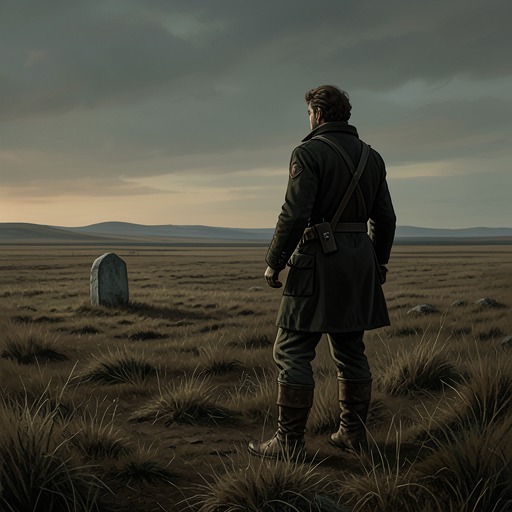
Marcher’s fatalistic law
The Beast in the JungleJohn Marcher’s fatalistic law is the conviction that an exceptional event has been reserved for him: something he must endure, not achieve, and whose arrival he can neither choose nor control. The belief organizes his life around suspense, but its final reversal is that the fate he expects to meet in the future has, as May Bartram tells him, already taken its form. What remains is not the fulfillment he imagined but the recognition that his life has passed without his understanding what happened in it.
The conviction and its limits
Marcher describes the belief as something rooted in him from his earliest years: a sense that he is being kept for something rare, strange, and perhaps prodigious or terrible. It may overwhelm him, destroy further consciousness, annihilate him, or alter everything at its root while leaving him to face the consequences. The range of possible outcomes is broad, but the governing premise is firm: something is coming, and he is to suffer or confront it.
He distinguishes this anticipated fate from an ambition. It is not a deed by which he expects to become distinguished or admired, and he recognizes that the event is not something he will bring about through action. He describes himself instead as waiting for it to break suddenly into his life. His uncertainty concerns what the event will be, not whether he has chosen to pursue it: in his account, the apprehension is a daily fact, while the form and operation of the law belong to forces beyond his command.
Marcher also insists that the belief is not simply a wish. He disavows wanting anything and presents himself as living under an apprehension that haunts him. This distinction helps preserve the law’s authority for him: it is not a plan that could be abandoned when inconvenient, but a sentence about his existence that he treats as already imposed. The imagined event must be singular and peculiarly his own; ordinary experience, even painful experience, cannot satisfy the expectation merely by happening.
May Bartram as witness
The belief becomes a relationship when Marcher explains it to May Bartram during the Sorrento boat conversation. She understands him without ridiculing him, and her discretion becomes the basis of their bond. At Weatherend, she promises to watch with him. Her participation gives his private expectation a witness: he is no longer the only person who knows the terms on which he believes himself to be living.
That agreement changes the practical life of the conviction. In the year after their afternoon at Weatherend, the death of May Bartram’s great-aunt allows May to establish a small home in London, and opportunities for the two to meet multiply. They visit the National Gallery and the South Kensington Museum and speak of Italy; their friendship continues not as a single confession but as a repeated companionship. Marcher’s law thus acquires a shared duration. May keeps watch over the expectation even as Marcher continues to regard its outcome as inaccessible to choice or decision.
Their difference lies in what each thinks the waiting may mean. May raises the possibility that his familiar fear of danger might be the expectation of falling in love. Marcher considers that possibility but judges it too ordinary and not strange enough to match the fate he imagines. His standard of exceptional destiny therefore excludes an interpretation that could have connected the suspense to a human relationship already unfolding beside him. The law does not merely predict an event; it shapes what he is able to recognize as an event worthy of his attention.
Time turns the law against him
For much of his life, Marcher assumes that whatever is coming still has time to arrive. When May says that his fate has been coming in its own form all along, he hears in her phrasing a doubt that it is still to come. Her suggestion unsettles the future tense on which his belief depends: perhaps fate has not been delayed, but has already operated without appearing in the exceptional form he expected.
May’s illness makes that uncertainty immediate. She fears a deep disorder in her blood, becomes less able to leave the house, and is increasingly seen by Marcher seated beside the fire in a deep, old-fashioned chair. Her visible aging makes him confront the years that have elapsed for both of them. He begins to wonder whether the great accident might amount to losing her, but judges that outcome an anticlimax rather than the singular fate for which he has waited. At the same time, the possibility that May has waited in vain grows more painful to him.
The deeper correction is temporal. Marcher comes to recognize that he is no longer young and that the remaining margin for the expected event is scant. In his formulation, failure is not bankruptcy, disgrace, or some spectacular calamity; it is the possibility that nothing distinctive has happened at all. The law he had treated as an assurance of future significance now exposes the cost of postponement. Because he has organized his life around what is to come, the passage of time threatens to leave him with neither a fulfilled destiny nor a life lived independently of it.
Reversal and aftermath
After May Bartram’s death, Marcher is left with her assurance that what was to happen has already happened. He comes to believe this absolutely: the change from expecting a future event to confronting an unidentified past is final, and he can no longer frame his life in terms of fear or hope for what is still to come. The question becomes what his fortune was, and how it remained masked from him while he lived through it.
This reversal changes the law’s function without dissolving its hold. Marcher’s old suspense is extinguished, but the absence of suspense does not bring relief. He is tormented by the thought that he was asleep to the meaning of his own experience and tries to recover the lost substance of consciousness by reasoning backward. May had forbidden him, as far as possible, to guess; that prohibition leaves him with a past he believes to be decisive but cannot identify. His search for what the law meant becomes a new occupation.
The final irony is that Marcher’s belief was not simply disproved by an uneventful future. It is redirected toward what he failed to recognize while it was happening. The expectation of a unique, terrible interruption made him wait for fate as spectacle, while May’s long companionship and devotion remained within his life without being understood as its defining possibility. The law’s apparent fulfillment is therefore inseparable from its failure: Marcher learns that fate has already acted, but only after the time in which recognition could have changed how he lived. In The Beast in the Jungle, his creed turns suspense into a structure of deferral, and its late reversal reveals the life that deferral has consumed.