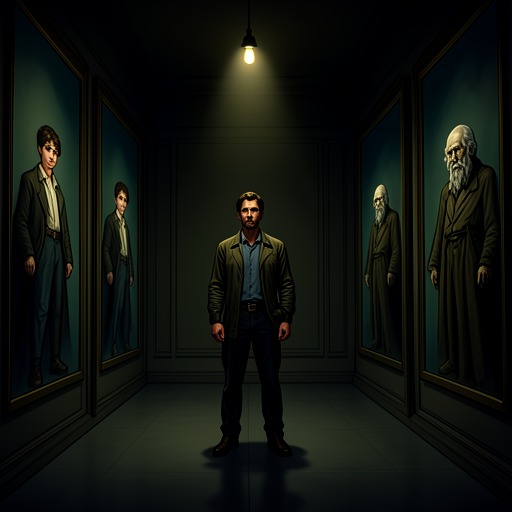
Marcher’s final collapse on May’s tomb
The Beast in the JungleJohn Marcher’s final collapse on May Bartram’s tomb follows his belated recognition that the catastrophe he had expected was the life he had already lost. The name on the tomb brings the truth into focus: May Bartram had loved him, and he had mistaken her presence for a means of watching his own fate. His last movement is at once an evasion of the imagined Beast and a physical surrender to the knowledge he can no longer escape.
The Recognition at the Tomb
The sight of May Bartram’s name makes the scattered pieces of John Marcher’s past cohere. He understands that the waiting itself had been his portion: while he anticipated some extraordinary event, his life was passing in suspension. May Bartram had seen this before he did and had offered him a chance to escape that fate. The realization is not simply that he has lost her; it is that the possibility of another life had been present in their relationship, and he did not recognize it.
Marcher sees his own failure in the difference between May Bartram’s love and his attention to her. She had loved him for himself, while he had regarded her through what she could do for him—as the companion of his vigil and witness to the secret he guarded. What he had treated as a shared watch had therefore concealed an unequal relation: May Bartram understood both his fate and the possibility of changing how he lived, while he remained absorbed in waiting to discover what would happen to him.
The Missed Offer
The recognition returns him to a cold April twilight, when May Bartram was pale, ill, and wasted, yet still beautiful and perhaps recoverable. She rose from her chair and stood before him, giving him the chance to guess what she was offering. John Marcher did not understand. She turned away hopelessly, and by the time he left her the decisive opportunity had passed.
In retrospect, that moment is where the feared Beast sprang: not as an external attack, but through John Marcher’s failure to recognize May Bartram’s love and answer it. His fate had not required a spectacular incident to arrive. It had taken shape in the ordinary encounter he misread, and in the life he declined without knowing that he was declining it. He remembers, too, that May Bartram had prayed he might never know; his new understanding is precisely the painful knowledge she had hoped to spare him.
The Final Collapse
The revelation first gives John Marcher a painful sense of contact with life. Through his tears, he tries to hold the truth in view, because even its bitterness seems to offer something more real than his long suspension. But that pain turns sickening as he sees the whole pattern of his life and imagines the Beast rising for its final leap. He turns instinctively to avoid it and flings himself face down on May Bartram’s tomb.
The ending makes bodily action complete what thought has disclosed. John Marcher cannot undo the missed offer or recover the life May Bartram’s love might have opened to him; his collapse marks the extremity of his recognition, not a rescue from its consequences. The Beast’s final appearance gathers his lifelong fear into an image, while the tomb fixes the truth that he reaches too late: the decisive event was not what he waited for, but what he failed to perceive and live.