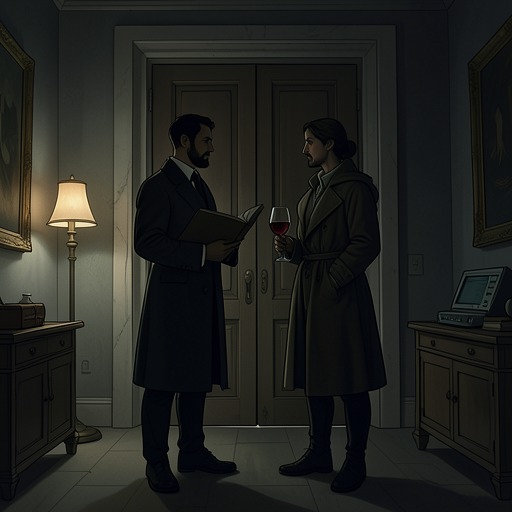
May Bartram
The Beast in the JungleMay Bartram is John Marcher’s trusted confidante and companion, and the person whose love he recognizes only after her death. She sees the emptiness in his long vigil more clearly than he does, yet remains beside him through it; her devotion gives their friendship its deepest meaning, while his failure to understand it turns that devotion into the measure of his loss.
Identity and Background
May first re-enters Marcher’s life at Weatherend, where the two discover that they have met before. When their reunion seems in danger of remaining a polite encounter between near-strangers, she supplies the missing link: she remembers their day at Sorrento, including the return boat conversation beneath the awning. Marcher has forgotten what he told her. Her recollection does not function as a claim on him for a compliment or a romantic promise; she brings it forward to restore a connection he has lost. The difference between what she remembers and what he has forgotten immediately establishes her as the keeper of their shared past.
May’s family circumstances also help explain her position. Since losing her mother, she has lived under the protection of her great-aunt, whose death changes May’s circumstances and multiplies the opportunities for her and Marcher to meet. Marcher recognizes her as a dependent whose pride matters to her. The narrative does not present her merely as an accessory to his story, however: she has a private truth of her own, one she cannot speak plainly to anyone, least of all to him.
The Secret and the Vigil
May becomes the only person who knows the secret Marcher has disclosed. She tells him that she has never repeated what he told her and never will. Her promise makes trust possible between them: Marcher is relieved not by mockery or judgment but by her sympathy, a response he has not found elsewhere. The confidence becomes a bond that distinguishes their intimacy from the ordinary social relationships surrounding them.
When Marcher asks whether she thinks the event he expects will happen, she does not claim to know. Instead, she proposes that he let her watch with him, so that she can judge what is coming for herself. At the door, they make the agreement explicit: May will watch with him. This is more than a convenient arrangement. It lets Marcher keep his belief and its suspense, while giving May a place beside him in the long interval before any answer arrives.
As the years pass, the agreement comes to shape May’s existence as well as his. Their outward relationship can look like the habitual friendship of a man and woman who see one another regularly; beneath that appearance, each understands that the secret makes their companionship exceptional. May is unusually able to read Marcher’s divided life. She sees the distance between his social conduct and his inner detachment, and understands how the preoccupation with his supposed fate keeps him from doing things he might otherwise have done. He knows his own feelings, but she can also see how those feelings appear and what they cost him. Her understanding is at once perceptive and painful: she gives his secret the attention it requires, while he remains largely unconscious of the truth she cannot bring herself to declare.
Love Beneath the Friendship
May’s love is present within the association she has agreed to sustain, but Marcher interprets her primarily through the use she serves in his life. The narrator makes the imbalance explicit: she has lived through loving him for himself, while he has thought of her in terms of his own need and the help she provides. Her devotion is not a sudden response to his illness or a late attempt to redirect his attention. It has been concealed within the years of watching, their familiar visits, and the ordinary forms by which they make their companionship legible to other people.
That concealment does not mean May is simply without agency. She has kept Marcher’s confidence by choice, offered to share his vigil, and repeatedly helped him confront the meaning of his expectations. Yet her own truth remains unspoken to him. Their relationship therefore carries a sharp asymmetry: May can see and interpret Marcher’s inward life, while the significance of her own remains outside his understanding. What appears to him as a sustaining friendship is also, for her, a life organized around love that he cannot recognize.
The Birthday Revelation and Final Offer
On May’s birthday, Marcher visits her with one of the small, carefully chosen gifts that have become part of their habit. He takes such offerings as evidence that he has not become wholly selfish. The scene gives that ritual a double edge: he can measure his attentiveness by the trinket, while remaining unaware of the much greater emotional truth his conduct has not answered.
In their conversation, May tells him that his history has not been an empty illusion and that the door is not shut. Her assurance that it is still not too late gives Marcher the sense that she has something more to offer, though he does not understand it. As she stands close to him and grips the mantel shelf, the narrative makes visible both her hesitation and the effort involved in speaking. Her face is wasted by illness, but her manner carries the unspoken possibility that Marcher might yet choose a life with her.
When he finally understands that she is dying, May tells him that she would live for him still if she could, but cannot. The declaration makes her love unmistakable at the very moment when she can no longer build a future from it. They part for the last time. Her illness keeps Marcher almost entirely from access to her chamber, and at the funeral in a London cemetery he discovers that their deep private intimacy gives him little recognized claim among her relatives and other mourners. He is left not only bereaved but painfully aware of how little public standing their relationship had possessed.
Death and Narrative Significance
May’s death completes the recognition she could not bring Marcher to make while she lived. At her tomb, he understands that she was the person he had missed and that loving her would have meant actually living, rather than waiting for a dramatic fate to arrive. The danger he had imagined as a Beast in the Jungle had, in the story’s final reversal, been his own capacity to let life pass without responding to love. May had already understood what he did not: the waiting itself was his fate, and her offer had been a chance to escape it.
Her role is therefore both intimate and structural. May is the person who protects Marcher’s secret, joins his vigil, and gives the years their apparent purpose; she is also the truth that the vigil conceals from him. The belatedness of Marcher’s understanding ensures that her love cannot become a shared future. It survives instead as the knowledge that she had offered him one, and that he had mistaken the person beside him for an instrument of his own suspense.