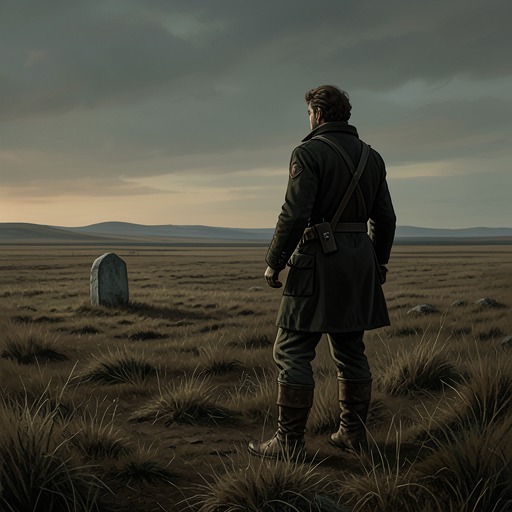
May Bartram tells Marcher that his fate has already happened
The Beast in the JungleMay Bartram tells John Marcher that the fate he has spent his life awaiting has already happened, though he never recognized it. The revelation reverses the direction of his suspense: what he had treated as a future event is, in May’s account, a completed experience whose defining feature is that it escaped his awareness. As she nears death, she insists that it has marked him and made him its own, but refuses to give him the understanding he demands. The scene’s decisive turn is therefore also a limit: May names the event as accomplished, while Marcher remains unable to know what it was.
Background and Circumstances
The disclosure comes after May has kept Marcher waiting through a series of days in which he repeatedly asks after her and must turn away. When she finally receives him in the place where she has always received him, she is so altered that her condition overwhelms him. He is moved to abandon the matter that has occupied them, but May brings him back to their unfinished business. She wants it put in order while she can still reach out to him, and takes up again the last word she had given him during their earlier exchange.
For Marcher, her condition has already suggested one possible answer. He has begun to think that her dying, her death, and the solitude that will follow may be the event he had called the Beast in the Jungle. This would not be a rare or glorious fate, but the common doom of losing someone close. Even so, he is prepared to accept it as the culmination of his long waiting. May’s explanation overturns that provisional interpretation: she does not present her death as an event still to come that will fulfill his expectation, but tells him that the awaited thing has already taken place.
The Disclosure
May makes the claim plainly: “I'm not sure you understood. You've nothing to wait for more. It HAS come.” Marcher asks whether she means the thing they began watching for in their youth. When he presses for a positive, definite occurrence with a name and date, she confirms its definite character but is uncertain about its name; the date, she says, is unmistakable. Her answers establish that she is not speaking merely of an approaching possibility. In her account, the event belongs to the past, even though Marcher cannot identify it.
His next objection is precisely that he has not experienced it consciously: could it have arrived in the night and passed him by, or touched him without his awareness? May answers that this unawareness is the marvel within the marvel. Her voice is weak, yet she speaks with the authority of someone who knows what she is saying. She tells him that the event has touched him, performed its work, and made him entirely its own. When he repeats the difficulty of having undergone it without knowing, she answers that it is enough that she knows.
May’s certainty does not supply the explanation Marcher wants. She says he will never know now and, she thinks, ought to be content: he has had what was to mark him out, the proof of the law he has believed in. She is glad, she adds, to have been able to see what it is not. That qualification matters. May can affirm the event and reject at least one interpretation of it, but she does not give Marcher a name for the fate or a conscious episode he can recall as its fulfillment.
Marcher’s Resistance and May’s Warning
Marcher cannot make May’s account fit his idea of experience. He says that nothing is past for him and that nothing will pass until he himself passes; he also protests that he cannot understand how something he never felt could be what he was marked out to feel. May distinguishes suffering a fate from knowing it. Marcher objects that knowledge itself seems inseparable from suffering, but her answer shifts the issue away from the feelings he has taken for granted: undergoing the fate did not necessarily mean recognizing it.
The strain of their parting presses on this dispute. Marcher says he would rather have had the event present than have it absent along with May, and he senses the weight of what may be their last meeting. Yet even the prospect of losing her does not make him accept her claim without resistance. He can believe her and still insist that he does not understand. His questions repeatedly seek an experience he can identify, while May’s account depends on the possibility that the decisive experience has left him without such knowledge.
When May urges him not to know, Marcher glimpses a possible meaning in her warning but cannot hold onto it. She tells him that he need not know because they should not know; when he asks what she means, she answers that it is too much. Her refusal leaves the central contradiction intact: she has declared his long-awaited fate accomplished, yet withholds the further recognition he might use to comprehend it.
Consequences and Significance
The exchange transforms Marcher’s lifelong suspense from expectation into retrospective uncertainty. He had imagined that the defining event would announce itself as an exceptional blow, something he could experience and name. May instead describes a fate that has acted without his conscious awareness, and she speaks as its witness. The disclosure therefore makes her knowledge—not Marcher’s recognition—the immediate evidence that his waiting has ended.
It also changes the meaning of their shared history. May has accompanied him through the long period of watching and waiting, and now she seeks to bring their business to its conclusion before her own life ends. But the exchange does not resolve the difference between them: she can see what has happened, while he cannot. Her final warning protects him from a knowledge she considers too much, even as that restraint leaves him confronting the loss of May and the unexplained claim that his fate is already complete. The event ends not in clear comprehension, but in a reversal whose truth May asserts and whose meaning Marcher cannot yet grasp.