May’s Declaration of Love, Unrecognized by Marcher
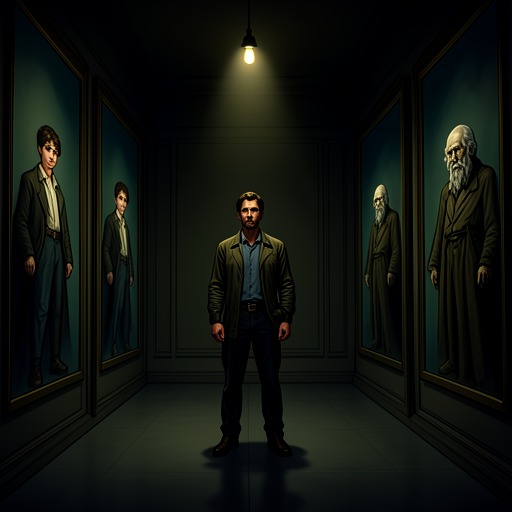
The Beast in the JungleMay Bartram’s Declaration of Love, Unrecognized by Marcher is the missed chance at the heart of John Marcher’s belated recognition that his life has been defined not by a coming catastrophe but by love he failed to return. In an April conversation, May offers him a possibility beyond the fate he has spent years awaiting. He does not recognize the offer: watching her face, he expects some further explanation of his destiny, while she struggles to express what she feels. At the cemetery, after her death, he finally understands that loving her would have been his escape from the life he feared and that he let that possibility pass.
The Unspoken Offer
The scene grows out of a discussion of whether Marcher’s anticipated fate is still ahead of him. May insists that the truth is not simply that the door has shut: whatever the reality, the door remains open. When Marcher asks whether something is still to come, she answers that it is never too late. Her words continue to sound, to him, like a promise about the future event that has governed their relationship. In retrospect, however, they also carry a more intimate meaning: she is giving him a chance to respond to her love.
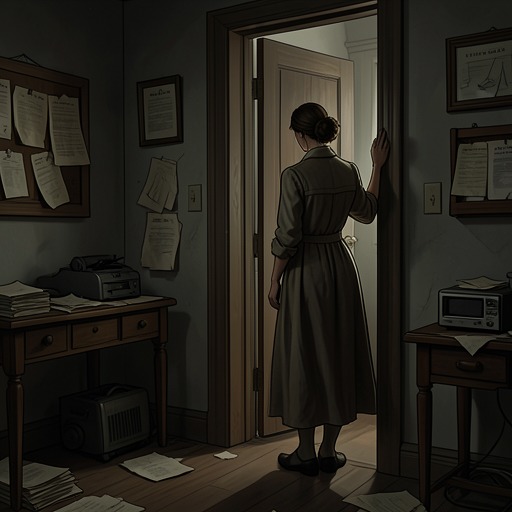
May’s effort to make that meaning perceptible takes place less through a declaration than through her movement and expression. Keeping her eyes on Marcher, she glides closer and stands near him. At the chimney-piece, she grips the shelf, as if she needs support or encouragement, and leaves him waiting while she hesitates over what she intends to say. The room’s sparse furnishings include a small French clock and two pieces of rosy Dresden; against this still, spare setting, her approach makes the unspoken possibility vivid to him, but not intelligible.
Her wasted face seems to shine with what she has to give. The narration likens its brightness to the lustre of silver, and Marcher sees a truth in her expression even while failing to identify it. The contrast is central to the encounter: he senses the intensity of her feeling and receives it gratefully, yet continues to await a revelation about himself. The possibility before him is emotionally present but remains, for him, a mystery to be solved rather than a relationship to enter.
The Failed Recognition
May’s appearance complicates Marcher’s expectation. Although they have been speaking as if the truth were dreadful, she seems to present what she is about to reveal as soft. Her closeness presses on him without becoming a clear proposition, and the two remain silent for several minutes: she faces him with her expression bright, while he stares back, kindly but expectantly. He assumes that the moment is leading toward an explanation of his fate. The difference between what he waits for and what she is trying to offer makes the silence consequential.
The expected revelation does not come. May closes her eyes, gives a slow, fine shudder, turns away, and returns to her chair. Marcher keeps staring, harder rather than more perceptively, and is left thinking about the failed moment without understanding what has failed. Her withdrawal marks the end of her attempt to say what she had intended. The scene supplies no explicit spoken declaration of love; its meaning is made legible through gesture, hesitation, and, later, Marcher’s reconstruction of what she was offering.
That reconstruction establishes the encounter as a choice he did not know he was making. At the time, Marcher sees May’s closeness and apparent revelation through the framework of his obsession with what is to come. He does not turn toward her as a beloved person. His attention remains fixed on the interpretation he has already prepared for the scene, so the emotional evidence in front of him cannot alter his expectations.
The Cemetery’s Retrospective Revelation
After May’s death, Marcher’s encounter with a grieving stranger at the cemetery makes him recognize what May’s feeling meant. The stranger’s ravaged face appears to him as evidence of having loved and lost someone. Comparing that visible grief with the aridity of his own life, Marcher realizes that he has never suffered such a loss because no passion has touched him. The recognition is not knowledge gained through his own experience of love; it reaches him by chance, through witnessing another man’s grief.
The cemetery revelation then brings May’s earlier encounter into focus. Marcher understands that she was the person he had missed: she loved him for himself, while he had regarded her through the chill of his egotism and the light of her usefulness to him. He sees that she had already understood the shape of his fate and had offered him a chance to defeat it. The escape, as he now recognizes it, would have been to love her. She had lived through loving him; he had waited instead of living with her.
Marcher recalls the April scene in its bodily detail: May, pale, ill, and wasted, rose from her chair and stood before him, perhaps still recoverable, giving him the chance to guess what she could not bring herself to say. He did not guess. She turned away, and the chance was lost. His subsequent understanding does not repair the encounter; it changes its meaning for him too late, when May is dead and the life they might have shared cannot be recovered.
Consequence and Narrative Significance
The declaration’s force comes from its double timing. In the original scene, Marcher experiences suspense: he waits for the event he believes will define him. In the later cemetery passage, the narrative returns to that suspense and reveals that the decisive event has already occurred. The long-awaited fate was not an external catastrophe still approaching; it was the life Marcher’s waiting prevented him from recognizing and choosing. The scene’s near-silence thus conceals a reversal that becomes clear only after loss.
May’s failed attempt is also the point at which the story’s Beast imagery acquires its final meaning. Marcher understands that the Beast has sprung not as the extraordinary event he feared, but through his failure to recognize her offer and the life that could have followed from accepting it. His terror is therefore bound to belated knowledge: he remembers May’s face and withdrawal as the moment when his opportunity was before him, while the consequence of his blindness has become irreversible. Her wish that he might never understand only deepens the tragedy of his eventual recognition. The declaration remains unspoken, but its missed meaning becomes the truth by which Marcher measures his entire life.