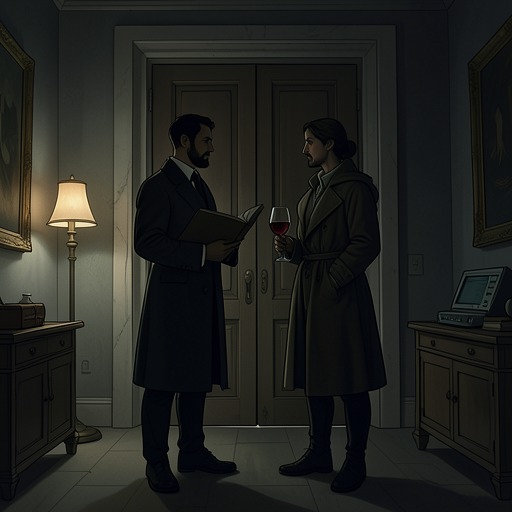
The October afternoon at Weatherend
The Beast in the JungleThe October afternoon at Weatherend is the chance reunion that gives John Marcher and May Bartram a shared past—and sets in motion their agreement to wait together for the fate he believes is coming. Amid the house’s visitors and historical rooms, their conversation restores an earlier encounter Marcher has misremembered and reveals that May has kept both the meeting and his words in mind. In retrospect, the afternoon becomes the beginning of a relationship whose long duration will expose how differently the two have understood their time together.
Setting and First Recognition
The encounter takes place during an October afternoon at Weatherend, where visitors move through the great rooms, attending closely to objects and the history around them. Marcher finds the crowd disconcerting and wanders apart to feel more properly related to the house. That impulse brings him closer to May, whose face seems familiar without yielding a clear memory: their meeting feels like the continuation of something whose beginning he has lost.
Marcher supposes that May belongs to the household as a dependent, perhaps helping to show the house and answer visitors’ questions. She is, in fact, there on difficult terms shaped by the years between their meetings. When they are left alone in a room marked by a portrait over the chimney-place, the waning autumn light reaches across the old wainscots, tapestry, and gold. They have, without needing to say so, already chosen to stay behind and talk.
Recovering the Earlier Meeting
When May speaks, Marcher recognizes that they met years earlier, but his confidence outruns his memory. He offers a succession of details as if bringing their shared past fully back into view; May’s recollection shows that he has got much of it wrong. The meeting was in Naples, not Rome, and nearer ten years earlier than the eight he suggests. May was travelling with her mother and brother, not an aunt and uncle; Marcher was with the Boyers, not the Pembles. The thunderstorm that drove the group to shelter broke over them at Pompeii, where they had gone to see an important archaeological find, not at the Palace of the Caesars.
The corrections make the reunion more than a simple exercise in memory. May knows the encounter distinctly and has evidence for her account, while Marcher has retained a blurred impression and misplaced its particulars. Her knowledge restores the connection, but she has not simply handed it to him: she had been holding back what she remembered, and the conversation advances when she decides to supply the missing link.
The Sorrento Memory and Their Agreement
May recalls another part of their earlier travels: on a very hot day, they went across the bay to Sorrento for a breeze. On the return boat, seated under the awning in the cool, Marcher said something that she has never forgotten and that has repeatedly made her think of him. He cannot recall what he said. May is not invoking a compliment or pressing a claim; she even suggests that it may be better if he has lived away from the person he was ten years earlier. The remembered remark thus matters less as a recoverable quotation than as proof that the earlier conversation left a lasting impression on her.
This disclosure helps establish the intimacy of their new understanding. By the time they leave the room, May agrees to watch with Marcher. The afternoon’s recovered memories and her knowledge of his preoccupation become the basis of a bond: she knows what occupies him, does not mock or betray him, and joins him in waiting to see what will happen.
Aftermath and Retrospective Significance
Within the year, the death of May’s great-aunt and the changes that follow give Marcher and May more opportunities to meet. May is able to establish a small home in London under the terms of her aunt’s complicated will. Marcher visits her there, and they also meet at the National Gallery and the South Kensington Museum, talking about Italy without trying to reconstruct the ignorance and sensations of their youth. The first afternoon at Weatherend has already given them enough of that shared beginning; their relationship now moves forward through repeated meetings and the promise to watch together.
The afternoon’s meaning darkens as May grows old and seriously ill. Marcher realizes that she has waited alongside him for years, while he has continued to imagine that the decisive event lies in the future. The possibility that he may lose her before either of them sees the answer to his obsession makes him confront, however belatedly, the thought that time may have run short. After May’s death, he accepts the assurance that what was to happen has already happened, though he cannot identify the past event that fulfilled his expectation. The suspense that began to govern their bond is ended, but its unresolved history continues to torment him; a chance encounter in the cemetery later turns his attention toward what his life with May meant. The October reunion therefore stands at once as the beginning of their shared vigil and as the origin of a retrospective search that Marcher will understand only after it is too late.