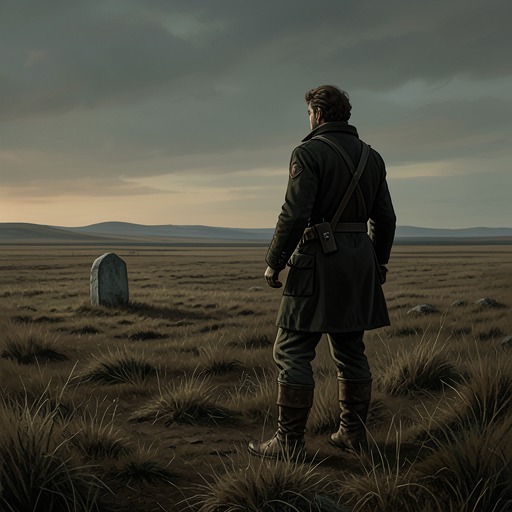
Waiting and Life on Hold
The Beast in the JungleWaiting and Life on Hold names the suspended existence at the center of John Marcher’s story: he lives as though a rare and devastating event is destined to arrive, and makes anticipation the measure of his life. The final revelation reverses that expectation. The catastrophe is not a spectacular event still to come but the life already lost to waiting, including his failure to recognize May Bartram’s love while there was still a chance to answer it.
The Shape of the Expected Future
From his earliest years, Marcher has carried the conviction that he is being kept for something rare and strange, perhaps prodigious and terrible. He imagines a future event that will overwhelm him, but cannot identify what it will be or when it will occur. The expectation is powerful precisely because it remains without a definite form: it gives his life a destination while withholding any knowledge of what reaching it would mean.
When May Bartram asks whether the event has happened, Marcher insists that it has not. He distinguishes the anticipated fate from ordinary achievement: it is not a public accomplishment for which he might be admired, but something he must endure. He pictures himself having to meet and face it when it suddenly breaks into his life. In one possibility, it could destroy his consciousness or annihilate him; in another, it could alter everything and strike at the roots of his world, leaving him to live with the consequences. These are imagined outcomes, not confirmed events. Their uncertainty lets the feared future remain open and occupy the place of a life actually being lived.
May offers a more familiar possibility: perhaps what Marcher describes is the danger people associate with falling in love. Her suggestion does not settle the question for him. The suspense persists because Marcher continues to treat the future as an appointed force whose nature is beyond his choice, rather than as a possibility that might involve his own feelings and decisions.
Waiting as a Shared Practice
The expectation is not entirely solitary. May has heard Marcher’s account and remained with him through the long period in which he waits for its fulfilment. At the moment when their exchange becomes grave, Marcher asks her not to leave him; she proposes that they watch together. Their companionship gives the suspense a human shape: waiting becomes something they share, and her presence helps sustain the vigil around the event he cannot name.
Yet the arrangement is unequal in what each person understands. Marcher sees May’s company in relation to his fate, as part of the watch for whatever may happen to him. At the end, he understands that May had already perceived another possibility: that his fate had come in its own form and way, and that the waiting itself was the portion he had been given. She had offered him an opportunity to escape that doom by loving her. He did not recognize what the offer meant. The vigil that seemed to join them therefore also records the distance between May’s insight and Marcher’s self-absorption.
Marcher’s own account of fate reinforces that distance. He says that he cannot choose or decide on a change; the law governing him will take its own form and operate in its own way. This language turns uncertainty into an excuse for passivity. If the event belongs to a law beyond his control, he need not ask whether the present contains a decision he could make or a relationship he could meet differently.
Familiarity, Doubt, and Reassurance
As the waiting continues, it changes from acute fear into habit. Marcher and May can return to the question of his fate, but the imagined danger has lost some of its force. May observes that he has become so accustomed to living close to danger that he knows it is there while growing indifferent to it; he no longer needs the old effort of whistling in the dark. The change is not evidence that the anticipated event has occurred. It shows how suspense can persist even after its emotional intensity has worn down, remaining the organizing fact of a life that no longer actively feels its alarm.
That persistence is challenged by doubts about whether Marcher has mistaken his own story. He fears that the expectation may be a vain imagination, a besotted illusion, and that he has waited only to find a door shut against him. May rejects the idea that his history is simply a mistake and tells him that the reality remains real and the door remains open. Her reassurance preserves the possibility of a meaningful fate, but Marcher still hears it within his established framework: as confirmation that something is to come, rather than as a summons to recognize what has already happened between them.
The contrast between Marcher’s interpretation and May’s is central to the suspense. He treats the future as a still-unrevealed event; she understands that a life can be shaped by what a person fails to recognize in the present. Her insight does not immediately free him from the vigil. Instead, the reader sees how the same language of fate can sustain two understandings: for Marcher, an external ordeal awaits; for May, his failure to respond to love is already giving his life its form.
The Reversal: The Wait Was the Fate
The final recognition makes the waiting itself the answer to the question that has governed Marcher. He sees that the exceptional fate was not a blow from outside his life but the discovery that nothing on earth had happened to him. His long suspense was not a temporary passage toward a more meaningful event. It was the condition of an arid life, mistaken for the prelude to one.
This recognition also changes the meaning of the Beast in the Jungle. The image had given Marcher’s fear a figure: something hidden that might one day spring upon him. At the end, the Beast’s arrival belongs to his realization of what he has missed. The leap does not disclose a separate supernatural threat; it gives violent imaginative form to the truth that his waiting has concealed. May’s love, and his failure to return it, make the supposedly empty interval consequential: he had a chance to live differently, but did not understand it as that chance.
The suspense therefore depends on a reversal between anticipated and actual experience. Marcher expects the decisive event to arrive later and transform his life. Instead, the decisive meaning becomes visible belatedly, when he recognizes that he had treated May chiefly in relation to his own need and had failed to love her for herself. Waiting has held his attention on a possible future while blinding him to the relationship that was already present. By the time he understands, the possibility of escape has passed, and the revelation gives the long-delayed suspense its devastating conclusion.