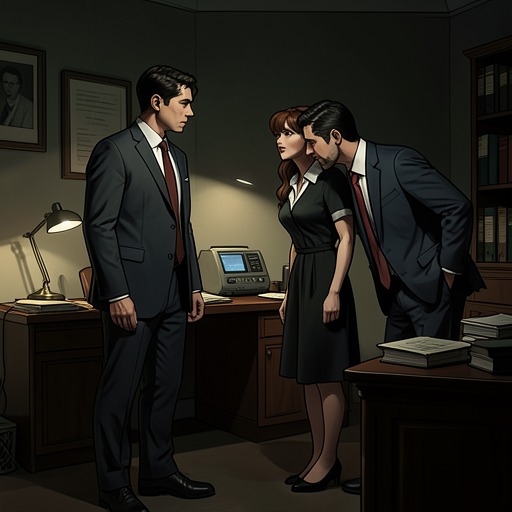
Conflict driven by misunderstanding and rumors
The Beki CEO Got Me PregnantMisunderstanding and rumor-driven conflict is one of the book's most consequential social forces: information rarely arrives neutrally, and a partial observation can become a weapon once it passes through desire, jealousy, or deliberate deception. The pattern is especially destructive in the relationship among Yohan Xyle, Kazumi Lhynx, and Vixon Rae, where suspicion replaces verification and loyalty becomes a reason to believe rather than a reason to investigate. What begins as talk of eye-rolling, seduction, and backstabbing escalates into physical violence, the collapse of a best-friend relationship, and accusations that are only corrected when a private recording, a second point of view, or official CCTV evidence exposes the gap between appearance and fact.
The Mechanism of Suspicion
The conflict first takes shape through Vixon Rae's interpretation of Kazumi Lhynx's behavior. Vixon tells the narrator that Kazumi may be discussing them behind their backs, pointing to her apparent eye-roll and her complaint that they were being noisy. The accusation is not presented as established fact; it is a reading of gestures and tone. Yet the narrator accepts it because the eye-roll was also personally witnessed while Vixon and the narrator were flirting. That small coincidence gives Vixon's speculation the appearance of confirmation, showing how rumor gains force when an ambiguous detail can be fitted to an existing emotional story.
Vixon then adds a more pointed allegation: Kazumi supposedly tried to seduce Vixon after leaving the office following the job interview. The claim converts rivalry into sexual betrayal and encourages the narrator to regard Kazumi as an active threat. At the same time, suspicion spreads downward through Yohan's workplace. Yukim, one of Yohan's workers, is imagined as Kazumi's accomplice simply because the original accusation has already established a hidden conspiracy. The logic is cumulative rather than evidentiary: once Kazumi is labeled a backstabber, anyone associated with her can be absorbed into the same story.
Kazumi also participates in the circulation of damaging information, though her statement to Yohan is framed as a warning rather than an attack. She tells him that Vixon said Kazumi was interested only in Yohan's money. The remark forces Yohan to confront the possibility that his relationship with Vixon is based on exploitation. Instead of creating calm, however, the warning becomes another contested version of events, because Yohan is already emotionally invested in Vixon and therefore vulnerable to rejecting information that threatens that attachment.
Manipulated Evidence and Divided Viewpoints
The central deception depends on the difference between what a recording appears to capture and what it actually means. A voice message contains Kazumi laughing and saying that she managed to make someone believe her because that person was gullible. The message cuts off immediately after Cleastra begins to respond. Yohan therefore assumes that Kazumi and Cleastra are mocking him, and the incomplete ending becomes apparent proof: because the recording stops at the beginning of Cleastra's response, Yohan decides that he must be the subject of their conversation.
Vixon strengthens the deception by supplying a false account of how the recording was obtained. He claims that he has just left Zhara's room after thanking her for helping with a painting, heard noises from Kazumi's room, taken out his phone, and recorded Kazumi and Cleastra speaking behind Yohan's back. The message presents Vixon as an attentive protector who has gathered evidence on Yohan's behalf. It also gives the suspicious recording a plausible location and circumstance, making a deliberately incomplete fragment seem like an accidental discovery.
The later Vixon Rae point of view reveals that both parts of this account are fraudulent. Vixon admits that the supposed painting activity with Zhara was a cover: he and Zhara had actually had sex, while the painting had merely been purchased because Vixon would not make the effort to create it. He also explains that he sent Yohan a conversation between Kazumi and another person while allowing Yohan to believe that the conversation concerned him. In reality, Kazumi and Cleastra were discussing Kazumi's friend. The voice message is therefore not simply misunderstood; it has been selected and framed so that misunderstanding becomes the intended result.
This divided presentation makes viewpoint itself part of the conflict. Yohan receives a partial recording and a persuasive explanation, while the reader later receives Vixon's private admission. The two accounts do not carry equal reliability: Yohan's interpretation is emotionally sincere but mistaken, whereas Vixon's explanation exposes a conscious strategy of misdirection. The narrative consequently turns communication into a contested field in which the person controlling context can control the apparent truth.
Rupture Between Yohan Xyle and Kazumi Lhynx
The rumors become most damaging when they collide with Yohan's long-standing bond with Kazumi. Kazumi tries to warn Yohan that Vixon is using him and urges him not to trust Vixon's claims. She specifically says that she saw Vixon having sex with Zhara in the office while no one else was present. Before she can finish explaining the circumstances, Yohan slaps her. The physical interruption is crucial: the allegation is not disproved through questioning or evidence; it is stopped through anger, and the conflict moves from verbal suspicion to bodily harm.
Yohan's reaction shows how rumor has reorganized his loyalties. He tells Kazumi that she has changed since Vixon began working there and insists that he cannot simply believe her merely because she used to be his best friend. He declares that he no longer considers her his best friend and feels that she is his enemy, while presenting his desire to be happy with Vixon as something Kazumi is unjustly trying to deny him. His language turns disagreement into a moral opposition between an obstructive enemy and a partner who represents happiness.
Kazumi's response remains direct: she insists that Yohan cannot be happy with Vixon because Vixon is only using him. Her warning contains the truth that Vixon's manipulation later confirms, but its timing and emotional force make it easy for Yohan to classify it as jealousy or hostility. The resulting rupture is therefore tragic in structure: Kazumi's accurate accusation arrives inside a relationship already poisoned by Vixon's invented accusations, and the truth sounds indistinguishable from another attempt to control Yohan's choice.
The conflict also demonstrates how affect travels faster than verification. A glance becomes an accusation, the accusation becomes resentment, and resentment becomes a slap and a declaration of enmity. Neither side needs a complete account of events for the emotional consequences to become real. By the time clarification might be possible, the relationship has already been altered by what each person believes the other believes.
From Private Rumor to Public Record
The same instability of information later appears on a larger scale when Yohan discovers a Facebook article reporting that the garden owned by Yohan Xyle near his company has been bombed. The report states that the garden was completely destroyed, that no one saw or knew who was responsible, and that the damage was concentrated on the garden rather than causing widespread harm. At this stage, the public article supplies a visible result without identifying a culprit, leaving the event open to speculation and blame.
The bombing is linked in the narrative to failed planning and wasted money, but the broader public account initially remains uncertain. That uncertainty echoes the earlier private conflicts: a damaged object is undeniable, while intention and responsibility remain hidden. The garden becomes a material version of the book's communication problem, presenting unmistakable evidence of harm while withholding the chain of causation needed to interpret it.
The later report of Vixon's death finally introduces a formal corrective to the rumor system. Articles describe Yohan's ex-assistant as having accidentally killed himself after police knocked his gun aside, with Vixon dead on arrival. Netizens blame Vixon for the surrounding events, but an official police statement clears Yohan. CCTV footage shows that Yohan did not kill Vixon and that Vixon was at fault because he attempted to kill Yohan. The recorded image succeeds where the earlier voice message failed: it preserves enough context to distinguish accusation from action and rumor from responsibility.
Consequences and Narrative Significance
Misunderstanding and rumor-driven conflict changes relationships before facts can be established. Vixon's claims isolate Kazumi, persuade Yohan to distrust the person closest to him, and provide cover for Vixon's sexual relationship with Zhara. The incomplete recording demonstrates how little evidence is needed when the receiver is already emotionally committed, while Vixon's confession demonstrates that the apparent evidence was engineered rather than merely misread.
The pattern also creates a recurring contrast between private testimony and external verification. In the office conflict, Yohan privileges Vixon's account over Kazumi's warning; only the later Vixon Rae point of view reveals the manipulation. In the public crisis surrounding Vixon's death, Facebook articles and netizen reactions again produce immediate blame, but the police statement and CCTV footage establish a more reliable account. The narrative does not suggest that every recording or public report is automatically truthful. Instead, it distinguishes between information that has been stripped of context and evidence that preserves the sequence of actions.
By the time Yohan and Kazumi look at the tiles that still bear traces of blood after the scene has been cleaned, rumor has acquired a physical aftermath. Workers ask in a group chat whether Vixon is still alive, and the answer is that he is dead. The question itself shows how quickly crisis becomes mediated through messages, while the blood marks resist being reduced to a message or explanation. The concept's decisive significance lies in that tension: miscommunication can produce real violence, but the eventual revelation of facts cannot simply restore the relationships that suspicion has already damaged.