Hospital
The Beki CEO Got Me PregnantHospital is the decisive medical setting for the story’s movement from concealed pregnancy to shared parenthood. It receives Kazumi after severe bleeding and visible assault, becomes the place where Yohan learns that the baby has survived, and later contains the delivery that makes their child physically present. Across these scenes, Hospital is not merely a backdrop: it is where uncertainty is converted into diagnosis, danger into monitored survival, and anticipation into an embodied family.
Definition and Narrative Function
Hospital appears through several connected medical spaces, including the ER and the delivery setting. Its significance develops from the circumstances that precede each arrival. Kazumi’s pregnancy begins unexpectedly after a drunken encounter in which Yohan apparently used no condom; later, a pregnancy test gives a positive result, represented by the discovery of two lines. Zhara’s account of her own positive test and Vixon’s refusal to accept responsibility establishes pregnancy as a source of vulnerability as well as a demand for accountability. Against that background, Hospital becomes the institutional setting where pregnancy is no longer only a private fear or an argument between people, but a condition requiring professional care.
The setting also mediates between competing forms of knowledge. Kazumi and Yohan experience pregnancy through bodily danger, panic, exhaustion, and hope, while doctors and nurses translate those experiences into examination, reassurance, treatment, delivery, and newborn procedures. The hospital scenes therefore give medical authority a concrete narrative role without removing the characters’ emotional involvement. A pregnancy first discovered through a test and surrounded by misunderstanding reaches its most consequential stages under clinical observation.
Emergency Admission and Threatened Pregnancy
Kazumi is brought to Hospital in an emergency after she is found bleeding. Yohan drives while workers and others attempt to clear the way, and the urgency of the journey is expressed through his demand that they be allowed through because the pregnant woman is bleeding. On arrival, he carries Kazumi into the hospital and calls for help, identifying both her condition and the immediate stake: her life and the baby’s survival. The scene shifts rapidly from chaotic movement outside to organized medical intervention, as the doctors take Kazumi into care.
After several hours, Yohan is allowed into the ER, where he approaches a doctor with fear and tears and asks whether Kazumi and the baby are all right. The doctor’s reassurance that they are very lucky and that the baby has a strong hold changes the immediate meaning of the crisis: the bleeding has not resulted in the loss Yohan fears. Yet the reassurance does not erase the violence that caused the admission. The doctor questions what happened and why Kazumi bled so much, making the physical evidence demand an explanation rather than allowing the emergency to remain an isolated medical accident.
Hospital preserves that evidence in Kazumi’s body. When Yohan sits beside her, he sees many wounds and scratches on her face, including the imprint of Vixon’s palm on her cheek. The ER thus becomes a place of witnessing as well as treatment. Yohan apologizes for not having been present and promises to beat Vixon, while speaking to Kazumi’s stomach and telling the unborn child not to kick its mother. His words reveal a protective commitment, but they also show how the hospital redirects his anger toward responsibility: he must confront both the injury done to Kazumi and his own absence during the assault.
Recovery, Confinement, and Care
Yohan later wakes in the ER with Kazumi in the neighboring bed; they are alone there. Kazumi asks what has happened to him as she tries to stand, placing their injuries and recovery in the same immediate space. The hospital briefly suspends the conflicts surrounding them and makes mutual survival the primary fact. Rather than presenting care as abstract sentiment, the setting shows bodies needing assistance, observation, and time before ordinary life can resume.
The contrast between emergency treatment and domestic recovery becomes visible when Kazumi eats afterward. She is assisted into the kitchen, where a large meal includes eggs, sausage, waffles, and pancakes; she chooses eggs and waffles and eats a great deal. Although the meal is not itself located inside Hospital, it extends the hospital episode’s concern with bodily restoration into the home. The contrast matters: the ER is defined by bleeding, wounds, doctors, and fear, while food represents the return of appetite and routine after medical danger. At the same time, the narrative reports that Yohan learns Vixon has been jailed for two years after his workers called the police, connecting medical care with a social response to violence.
Hospital consequently functions as a threshold between private harm and public accountability. Kazumi’s injuries are seen by Yohan and examined within an institution; Vixon’s actions are no longer only a source of accusation between characters, because the aftermath includes police intervention and imprisonment. The setting does not resolve every emotional conflict, but it makes the consequences of violence materially undeniable and helps shift the story from denial toward protection.
Delivery and the Child’s Arrival
Hospital later becomes the setting of delivery, transforming the pregnancy from a threatened possibility into the physical presence of a child. During labor, Kazumi curses Yohan and pinches him repeatedly, while he accepts the treatment and continues trying to calm her despite their exhaustion. The doctor’s announcement that the baby is almost out marks the final threshold of the medical sequence. After several loud screams, the baby is born, and the sound of Kazumi’s labor is replaced by the newborn’s crying. The change in sound gives the setting its clearest reversal: the hospital has carried them from fear of loss to the audible confirmation of life.
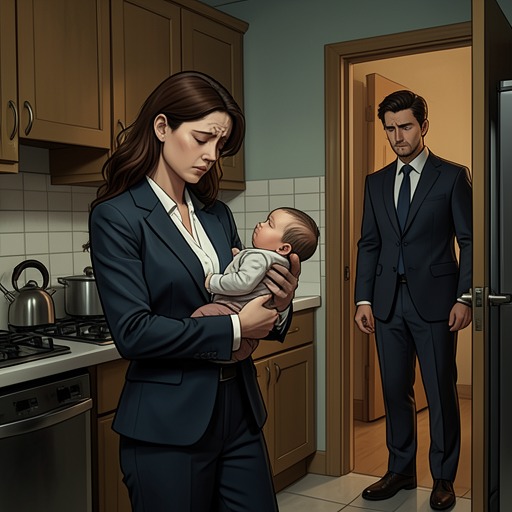
After a few minutes, a nurse returns carrying the baby and addresses Kazumi and Yohan as Mrs. and Mr. Laroses. Yohan takes the newborn in his arms and remains overwhelmed that their child has finally been born. He discusses the proposed name, Yoshiro Kenzie, with the baby, linking the clinical event of birth to the family identity being formed around it. When he notices that the baby has Kazumi’s lips, he brings the child to her, and Kazumi smiles at the sight. Hospital therefore does more than complete a pregnancy plotline: it makes parenthood visible through touch, recognition, and the first shared response to the infant.
Newborn Care and Family Formation
The nurse’s instructions place the newborn within a sequence of ordinary medical care. Breastfeeding can begin, after which the baby receives a vitamin K shot and eye drops, has measurements and footprints taken, undergoes screening tests, is examined by a pediatrician, and may receive a first bath before discharge. These details broaden Hospital’s function beyond crisis intervention. The same institution that treated Kazumi’s bleeding now supervises the child’s transition into life outside the womb, recording the infant’s body and checking its health through standardized procedures.
The handover to Kazumi also completes the movement from assisted birth to parental care. Yohan first holds and plays with the baby while Kazumi rests, then gives the child to her when the nurse says that breastfeeding may begin. His question about whether she knows how to breastfeed introduces care as a practical responsibility rather than an abstract promise. The hospital scene thus gathers together the consequences of the earlier pregnancy: Yohan and Kazumi are no longer only people responding to an unexpected conception, but parents learning how to hold, feed, name, and protect their child.
Medical Space as Narrative Threshold
Across its appearances, Hospital contains the story’s sharpest reversals. Kazumi arrives carried by Yohan, bleeding and covered with wounds; the doctor confirms that the baby has survived. Later, she endures labor while Yohan remains beside her, and the child is returned to them after birth for feeding and examination. The progression connects emergency care, recovery, delivery, and newborn assessment in one institutional frame, making bodily vulnerability the mechanism through which relationships and obligations become undeniable.
The setting also exposes the limits of private interpretation. Pregnancy begins in confusion about a drunken night and the absence of a condom, while Zhara’s positive test and Vixon’s refusal to take responsibility show how reproductive consequences can be denied or displaced. In Hospital, however, bleeding, fetal survival, labor, and newborn procedures are presented through observable bodily conditions and professional statements. The doctor’s reassurance that the baby is strong does not erase the violence surrounding Kazumi’s admission, but it establishes a fact the characters must act upon. Hospital is consequently the novel’s clearest space of witnessing: it converts rumor and fear into medical evidence, turns injury into a demand for accountability, and culminates in the child whose arrival reorganizes the characters’ future.