Kazumi's unrequited love for Yohan
The Beki CEO Got Me PregnantKazumi's unrequited love for Yohan is a private attachment that becomes decisive precisely because Yohan does not recognize it as genuine. Her longing survives beneath jokes, flirtatious lines, and the ordinary intimacy of their companionship, while Yohan interprets those signals as play. When she finally asks whether marriage or the passage of time might give him a chance to love her, his refusal confirms that the relationship she imagines cannot be reciprocated on the terms she desires. The result is not only romantic disappointment but a deliberate retreat from the emotional habits that have defined their closeness.
Identity and Emotional Conditions
Kazumi's feeling is presented as romantic hope rather than a casual infatuation. She asks Yohan directly whether he might love her someday if they were married or eventually became husband and wife, revealing that she has attached her hope to both the future and the institution of marriage. Her question is anxious but purposeful: she is testing whether the relationship has any possible path beyond friendship. Yohan's repeated shake of the head gives the answer a finality that wounds her more deeply because she had allowed herself to expect a different future.
The asymmetry of the attachment is sharpened by Yohan's explanation of his sexuality. He says that he cannot love a woman, that he is capable of loving men, and that a woman flirting with him produces disgust while a man flirting with him produces excitement. He can therefore treat Kazumi only as his best friend. His statement is not framed as a temporary hesitation or an uncertainty about Kazumi personally; it defines a boundary he believes cannot be crossed. Kazumi's pain comes from loving someone whose emotional and sexual orientation makes the desired return unavailable, not from a simple failure of timing.
Hope, Misrecognition, and the Broken Promise
Yohan has not taken Kazumi's repeated declarations of love seriously. He treats them as jokes, even when she says that she likes him, because their established promise forbids either of them from falling in love. In his reading, the promise is protected by the assumption that they are incompatible: he is gay and she is a woman. Their joking language lets him preserve the relationship as safe friendship, but it also erases the seriousness of Kazumi's desire. The same words that allow him to remain comfortable become, for Kazumi, evidence that he has never truly seen what she means.
Yohan's confidence that Kazumi will not break their promise intensifies the misrecognition. He believes her feelings are contained by the rules of friendship; Kazumi knows that she has already crossed the emotional boundary those rules were meant to protect. The promise functions less as mutual protection than as a structure that prevents her from confessing without threatening the relationship. Her love is therefore trapped between disclosure and concealment: speaking plainly could make Yohan withdraw, while remaining silent leaves her hope alive and uncorrected.
Withdrawal and Private Grief
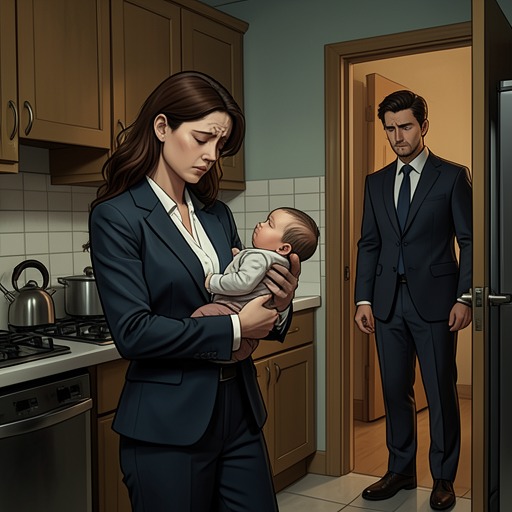
After Yohan's refusal, Kazumi leaves the kitchen, goes to her room, locks the door, and releases the tears she had been holding back. The locked room gives her grief a physical boundary. In private, she calls herself foolish for hoping that someone unable to love her could love her in return, turning disappointment inward rather than blaming Yohan. Her response is not an outward confrontation but a retreat into self-reproach, secrecy, and controlled silence.
Her fear extends beyond rejection. She worries that Yohan would distance himself from her or feel repelled if he learned the truth, and she does not want them to fight again. This makes the attachment a pursuit-and-withdrawal pattern: she wants emotional recognition, yet the danger of losing Yohan causes her to suppress the very feeling she wants him to understand. Her decision is explicit in its sacrifice. She resolves not to force him, asks only that he not avoid or reject her, and promises herself that she will stop allowing herself to love him.
That decision changes her visible behavior. She no longer asks Yohan to buy Mamon, stops using pick-up lines on him, and loses the energetic manner that had marked their interaction. These small habits had been comic forms through which her affection could circulate without being named. Removing them does not restore emotional neutrality; it exposes the cost of trying to extinguish the attachment. Her silence is therefore legible as a change in the relationship, even though Yohan is not initially given the full explanation.
Wedding Pressure and Narrative Significance
The timing makes Kazumi's unrequited love especially severe. Only three days remain before the wedding, yet more than a week has passed with no restoration of her former manner toward Yohan, despite his efforts to court or coax her back into conversation. The approaching marriage does not resolve the emotional contradiction. Instead, it compresses the interval in which Kazumi must live beside the person she loves while accepting that he does not love her in the same way.
Kazumi also recognizes that suppressing the feeling is becoming harder. After crying through the night, she whispers that Yohan should stop making it more difficult for her to drive away what she feels for him. The line reveals the central paradox of the state: Yohan's attempts to regain their former closeness may comfort him, but they keep Kazumi emotionally attached. Her love is not defeated by his refusal; it is forced underground, where every familiar gesture can reactivate it.
The state consequently gives the surrounding relationship its emotional tension. Yohan's insistence on friendship preserves his understanding of himself and of their promise, while Kazumi's concealed love turns that same friendship into a source of recurring pain. The narrative does not portray her withdrawal as proof that the feeling has ended. It portrays it as an act of self-protection undertaken because the attachment remains powerful, because the truth feels dangerous, and because the wedding leaves little room for an uncomplicated retreat.