Kazumi's pregnancy
The Beki CEO Got Me PregnantKazumi's pregnancy is the decisive state linking an unexpected intoxicated encounter to the later formation of a family with Yohan Xyle Laroses. It first appears as a frightening possibility after the two spend Yohan's birthday at a five-day resort stay, become heavily drunk, and are brought to a bedroom after Yohan is dared to kiss the person in front of him. Yohan believes he is kissing Vixon Rae, but the person is Kazumi, and Kazumi returns the kiss. Because the encounter occurs without a condom and while both are not thinking clearly, the pregnancy carries both physical consequences and an unresolved question of responsibility. What begins in confusion eventually becomes the basis for cohabitation, shared prenatal care, marriage, and the birth of their son.
Origin in the Unexpected Night
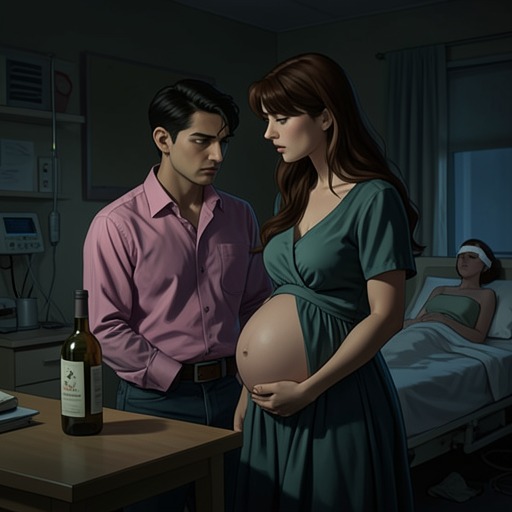
Kazumi's pregnancy is traced to the night when the resort group has been drinking for roughly four hours and everyone is already drunk. During a truth-or-dare game, Yohan accepts a dare to kiss the person in front of him. Kazumi is seated there, heavily intoxicated herself, and Yohan mistakes her for Vixon Rae. The kiss deepens, Kazumi kisses him back, and the others escort them to a bedroom while they continue kissing. The account later given by Henderson indicates that the pair kept making out after being left alone, although neither can fully remember what happened. The absence of a condom becomes an immediate practical concern, while the story also presents the encounter as an unintended consequence of alcohol, mistaken identity, and impaired judgment rather than as a planned beginning to a family.
Kazumi recognizes the pregnancy as emotionally dangerous because she believes Yohan may still be angry with her and may misunderstand her actions. She hopes that, if she is pregnant, he will not reject either her or the child. The pregnancy therefore carries a double uncertainty: Kazumi does not know whether Yohan will accept the fatherhood implied by the event, and she does not know whether their long friendship can survive the change from assistant and employer to co-parents. Her remark that they are both twenty-nine and old enough for pregnancy acknowledges adult readiness while preserving the event's accidental character.
Discovery and Disclosure
The pregnancy becomes visible first through illness. Three weeks after Yohan's birthday and the night at the resort, Kazumi repeatedly vomits at the office, returning again and again to the restroom in a way she has never experienced before. Yohan watches her suspiciously, making the workplace an uncomfortable setting in which bodily evidence begins to expose what Kazumi has not yet said. Rather than relying on the symptoms alone, she goes to an empty restroom, uses a pregnancy test, and waits five minutes for the result.
The test shows two lines. Kazumi identifies herself as pregnant and knows that Yohan is the father. The discovery changes the pregnancy from a private fear into an obligation to speak. In her point of view, she decides that Yohan must be told even if he sends them away, because the information belongs to him as the child's father. She then shows him the pregnancy test and states that she is pregnant. Yohan is stunned and turns pale, making his first reaction one of shock rather than immediate reassurance.
His response nevertheless establishes the direction of the pregnancy's future. Yohan tells Kazumi that he will take responsibility for her and instructs her to live in his house for the time being. The pregnancy thus changes their domestic arrangement almost immediately. It also converts the authority of the successful company boss and assistant relationship into a shared private problem, requiring Yohan to respond not only to Kazumi's condition but to the child whose existence is now confirmed.
Bodily Progression and Concealment
The pregnancy is narrated through successive bodily milestones. At seventeen weeks, Kazumi has a noticeable but still modest bump, and she and Yohan attend check-ups together. The pregnancy remains hidden from Vixon Rae for the time being, so medical care and secrecy develop side by side. Yohan's presence at the appointments makes responsibility concrete: he is not merely acknowledging the pregnancy verbally but accompanying Kazumi as the fetus is examined and judged healthy.
The pregnancy also produces ordinary but disruptive cravings. After one check-up, Yohan reports that the baby is healthy and complains that Kazumi's cravings wake him in the early morning. On one such night, she wants Goldilocks mamon badly enough to wake him and send him out while the shop is still open. The comic complaint gives the pregnancy a recurring domestic texture, but it also shows how the condition reorganizes Yohan's time and habits. Care appears through inconvenience, with irritation and practical compliance existing together.
As Kazumi's abdomen grows, Yohan stops allowing her to work. She remains at home, spending her days resting and eating, while she resents the loss of her job and independence. When she does enter the company, she wears oversized clothes so Vixon Rae will not notice the increasingly obvious bump. The pregnancy therefore creates two forms of restriction at once: Yohan's protective prohibition removes Kazumi from work, while the secrecy policy forces her to disguise the body that makes the pregnancy progressively harder to conceal.
At twenty-one weeks, Yohan embraces Kazumi from behind while they lie down and rubs her abdomen. He comments on how large it has become and asks how many weeks have passed. The gesture marks a change from the pregnancy as an external responsibility to a shared bodily reality. Later, a strong kick makes Kazumi wince, and Yohan asks whether it hurts; when she confirms that the kick is powerful, he imagines the pain and reacts sympathetically. These moments give the fetus an active presence in their relationship before birth, making the child a participant in their developing intimacy.
From Responsibility to Family
Two months later, Kazumi and Yohan are described as much closer. They learn that the baby is a boy, and by then Kazumi is seven months pregnant with a much larger abdomen. The pregnancy has consequently moved beyond secrecy and crisis into anticipation. Although they still have no news about Vixon Rae, their shared attention is directed toward the child and toward the household they are building together.
Yohan's sudden proposal is explicitly connected to the child's future rather than initially explained as a declaration of romantic love. He says he does not want their child to be hurt or to wonder why a person they love is present in their lives without being known. He also frames marriage as a way to stand firmly behind his responsibility as a parent, jokingly calling himself the child's mother. Kazumi laughs at the joke but is saddened because she had expected the proposal to mean that Yohan loved her. The pregnancy therefore exposes a gap between legal or parental commitment and romantic interpretation, even as it brings the pair closer.
The marriage ceremony gives the pregnancy an institutional consequence. Kazumi is asked to take Yohan as her lawful husband, and she accepts him, promising fidelity, love, and honor through good times and bad, sickness and health. The ceremony uses conventional marital language while the surrounding relationship remains marked by unusual gendered terms and identities. Yohan is a gay man who continues to dress, wear makeup, and present himself femininely, yet he enters the role of spouse and parent without the narrative treating those aspects as mutually exclusive. The pregnancy thus helps move the couple into marriage while also revealing that marriage, parenthood, gender expression, and sexual identity do not align into a single conventional pattern.
Birth and Lasting Significance
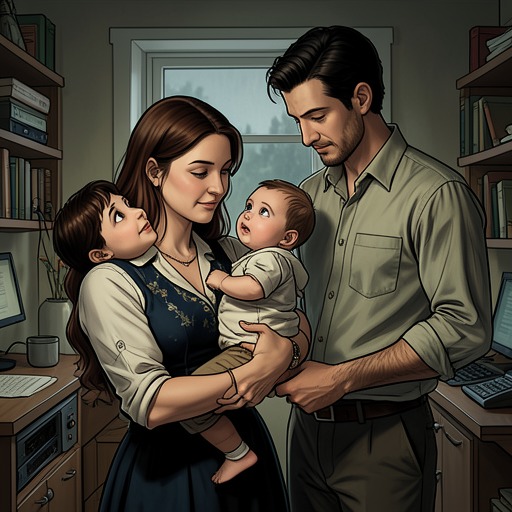
The pregnancy culminates in childbirth after prolonged labor and loud screams. When the baby finally emerges, Kazumi's cries are replaced by the baby's crying. A nurse cuts the umbilical cord, and Yohan looks at the newborn wrapped in a towel with overwhelming happiness. The nurse later places the baby in Yohan's arms and addresses both parents as Mr. and Mrs. Laroses, formally recognizing the family produced through the pregnancy. The newborn is to be breastfed and receives the routine early care described by the nurse, including a vitamin K shot, eye drops, measurements, footprints, screening tests, pediatric examination, and a first bath.
The pregnancy's consequences continue long after birth. Ten years later, Yohan and Kazumi are still married and have grown into a lasting family relationship. Their child does not regard Yohan's continued dressing, makeup, and feminine self-presentation as wrong; instead, Yohan is accepted as being true to himself. The pregnancy therefore has significance beyond its biological result. It is the narrative mechanism through which an accidental and morally complicated night becomes sustained co-parenthood, a marriage, and a family capable of holding together Yohan's homosexuality, his gender expression, Kazumi's role as wife and mother, and the child's acceptance of both parents.
In structural terms, Kazumi's pregnancy turns delayed consequences into the central measure of the couple's development. The birthday-party intoxication creates immediate uncertainty; the pregnancy test makes the hidden result undeniable; medical appointments and bodily changes make responsibility repetitive rather than symbolic; and birth transforms responsibility into attachment. The state is initially associated with fear, nausea, secrecy, and the possibility of rejection, but it gradually becomes associated with care, domestic closeness, legal commitment, and a shared future. Its decisive force lies in that reversal: the pregnancy does not simply add a child to the story, but compels Yohan and Kazumi to redefine every relationship around them.