Marriage for the Sake of the Child
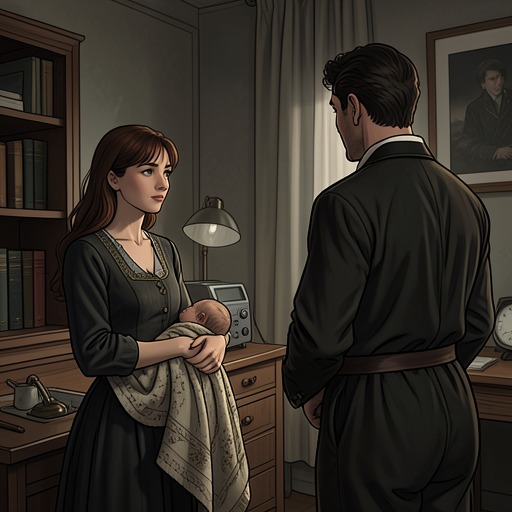
The Beki CEO Got Me PregnantMarriage for the Sake of the Child describes the central family arrangement between Yohan Xyle Laroses and Kazumi Lhynx Valeres: they marry because they believe their child should grow up with a stable, visibly shared family rather than wonder why the parents are unmarried or why each later has a separate romantic partner. The decision is explicitly framed as parental responsibility, but its consequences exceed that original purpose. Marriage, cohabitation, childbirth, and daily care gradually give form to a relationship that the characters initially describe as friendship and responsibility before it becomes romantic love.
Definition and Background
Marriage for the Sake of the Child emerges from Yohan's anxiety about the future rather than from a conventional proposal scene of mutual romantic confession. Yohan has long identified as gay, and Kazumi introduces him as her only boss while openly presenting his sexuality as his own choice rather than a public matter for others to judge. Their history, however, is intimate and unusually durable: they first met in sixth grade, remained best friends through college, separated after graduation, and later became employer and assistant when Kazumi needed work after the restaurant where she had been a waitress closed. Their established trust gives the later marriage a foundation, but the narrative initially distinguishes that bond from romantic love.
The immediate pressure is the child they are expecting. Yohan imagines the child growing up confused or hurt if the parents remain only best friends while each eventually brings an unfamiliar loved one into the household. His reasoning is shaped by films in which children suffer from the way unmarried parents treat one another, and he focuses less on social prestige than on preventing the child from experiencing that kind of emotional uncertainty. The thought becomes an ethical obligation: he does not want the child to ask why the parents are not married or why the family contains people the child does not know.
The Decision and Its Stated Terms
After hours of thinking on the sofa, Yohan makes up his mind to marry Kazumi for the sake of their child. The decision is therefore a value shift from uncertainty to commitment, but not yet from friendship to declared romantic attachment. It is also a deliberate attempt to separate the duties of parenthood from the question of desire. Yohan does not claim that he has suddenly ceased to be gay or that marriage proves an immediate change in his identity; instead, he treats marriage as a structure capable of organizing care, responsibility, and the child's sense of security.
Kazumi later asks directly whether Yohan married her because he loved her. Yohan shakes his head, and the answer hurts her because she had expected the sudden proposal to mean that he loved her. He explains that he wants to protect their child from the confusion he had already described and that marriage will help him properly uphold his responsibility as a parent. He jokingly calls himself a mother, and Kazumi laughs at the comic wording, but the humor does not erase her disappointment. The scene preserves the arrangement's original asymmetry: Yohan presents marriage as responsible parenting, while Kazumi has emotional expectations that the stated terms do not satisfy.
Marriage as Domestic and Legal Practice
The arrangement becomes concrete through shared material preparation. Yohan buys supplies for their child, including a crib, and tells Kazumi that he will have an extra room on the third floor converted into the baby's room. These purchases and renovations make parenthood visible before the ceremony: responsibility is expressed through objects, space, and preparation as much as through promises. The family is being built in the mansion before the marriage is fully enacted, and the domestic setting gives the abstract phrase “for the sake of the child” an everyday infrastructure.
At the ceremony, the legal and ritual language places Yohan and Kazumi into conventional marital roles. The officiant asks Kazumi whether she takes Yohan as her lawful husband, and she responds by accepting him as her husband and promising fidelity, love, and honor in good times and bad, in sickness and health. The exchange creates a formal identity that sits alongside the more complicated identities already present in the story. Yohan's sexuality, Kazumi's expectations, and their parental obligations are not made identical by the ceremony; instead, the marriage becomes the institution through which those elements must coexist.
The same tension appears in their use of domestic titles and roles. Yohan's language about being a parent, including his joking insistence that he can be called a mother, makes gendered family vocabulary playful and unstable. The ceremony nevertheless retains the conventional husband-and-wife framework, producing a contrast between institutional terminology and Yohan's feminine gender expression. The marriage thus both uses a familiar family form and unsettles the assumption that marital roles automatically reveal a person's gender identity or sexual orientation.
Cohabitation, Birth, and Shared Parenthood
The marriage becomes a working partnership after the baby is born. When Kazumi gives birth, her screams are replaced by the baby's crying, and Yohan reacts with overwhelming happiness as he sees and holds their child. The nurse addresses them together as Mrs. and Mr. Laroses, confirming them publicly as a married parental unit. That moment joins the legal promise to a physical event: the child whose future motivated the marriage is now present, and the couple's responsibility is no longer hypothetical.
Their care arrangement is deliberately shared. Yohan and Kazumi decide to sleep in the same room so that both can monitor the baby when the child cries at night. They move the crib into their bedroom, take turns helping with nighttime crying, and accept the exhaustion and sleep deprivation as part of caring for the child together. This is the practical fulfillment of Yohan's stated objective. Marriage does not merely give the child a formal family name; it produces a routine of joint vigilance in which both adults are accountable for the infant's welfare.
The family structure continues through the child's infancy. At eight months old, Kenzie crawls toward Yohan while Yohan spends his day off playing with the child and making time for Kazumi as well. The scene is set eight months after Vixon Rae's death, placing the family's continuing domestic life against an earlier loss without making grief the sole definition of the household. The parental arrangement has become an enduring pattern of affection, play, and presence rather than a temporary legal solution.
From Responsibility to Love
The most important reversal is that the marriage does not remain limited to its stated purpose. Ten years later, Yohan and Kazumi are still together and are described as deeply in love. They have met each other twenty years earlier, married ten years earlier, and, by that later point, have allowed the relationship to develop beyond Yohan's original insistence that he loved Kazumi only as a best friend. The chronology makes the marriage a delayed-romance structure: responsibility comes first, emotional recognition later.
Their intimacy is shown through ordinary dependence rather than another grand declaration. Kazumi gives Yohan a small household instruction to fetch Mamon while he is lying with his head on her lap; he gets up, brings the food, and returns to her lap. The gesture is domestic and reciprocal, presenting the long-term marriage as a settled rhythm in which affection is embedded in minor acts of care. The scene's force comes from the contrast between the original premise of a marriage without romantic love and the later description of a couple who remain passionately in love.
The later family also accepts Yohan's continuing self-expression. At thirty-eight, he still dresses, wears makeup, and beautifies himself, although his planned sex-change operation and breast augmentation did not happen; he decides to keep his penis because he believes removing it might bring bad luck. The narrative states that Kenzie sees nothing wrong with this and that Yohan is simply being true to himself. Marriage and parenthood therefore do not require Yohan to abandon his gay identity, feminine presentation, or bodily autonomy. Instead, the family becomes a space in which those features remain visible alongside his roles as spouse and parent.
Narrative and Social Significance
Marriage for the Sake of the Child presents marriage as both a protective institution and an incomplete explanation of intimacy. Yohan initially treats it as a solution to a parental problem: a way to prevent confusion, coordinate responsibility, and spare the child the pain he associates with fractured family relationships. The narrative validates the seriousness of that concern through the crib, the prepared bedroom, the ceremony, the birth, and the shared nighttime care. Yet it also shows that a family cannot be fully explained by its legal purpose. Kazumi's hurt at Yohan's answer exposes the emotional cost of entering marriage under a deliberately limited premise.
The concept is especially significant because it separates sexual orientation, gender expression, marital status, and parenthood instead of allowing one category to define all the others. Yohan is introduced as gay, continues to present himself in feminine ways, participates in a husband-and-wife ceremony, and becomes an attentive parent. The child accepts him without treating his appearance as a problem. This does not erase the conventional language of the ceremony, but it complicates what that language can mean: “husband” and “mother” become roles negotiated within a family rather than simple proofs of heterosexual identity.
Finally, the arrangement becomes a form of delayed emotional truth. Yohan's initial decision is not represented as a secret romantic confession; he explicitly denies that love is the reason for the proposal, and Kazumi experiences that denial as painful. Nevertheless, the years that follow transform the legal arrangement into a genuine partnership. By the ten-year point, the marriage has become more than a safeguard for Kenzie: it is the durable household in which Yohan and Kazumi live, care for their child, preserve their individual identities, and love one another. The original “for the sake of the child” therefore remains true as a starting motive while becoming insufficient as a description of what the marriage ultimately is.