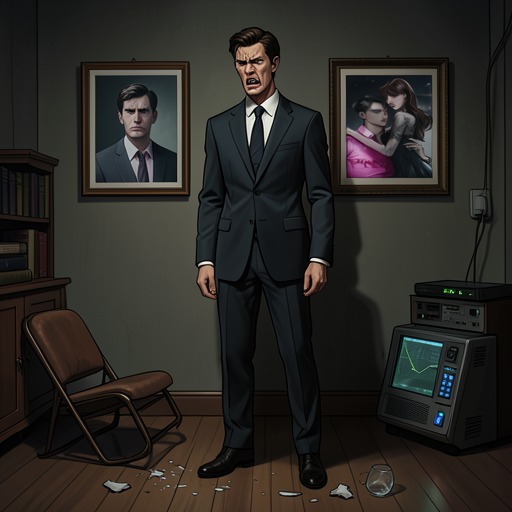
Vixon Rae Herrares
The Beki CEO Got Me PregnantVixon Rae Herrares enters the story as a familiar name and an immediately recognizable source of fascination. Kazumi Lhynx Valeres, Yohan Xyle Laroses’s assistant and longtime friend, reacts with delighted shock when she learns that Vixon is seeking work. Her excitement is partly rooted in Vixon’s reputation and appearance, but his arrival also carries the charge of a past connection re-entering the carefully organized world of Yohan Xyle’s Company.
Identity and Introduction
Vixon is introduced through other people’s reactions before he fully explains himself. Kazumi recognizes his name with dramatic excitement, while Yohan, conducting the interview, struggles to conceal how handsome he finds Vixon. The interview places Vixon inside a company already shaped by Yohan’s authority and Kazumi’s close personal bond with the boss. Vixon’s request for an available position therefore becomes more than an ordinary application: it creates a new point of pressure within an existing friendship and workplace hierarchy.
The company’s scale and prestige make Vixon’s appointment consequential. Kazumi describes it as the most successful and famous company in the country, with Yohan as her only boss. Vixon is not presented as an isolated outsider for long; once hired, he becomes part of a network involving the CEO, assistants, workers, drivers, and private household relationships. His position gives him access to Yohan’s attention and to information about the tensions surrounding Yohan and Kazumi.
Manipulation and Deception
Vixon’s defining early action is the deliberate manipulation of Yohan. He notices that Yohan is treating Kazumi harshly and directly tells Kazumi that he knows she has noticed Yohan’s rudeness, prompting her to ask whether he is involved. This intervention presents Vixon as perceptive and possibly sympathetic, but later evidence reveals that his apparent insight is a tool rather than a form of loyalty.
Vixon privately admits that he deceived Yohan about a painting associated with Zhara. He allows Yohan to believe that he and Zhara created the painting together, although he actually bought it and had sex with Zhara instead of working on the artwork. The deception is paired with contempt: Vixon treats Yohan as easily fooled and expresses no willingness to make an effort for him. His manipulation is therefore both practical and humiliating, designed to preserve his access to Yohan while concealing a betrayal.
He also weaponizes fragments of conversation. Vixon sends Yohan a discussion involving Kazumi, encouraging Yohan to believe that Kazumi and her friend were talking about him. In reality, their conversation concerned Kazumi’s friend. By changing the apparent object of the conversation, Vixon turns an ordinary exchange into evidence of disloyalty. The episode establishes his preferred method: he does not need to invent every fact when a selective disclosure and a false implication can produce the desired reaction.
Pregnancy and Refusal of Responsibility
Vixon’s relationship with Zhara becomes an overt crisis when Zhara tells him that she is pregnant and identifies him as the father. Vixon reacts with panic and anger, recognizing that he has impregnated her but treating the pregnancy as an unwanted burden rather than a shared responsibility. His response exposes the gap between his confidence when manipulating others and his helplessness when confronted with consequences belonging to him.
His refusal hardens into direct hostility. When Zhara presses him to take responsibility, Vixon tells her that he does not care about her and rejects any obligation toward the child. The conflict occurs while Yohan and Kazumi are arriving at the company and hearing the pair shouting, turning Vixon’s private conduct into a public workplace disturbance. His financial behavior intensifies the contradiction: although he receives a substantial salary from Yohan, he claims to have exhausted it on expensive medicine and still asks Yohan for five thousand, leaving Yohan suspicious of the amount spent and the truth of Vixon’s explanations.
Vixon’s pregnancy crisis also exposes his attempt to control what others are allowed to know. Yohan orders the workers not to tell Vixon that Kazumi is pregnant, and they obey. Kazumi therefore works while wearing ordinary rather than oversized clothing, making her large abdomen visibly apparent to others but still hidden from Vixon. The secrecy reverses Vixon’s earlier advantage as an information broker: the person who once shaped Yohan’s understanding through selective revelations is himself kept outside a crucial truth.
Workplace Power and Escalating Conflict
Vixon’s employment gives Yohan several ways to respond to his conduct without immediately severing the relationship. Yohan considers moving him from the sixth-floor office to a vacant room on the eighth floor, a seemingly administrative decision that functions as a disciplinary relocation. The proposed move separates Vixon from the shared office space occupied by Yohan and Kazumi and marks a change in how much access and proximity Vixon is permitted.
The office arrangement also reveals the entanglement of private feeling and formal power. Yohan manages schedules and meetings while Kazumi handles his schedule and Vixon attends meetings, but Vixon’s place in that structure is unstable because personal betrayal has entered the company’s operational life. Even ordinary matters, such as driver shortages when Nestor is ill and Yohan must find another driver, occur against the background of a workplace where staffing, trust, and private conflict are inseparable.
Vixon’s eventual behavior moves beyond manipulation into physical threat. He enters Yohan’s home or its surrounding domestic space carrying a gun taken from police and demands that the household staff reveal Yohan’s location, threatening to shoot them if they refuse. The scene transforms his earlier verbal aggression into armed coercion. His inability to obtain an answer does not restore his control; instead, the threat demonstrates how far his resentment and desperation have escalated.
Character Function and Thematic Significance
Vixon is written as a volatile counterforce to the developing bond between Yohan and Kazumi. Yohan’s attachment to Kazumi becomes more protective and intimate, while Vixon repeatedly exploits uncertainty, spreads misleading information, and converts access into leverage. His presence tests whether Yohan will continue to reward charm and proximity or will recognize the difference between loyalty and performance.
The character also complicates the story’s treatment of identity and gender expression. Yohan is openly identified as gay, and the narrative later shows him dressing, applying makeup, and expressing himself femininely while remaining accepted by his child as true to himself. Against that broader insistence that identity should not be reduced to social expectation, Vixon represents a different kind of instability: not gender nonconformity, but the deliberate fracture between public presentation and private action. His attraction, charm, and professional role do not guarantee ethical integrity.
Vixon’s trajectory is consequently less a heroic journey than an episodic descent through opportunities repeatedly converted into damage. He begins with employability, beauty, and social access; he then uses those advantages to mislead Yohan, conceals his sexual betrayal, rejects Zhara’s pregnancy, and finally threatens domestic workers with a firearm. The contrast with Yohan and Kazumi’s later marriage, shared parenting, and enduring acceptance of one another makes Vixon’s refusal of responsibility especially stark. He is significant not merely because he opposes the central pair, but because his actions give the story a sustained example of intimacy severed from accountability.