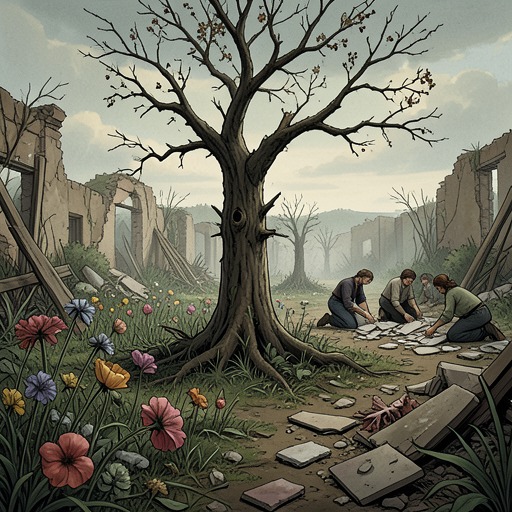
Yohan's Garden
The Beki CEO Got Me PregnantYohan's Garden is the private garden owned and cultivated by Yohan, a place whose meaning changes as sharply as the story around it. It begins as a spacious, clean, convenient extension of Yohan's company, but its flowers and accumulated memories make it personally irreplaceable. The garden is later destroyed by a bombing and eventually restored, allowing it to reappear not as an untouched refuge but as a repaired site where romance and family life can be consciously remade.
Setting and Ownership
Yohan's Garden belongs to Yohan and lies close to his company, making it an immediately practical location for gatherings as well as a personal retreat. When Yohan's workers discuss where to hold an event, Henzy proposes the garden because it is large, clean, and nearby. Yohan sits at the center and listens while the workers offer suggestions, asking Vixon to take notes. After four hours of discussion, they agree to hold the event there the following week, with the workers taking responsibility for the design. The scene establishes the garden as an accessible communal space: private property, but sufficiently open for the company to imagine using it together.
Its importance, however, exceeds convenience. Yohan has planted and cared for many flowers there, and the garden contains a dense store of memories. Its value is therefore simultaneously material, emotional, and relational. It is attached to Yohan's labor, his sense of ownership, and the experiences he associates with the people closest to him. The garden's proximity to the company also gives it a threshold quality, joining Yohan's public working world to the more intimate spaces of his life.
Destruction and the Threat of Repetition
The garden's apparent safety collapses when Yohan learns through Facebook that it has been bombed. He leaves the mansion without telling Kazumi, drives urgently to the site, and finds it badly wrecked and surrounded by caution tape to keep people out. Because there are no CCTV cameras in that part of the garden, identifying the perpetrator will be difficult. The damage immediately becomes a public subject as well as a private wound, promising another wave of questions from the gossiping public around Yohan.
No one is injured, so the bombing is not treated as a human casualty event, but the absence of bodily harm does not make the destruction emotionally minor. Yohan is saddened by the loss of the place where he planted and tended flowers and where he stored so many memories. His return to the car is dispirited, and the unresolved question of the culprit shadows the garden's physical ruin. He suspects Vixon, turning the site into a material trace of the hostility and danger surrounding Yohan's relationships.
The bombing also reveals a more frightening counterfactual. A date was originally supposed to take place in the garden. Yohan changed the location before the plan was carried out, and that decision may have saved the lives of everyone who would have been present. Had he not changed his mind, he believes they would have died, while the resulting public scrutiny would have added another layer of crisis. The garden thus becomes a place where romance, memory, and lethal threat occupy the same ground; its destruction retrospectively changes the meaning of an apparently ordinary change of venue.
Restoration and Romantic Reinscription
Yohan's Garden is eventually rebuilt. When Yohan prepares a proposal for Kazumi, he deliberately chooses the restored garden as the setting, even acknowledging that it is beautiful again but not as beautiful as it had been before the bombing. That qualification matters: restoration repairs the space without erasing its history. The rebuilt garden carries the memory of violence, and the possibility of another bomb remains sufficiently present for Yohan to joke anxiously about it. The proposal therefore takes place within recovery rather than innocence.
The renewed setting is designed to echo an earlier date while surpassing it in effort and romantic intention. Yohan brings Kazumi to the garden without revealing the plan. As they arrive, Kazumi appears amazed by the lights and designs, though the full arrangement is still hidden from view. Once Yohan opens the gate, hearts, flowers, balloons, and lights surround them, with a large heart-shaped balloon positioned in front of them. The scene repeats the garden's earlier romantic association, but the greater number of decorations and the greater effort invested in the occasion transform repetition into a deliberate act of reclamation. Yohan takes a place once threatened by death and makes it serve a promise of continued intimacy.
Family Life and Narrative Significance
Later, Yohan's Garden functions as a family space rather than only a romantic one. While Yohan plays with Kenzie, Kazumi watches the father and child; Kenzie does not respond to Yohan, creating a small moment of comic distance within the domestic scene. The garden is no longer defined solely by Yohan's private memories or by the danger attached to Vixon's suspected attack. It becomes part of the family's ordinary emotional landscape, capable of holding play, observation, and the uneven gestures of parent-child closeness.
The same domestic continuity appears when the family goes to the garden for a picnic. They spread a picnic blanket, take food from a picnic basket, and remain among the flowers while the wind blows strongly enough to carry Yisha's hair. Yisha asks Kazumi to tie it back, and Kazumi does so. This quiet act gives the restored garden a new scale of meaning: after serving as a corporate meeting place, a damaged crime scene, and a proposal setting, it becomes a place for caregiving and shared routine.
Across these appearances, Yohan's Garden records a movement from possession to communal belonging, from destruction to repair, and from threatened romance to sustained family life. Its flowers are not merely decorative background. They embody Yohan's investment in care, while the bombing makes visible how exposed that care is to violence and suspicion. The restored garden cannot return to its former untouched state, yet that loss gives later scenes their force. Every light, heart, picnic, and gesture of care takes place against knowledge of what the garden survived, making it one of the book's clearest physical expressions of memory, vulnerability, and renewal.