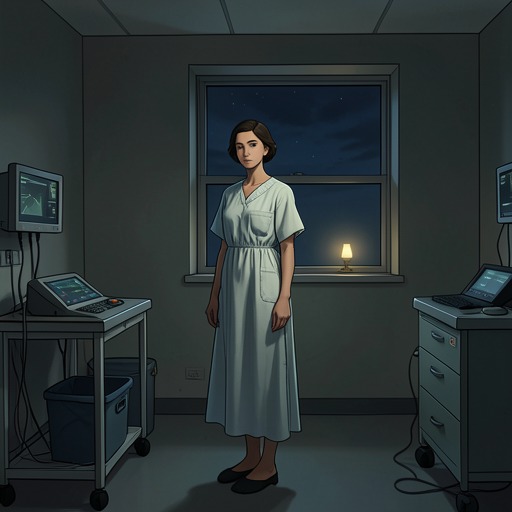
“I am, I am, I am”
The Bell Jar“I am, I am, I am” is a recurring refrain through which Esther Greenwood registers her continued existence at moments shadowed by suicide and death. Its return changes the words from a bare declaration into an insistence: life persists, even when Esther has recently tried to end it and is later confronted with another person’s death.
A refrain at the edge of death
While swimming, Esther thinks she will continue outward until she is too tired to swim back. Her heartbeat booms in her ears, and the refrain interrupts this movement toward exhaustion. Its stark repetition gives no explanation or promise of recovery; it records, with almost bodily immediacy, that she is still alive. The words recur in the same passage as Esther’s account of her attempt to hang herself that morning, when she took the silk cord from her mother’s yellow bathrobe and struggled to fashion a knot. The juxtaposition makes the refrain an assertion against a recent, concrete intention to die.
Return after Joan’s death
The expression returns near the end of the novel after Joan’s funeral. Esther imagines the cemetery lawn buried in snow, a six-foot grave cut into the hard ground, and the yellowish local soil eventually covered by another snowfall. Against this image of burial and erasure, she takes a deep breath and listens to what she calls the old brag of her heart: “I am, I am, I am.” The recurrence links the earlier swimming scene to the later funeral, but its setting has changed. What first sounded amid Esther’s own immediate peril now resounds beside Joan’s death and the thought of a grave.
Form and significance
The refrain’s force lies in its repetition and its plainness. It does not claim that Esther’s suffering has ended or that survival is assured; instead, breath and heartbeat supply the evidence for each renewed declaration. Its return after Joan’s funeral places continued life beside loss without making the two equivalent. As a structural echo, the phrase gathers the novel’s confrontation with suicide into a brief verbal act of self-presence: Esther can say that she exists, even when death remains close in memory and imagination.