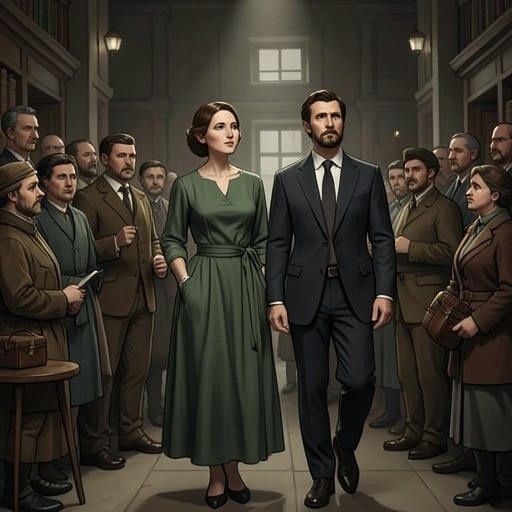
“What a man wants is a mate”
The Bell Jar“What a man wants is a mate” is the opening claim in a gendered formula that Buddy Willard repeatedly attributes to his mother. Its companion image casts a man as an arrow moving into the future and a woman as the place from which it is launched. Esther’s growing rejection of the formula makes it a compact expression of the traditional marriage roles she fears: a woman provides security and support while a man’s ambitions define the direction of their shared life.
The Saying and Its Paired Image
Buddy repeats his mother’s claims that a man wants a mate and a woman wants infinite security, then extends the formulation through the arrow metaphor. The parallel structure may sound like a division of complementary needs, but its images are unequal: the man travels toward the future, while the woman is assigned the stationary point that enables his movement. The language defines women through their relation to men rather than through independent ambitions of their own.
Esther’s Rejection of the Domestic Ideal
The saying gains force from the domestic life Esther associates with marriage. She imagines that being Constantin’s wife would mean preparing meals, washing dishes, and making the bed, then compares this prospect with the routine of Buddy’s mother, who spends her days cooking, cleaning, and washing despite having once been a private-school teacher and being married to a university professor. The example makes domesticity appear not as an incidental task but as a role capable of consuming a woman’s time and former identity.
Esther recalls Mrs. Willard braiding a rug from strips of her husband’s old suits. Esther admires its pattern of tweedy browns, greens, and blues, but Mrs. Willard puts it on the kitchen floor, where it soon becomes soiled and indistinguishable from a cheap mat. For Esther, the rug’s treatment gives physical form to the fate she fears for women after marriage: work and talent made ordinary, used up, and overlooked. She connects this image to her own mother’s experience after her honeymoon, when Esther’s father said that the couple could stop pretending and be themselves; Esther remembers her mother as having no peace thereafter.
Marriage, Motherhood, and the Cost to Writing
Buddy’s mother’s maxim that a man wants a mate is reinforced by his assurance that she still takes pleasure in his father, which he offers as proof that she knows what matters. Esther sees this defense as part of the same worldview that treats a woman’s satisfaction within marriage as evidence that the arrangement is right. Buddy also tells her that after having children she will feel differently and no longer want to write poems. Esther begins to imagine marriage and motherhood as a kind of brainwashing, leaving a woman numb and enslaved within a private world.
The saying therefore stands in direct tension with Esther’s ambition as a writer and with the years of achievement represented by her fifteen years of straight A’s. Rather than accepting the prescribed identity of a mate whose purpose is to provide security, she measures the ideal against its costs: repetitive labor, diminished autonomy, and the possible loss of poetry. The formula’s apparent symmetry cannot conceal that the future belongs to the man, while the woman is expected to make that future possible.