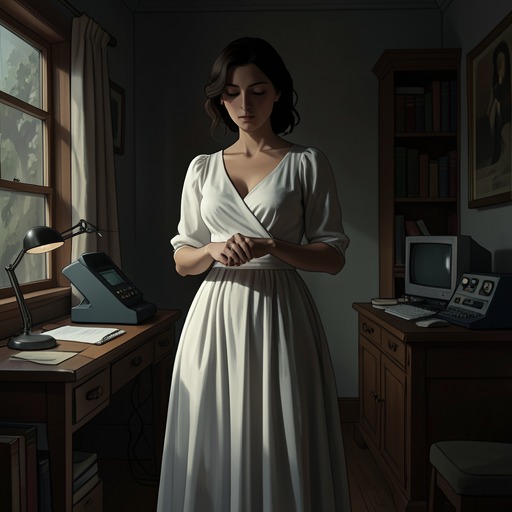
Buddy's sanatorium
The Bell JarBuddy's sanatorium is the Adirondack tuberculosis facility to which Buddy Willard is sent on a medical-student scholarship after an annual chest X-ray reveals that he has TB. Esther Greenwood visits him there, expecting a place shaped by illness but imagining its patients in a picturesque, almost romantic setting. The visit’s sickroom reality is subdued and awkward; recalled alongside Esther’s later psychiatric hospitalization, the sanatorium also marks a contrast between illness imagined from outside and treatment endured from within.
Diagnosis and the Visit
Buddy tells Esther by telephone that he has TB and will go to a sanatorium in the Adirondacks. He asks her to write at least once a week and visit during her Christmas vacation. Esther promises to write and expresses sympathy during the call, but afterward feels relief rather than sorrow. Her response makes the visit part of a larger emotional separation: Buddy’s illness does not restore the intimacy she has begun to relinquish.
Esther travels with Mr. Willard to see the place, uncertain what to expect. She pictures a wooden chalet on a small mountain, its attractive young patients lying beneath thick blankets on outdoor balconies, and recalls Buddy’s description of TB as a bomb in the lung that might go off while the patient lies still. This image is difficult to reconcile with Buddy’s habitual restlessness: even at the beach he ran, played ball, or did push-ups rather than lie quietly in the sun. The gap between his energetic character and the enforced stillness implied by his illness gives Esther’s imagined sanatorium a particular tension.
Interior and Reunion
The actual institution first appears through its reception room, where Esther and Mr. Willard wait for the afternoon rest cure to end. The room’s dark wood, burnt-brown leather chairs, damp-stained walls, and mottled brown linoleum make it feel oppressive rather than picturesque. On a low table lie wilted copies of Time and Life, their dark veneer marked by circular stains. A small fountain sputters from a rough pipe into a basin of yellowing water tiled like a public lavatory; its weak, collapsing trickle intensifies the impression of a place worn down by sickness and neglect.
A buzzer sounds, distant doors open and shut, and Buddy comes in. He greets his father, then approaches Esther with a conspicuously bright manner and offers his hand. She shakes it, registering that it feels moist and fat. The encounter gives her no easy return to the lively, vigorously healthy man she remembers: the patient appears within a routine of rest and institutional space, while their greeting remains formal and uncomfortable.
Family and Departure
Mr. Willard does not stay as Esther expects. He gives Buddy money and instructs him to make sure Esther has a comfortable seat on the train; she may stay a day or so. Esther feels deserted, but Buddy explains that his father cannot bear the sight of sickness, especially his son’s, because he regards illness as a sickness of the will. Mr. Willard, who has never been sick himself, leaves rather than remain with Buddy in the sanatorium. The departure exposes a sharp contrast between the patient’s physical illness and his father’s moral interpretation of it, while leaving Esther to sit on Buddy’s bed because there is nowhere else to sit.
Later Echo in Esther’s Treatment
The remembered sanatorium is not the site of Esther’s electroconvulsive treatment, but the novel’s later hospital scenes make it an important point of contrast. At Doctor Gordon’s institution, Esther is taken to a bare room with barred windows and doors, closets, and drawers fitted with keyholes. She lies on a bed as a nurse removes her watch and hairpins; Doctor Gordon brings in an electrical machine, and the nurse applies grease to her temples. Metal plates are strapped to Esther’s head, a wire is put between her teeth, and the shock arrives as a violent shaking accompanied by shrill noise and flashes of blue light. Afterward, Esther finds herself sitting with tomato juice, her watch fastened upside down and her hairpins displaced.
Esther later tells Doctor Nolan about the machine, the flashes, the jolting, and the noise. Doctor Nolan becomes still and says that the treatment was a mistake and was not supposed to happen that way. In a subsequent hospital visit, she accompanies Esther down a network of basement corridors connecting the buildings. They pass pipes, stretchers, and wheelchairs before stopping at a green door marked Electrotherapy. Esther hesitates, then agrees to go in; Miss Huey speaks soothingly, applies salve, fits small electric buttons at Esther’s temples, and tells her to bite down before the treatment blacks her out. These events occur at the psychiatric hospital, not at Buddy’s sanatorium. Read against Esther’s recollection of Buddy’s visit, they distinguish the illnesses and institutions rather than making them interchangeable: the sanatorium is the setting for Buddy’s TB and Esther’s uneasy visit, while the later treatment scenes reveal how profoundly Esther’s own experience of medical care is shaped by fear and by the difference between a harmful procedure and the treatment Doctor Nolan arranges.