Electroconvulsive Therapy Machine
The Bell JarThe Electroconvulsive Therapy Machine is the device through which the novel gives electroconvulsive treatment a frightening physical presence and exposes how much a patient’s experience depends on the people and procedures surrounding it. Esther Greenwood first encounters it in a locked room under Doctor Gordon’s authority, where the treatment becomes a traumatic assault in her perception. Later, as she faces another session with Doctor Nolan, she is still afraid of the machine, but receives a different kind of care. The device links those scenes while making their difference unmistakable: the machinery is not separated from the conditions of consent, explanation, and trust in which it is used.
Appearance and Operation
At Doctor Gordon’s office, the machine is wheeled out from a locked closet on a table. Esther is already lying on a bed when it is brought behind her head; meanwhile, a nurse removes her watch and hairpins and swabs her temples with grease. Doctor Gordon fits two metal plates to either side of Esther’s head, secures them with a strap that dents her forehead, and gives her a wire to bite. The clinical sequence is concrete and controlled by others. Esther can only lie still, shut her eyes, and submit to an apparatus whose operation she does not understand.
Her description of the treatment transforms electrical procedure into bodily catastrophe. A shrill sound cuts through the air, blue flashes accompany jolts, and Esther feels herself seized and shaken so violently that she imagines her bones might break. The machine’s force is registered not as an abstract medical intervention but as an assault on the body. In the immediate aftermath, Esther finds herself sitting in a wicker chair with tomato juice, her watch fastened upside down and her hairpins displaced. Those small, disordered details make the treatment’s effects legible even as the device itself has vanished from view.
The First Treatment and Its Consequences
The first encounter is shaped by an imbalance of knowledge and power before the machine is switched on. Esther follows Doctor Gordon upstairs, but when she tries to ask what shock treatment will be like, no words come out. The route leads away from the familiar carpet and into a corridor of shut white doors; she hears a woman shouting, sees barred windows, and notices that doors, drawers, and cupboards can be locked. The machine appears in a setting already marked by confinement. Its arrival is therefore part of a larger scene in which Esther is frightened, unable to ask her question, and surrounded by institutional precautions whose meaning she reads as threat.
The treatment leaves her with a lasting fear of the device and of the doctor who administered it. When Doctor Nolan asks about Doctor Gordon, Esther tells her about the machine, blue flashes, jolting, and noise. Doctor Nolan becomes very still and says the treatment was a mistake and was not supposed to happen that way. The exchange supplies an important distinction: Esther’s experience is not presented as an inevitable or acceptable property of the machine. Her account prompts a medical response that recognizes something went wrong, while her wariness persists; she suspects that the doctors are all involved and imagines another machine hidden somewhere in the hospital, ready to jolt her again.
A Second Encounter Under Doctor Nolan
Later, Esther learns that she is to receive another treatment and experiences the prospect as a betrayal by Doctor Nolan. She had trusted the doctor and understood that she would be warned beforehand if another shock treatment became necessary. Instead of returning to her room, where she fears the staff will come to get her, Esther retreats to an alcove and curls up with a blanket over her head. Her distress centers not only on the machine but on the loss of warning and choice: she believes she could have endured the dread if she had been told the night before and given time to prepare.
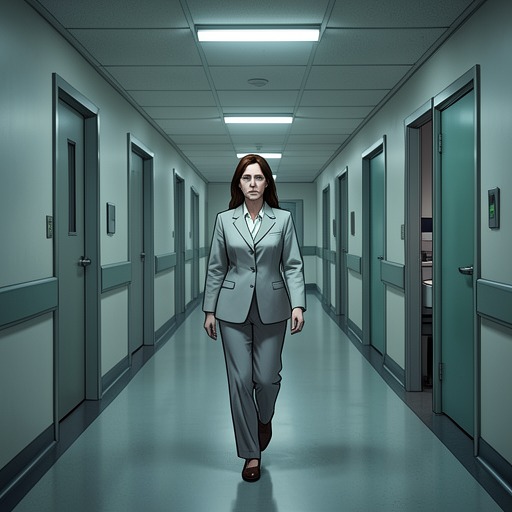
Doctor Nolan comes to Esther and promises her something; she wipes Esther’s face with a handkerchief, links arms with her, and accompanies her through the hospital’s basement corridors. The route passes white tile, bare bulbs, stretchers, wheelchairs, and pipes before reaching a green door marked for electrotherapy. Esther hesitates there, then decides to go in and get it over with. The machine is again part of an institutional procedure, but this time the approach includes Doctor Nolan’s presence and time for Esther to hold back before entering.
In the treatment room, Esther sees a high bed with a tightly stretched white sheet, the machine behind it, and masked figures around the bed. Miss Huey helps her lie down, talks in a low, soothing voice, applies salve to her temples, and fits small electric buttons on either side of her head. She tells Esther she will be all right and will feel nothing, then places something on her tongue. Esther bites down in panic, and darkness overtakes her. The scene still records fear and the loss of consciousness; reassurance does not make the apparatus benign or erase Esther’s earlier trauma. But its preparation differs from the first treatment’s: another attendant explains what to expect, while Doctor Nolan accompanies Esther through the route and waits when she hesitates.
Meaning and Narrative Function
The machine’s significance lies partly in this repetition with variation. Its plates, electrical contacts, bed, and jolts establish the material reality of electroconvulsive treatment, while Esther’s changing circumstances show that the device does not act as an isolated object. In the first session, she cannot voice a question and interprets the treatment as a terrible punishment; later, she can name the previous procedure to Doctor Nolan, and the doctor acknowledges that it was a mistake. The contrast shifts attention from machinery alone to the clinical relationship and practices that determine how treatment is encountered.
The machine also marks the tension between institutional authority and Esther’s account of her own body. Staff prepare her, move her, and fit equipment to her head, but the novel gives the sensory record to Esther: the strap dents her forehead, the current becomes flashes and jolts, and afterward the watch and hairpins are wrong. Her perceptions are not incidental decoration around a medical procedure; they are the evidence through which its human consequences become visible. When she tells Doctor Nolan what happened, the narrative places that testimony beside a professional admission that the treatment was mishandled.
Across the two episodes, the machine remains frightening even as the conditions surrounding its use change. The second procedure includes a quiet voice, salve, a warning, and a trusted doctor’s physical accompaniment, yet it still ends with Esther blacking out. That unresolved mixture of care and fear prevents the contrast from becoming a simple promise that reassurance cancels harm. The device functions as a focal point for the novel’s distinction between treatment as an authorized clinical act and treatment as lived experience: the same kind of apparatus can be encountered through radically different degrees of explanation, trust, and terror.