Esther Greenwood and her mother's relationship
The Bell JarEsther Greenwood and her mother's relationship is a bond of practical care under pressure, but also a conflict over the life a woman is expected to lead. Her mother has supported the family by teaching shorthand and typing since her husband’s death, and urges Esther to acquire the same practical skill. Esther, who wants to write and direct her own life, experiences that advice as a narrowing of possibility. When her plans collapse and her mental crisis deepens, her mother remains physically present and responsible for her care, yet Esther continues to feel that she cannot provide the understanding or direction she needs.
Work, Advice, and Divergent Futures
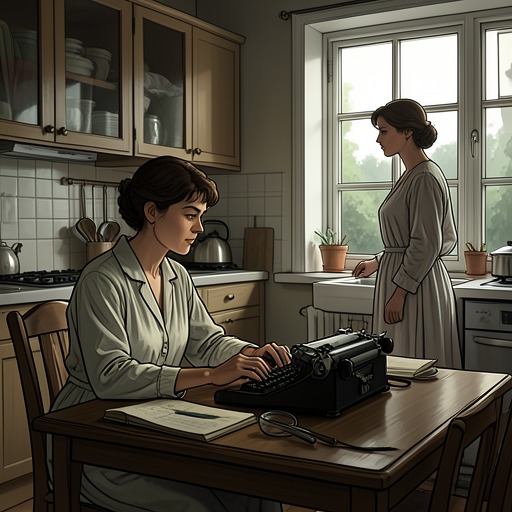
After Esther’s father died, her mother taught shorthand and typing to support the family. Esther understands that this work is not her mother’s choice: her mother secretly hated both the job and the circumstances that had left her doing it. She also resented Esther’s father for dying without leaving money, because he had distrusted life-insurance salesmen. The mother’s push for Esther to learn shorthand is therefore rooted in a material reality she knows directly: a college degree by itself may not secure a livelihood, while a practical skill can make a young woman employable.
Esther has not learned shorthand, and her mother warns that employers do not want a plain English major. In the future her mother imagines, shorthand turns an English degree into a marketable combination: Esther would be in demand and would transcribe letters for ambitious young men. Esther rejects not merely the symbols in the shorthand book, which strike her as baffling, but the position the skill seems to prepare her for. She hates the prospect of serving men and wants to dictate her own letters. The disagreement sets economic security against self-determination: her mother recommends a route that has helped her earn a living, while Esther fears that following it would organize her talents around other people’s needs.
That conflict appears alongside Esther’s exposure to commercial images of women’s success. In New York, she is one of twelve college women who won a fashion-magazine contest and received a month of paid work, gifts, tickets, and professional introductions. Their public image promises a glamorous city life; Esther privately feels detached from the spectacle. At a Ladies’ Day luncheon, the glossy kitchens and staged food make abundance into a photographed performance. These scenes do not erase the practical grounds of her mother’s advice: instead, they place it beside another set of expectations, in which women’s appearance and social display are also managed and sold. Esther’s mother urges a usable skill; the magazine world offers visibility and prizes, but does not give Esther a sense that she is steering her own future.
Marriage, Reproduction, and the Domestic Model
The mother’s advice about work is part of a wider social argument Esther encounters around women’s futures. While at college, Esther receives from her mother a Reader’s Digest article called “In Defense of Chastity,” written by a married woman lawyer with children. The article argues that men’s and women’s emotional worlds differ and that marriage properly joins them; it warns women to remain sexually pure and invokes the risk of pregnancy. Esther absorbs the pressure of this message even as she doubts its assumptions. Later, she tells Doctor Nolan that she hates the thought of being under a man’s thumb and that fear of having a baby hangs over her like a threat. She connects that fear to the lawyer’s advice and to the unequal power the article claims marriage will resolve.
Esther’s imagined marriage to Constantin makes the domestic future concrete. She pictures herself rising early to cook his breakfast, cleaning up after he leaves, preparing dinner when he returns, and washing the dishes again before bed. She regards that life as wasted for someone who has earned straight A’s. Her example is not abstract: Buddy Willard’s mother had been a private-school teacher, yet Esther sees her spending her days cooking and cleaning. She remembers the rug Mrs. Willard braided from strips of her husband’s old suits. Esther admired its colors, but Mrs. Willard put it on the kitchen floor, where it quickly became soiled and ordinary. The carefully made object becomes, for Esther, an image of work and creativity absorbed into domestic service.
Esther connects this example to her mother’s account of her own marriage. After the honeymoon, Esther’s father said they could stop pretending and be themselves; Esther remembers her mother as having no peace from that point on. She also recalls Buddy telling her that after having children she would no longer want to write poems. Together these memories harden into Esther’s fear that marriage and motherhood will extinguish a woman’s ambitions and leave her numb. That fear is not identical to her mother’s lived experience, but the mother’s warnings about earning a living and her account of marriage give Esther evidence with which to imagine the costs of dependence.
Crisis at Home
When Esther returns from the hospital, her mother is waiting at the station beside the family’s glove-gray Chevrolet. She notices Esther’s face and asks what has happened; Esther answers briefly that she cut herself and gets into the back seat because she does not want to be watched on the drive home. Their exchange shows care meeting withdrawal: her mother sees a visible sign of distress, while Esther limits what she will disclose.
In the car, her mother tells her that she has not been accepted into the writing course Esther had expected to carry her safely through the summer. Esther experiences the news as the collapse of a bridge. The rejection is a specific blow to the future she has imagined, and it intensifies the sense that the path ahead is disappearing. Her mother delivers the news rather than softening its consequence; Esther’s account emphasizes the shock of hearing it at the moment she has come home, not any resolution of the distance between them.
At home, Esther hears the routine her mother maintains. At seven, her mother gets dressed quietly, makes breakfast, washes and puts away the dishes, and leaves by car. She is teaching shorthand and typing to city-college girls and will not return until mid-afternoon. The sequence recalls the labor that supports the household and gives Esther’s long-standing resistance an everyday setting: the very skills her mother urges her to learn are the work her mother performs to provide for them. Esther notices the mother’s absence and the sounds of the house, but does not turn that recognition into agreement with the future her mother recommends.
A friend offers Esther the possibility of moving in if another girl drops out. Esther first tells her to ask the other girl, then immediately realizes she should have accepted. Listening to Dodo Conway’s baby carriage each morning, she thinks, would drive her crazy; she also makes a point of never living in the same house as her mother for more than a week. She reaches toward the telephone receiver, but her hand repeatedly stops and falls limp, as if it has met a pane of glass. The moment makes the relationship’s tension physical: Esther can identify a possible escape from the home, yet cannot carry the decision through.
Care, Dependence, and Ambivalence
Esther’s account does not reduce her mother to either a source of harm or a reliable confidante. She wishes she had a mother like Jay Cee, whom she imagines as a successful editor in an office surrounded by plants, because then she would know what to do. That comparison expresses Esther’s longing for guidance as much as dissatisfaction with her actual mother. Her mother’s experience has taught her about wages and employability, but Esther does not feel that those lessons can answer the larger question of how she should live.
The mother’s labor and Esther’s dependence remain present even when Esther recoils from domestic expectations. Her mother has earned a living through teaching and continues to work while Esther is home; she is also the person waiting to collect Esther and carrying the news of the writing-course rejection. Esther’s sense that her mother cannot help her is thus not the same as an absence of care. The relationship is sustained by practical acts, but those acts coexist with a profound difference between the future the mother knows how to recommend and the freedom Esther is trying to imagine.
That difference is sharpened by Esther’s fear of pregnancy and of being governed by a man. She tells Doctor Nolan that without the possibility of a baby she would act differently, and identifies the threat of motherhood as a force that could keep a woman in line. Her mother had mailed her the chastity article; Esther’s later account to the doctor shows how that advice continues to organize her thinking, even as she resists it. The mother’s protective intention and the article’s restrictive prescriptions cannot simply be equated, but Esther experiences them within the same world of warnings about sex, marriage, and women’s security.
Their relationship therefore joins affection and dependence to frustration and separation. The mother’s work is real economic support, not merely a symbol of convention; Esther’s refusal of shorthand is a demand to use her education for herself, not a denial that work is necessary. As Esther moves through crisis, this unresolved contrast remains active in the household’s routines, in the failed writing-course news, and in the hand that cannot quite pick up the telephone. Care brings mother and daughter into continued contact, but it does not close the distance between them.