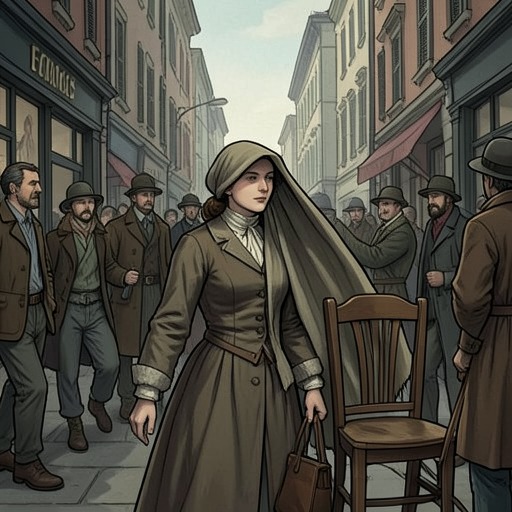
Esther Greenwood's traumatic first electroconvulsive treatment
The Bell JarEsther Greenwood's traumatic first electroconvulsive treatment under Doctor Gordon turns a medical procedure into an experience of terror and betrayal. At a private hospital marked by locked doors and a disturbing silence, she is given little meaningful preparation before metal plates are strapped to her head and an electric shock overwhelms her. She leaves the experience disoriented, rejects Doctor Gordon, and later learns from Doctor Nolan that what happened was a mistake. The scene's force lies not only in Esther's bodily fear but in the gap between institutional authority and the patient's experience of care.
Background and Setting
The treatment follows Esther's first consultation with Doctor Gordon, who twiddles a silver pencil while telling her that her mother has described her as upset. Esther sits curled in a cavernous leather chair across an immense polished desk. When she shows him scraps of her letter to Doreen, she thinks he must notice her poor handwriting; instead, he asks to speak with her mother. Esther agrees, but fears he might tell her she should be locked up. She gathers the scraps before he can piece together her plan to run away. The encounter establishes the imbalance that shapes the later treatment: Doctor Gordon has professional authority, while Esther tries to control what he and her family can know about her.
Doctor Gordon's private hospital stands on a grassy rise at the end of a secluded drive whitened with broken quahog shells. Its large yellow clapboard house and encircling veranda gleam in the sun, but the empty lawn and the enormous silence make the setting feel less reassuring than its bright exterior suggests. A nurse meets Esther and her mother at the door. Inside, Esther sees the people in the waiting area as shop dummies, figures posed to counterfeit life. The contrast between the sunlit grounds and Esther's sense of unreality frames the institution as a place where outward order does not resolve the distress she brings into it.
The Procedure
Esther follows Doctor Gordon upstairs, unable to ask him what shock treatment will be like. At the top of the stairs the carpet gives way to brown linoleum, and the corridor is lined with shut white doors. A woman shouts somewhere out of sight. A nurse tells Esther that another patient thinks she can jump from a window, but cannot because the windows are barred. In the bare room where Doctor Gordon takes her, Esther sees that the windows are indeed barred and that doors, drawers, and other things that open are fitted with locks. The setting makes confinement tangible before the apparatus appears.
Esther lies on the bed. The nurse removes her watch and starts taking the hairpins from her hair while Doctor Gordon unlocks a closet and wheels out a machine. After the nurse swabs Esther's temples with smelly grease, Doctor Gordon fits a metal plate on each side of her head, straps them in place so that the strap dents her forehead, and gives her a wire to bite. The brief silence before the shock offers no reassurance. Esther describes being seized and shaken as if the world were ending; the machine shrills, the air seems to crackle with blue light, and repeated jolts make her fear her bones will break. Her attention turns inward to the question of what terrible thing she could have done, as if the suffering demanded an explanation in the form of guilt.
Afterward, Esther is sitting in a wicker chair with a small glass of tomato juice. Her watch has been fastened back on upside down, and the hairpins feel unfamiliar in her hair. These small dislocations make the immediate aftermath legible without offering a clear account of how she has been treated: objects have been returned, but not quite as they were, and Esther is left to register the procedure through confusion and bodily unease.
Immediate Aftermath and Medical Judgment
On the drive away from the hospital, Esther feels dumb and subdued. When she tries to concentrate, her mind glides into a large empty space. Once her mother has left Dodo Conway and her black station wagon behind, Esther says she is through with Doctor Gordon and that her mother can tell him she will not come the following week. Her mother replies that she knew Esther was not like that; Esther asks what she means. The exchange shows how Esther's refusal is interpreted through her mother's assumptions, while Esther's own explanation is direct: she did not like what Doctor Gordon did to her.
Later, Esther tells Doctor Nolan about the machine, the blue flashes, the jolting, and the noise. Doctor Nolan becomes very still and tells her it was a mistake, that it was not supposed to be like that. This response gives Esther's account a clinical confirmation that the earlier scene did not provide. The treatment's trauma is therefore not presented simply as Esther misunderstanding an ordinary procedure: a later doctor identifies a difference between what happened to her and what should have happened.
The Later Treatment and Trust
Doctor Nolan's later involvement makes the first treatment's breach of trust more sharply defined. When Esther realizes another shock treatment is imminent, she retreats to an alcove and curls up beneath a blanket. She says that the shock itself is not what strikes her most, but Doctor Nolan's bare-faced treachery: Esther had trusted her and understood her to have promised that she would be warned beforehand. Esther imagines that, if she had known the night before, she would have spent the night in dread but could have composed herself by morning and gone with dignity. The account distinguishes the physical procedure from the conditions of consent and preparation: advance warning would not have removed fear, but it would have allowed Esther to meet it on her own terms.
Doctor Nolan comes to Esther, promises to accompany her, wipes her face, and helps her up. Esther lets the blanket fall as they walk together past Joan. Doctor Nolan then unlocks a door and leads her through the hospital's basement network of corridors, where pipes branch along the tiled walls and stretchers and wheelchairs stand against them. At a green door marked Electrotherapy, Esther holds back before deciding to get it over with. The route through locked doors and hidden tunnels retains the institution's unsettling atmosphere, but Doctor Nolan stays beside her and encourages her with a squeeze of the arm.
Inside, Miss Huey helps Esther lie down and talks in a low, soothing voice while applying salve and fitting small electric buttons beside her head. Esther asks her to keep talking. Miss Huey assures her she will be all right and will not feel anything, tells her to bite down, and places something on her tongue; Esther bites in panic, and darkness wipes her out. The later scene does not erase the earlier harm, and the evidence does not establish the outcome of this later treatment. It does, however, mark a contrast in the approach: Esther is accompanied, spoken to, and able to voice her fear before the procedure begins.
Significance
The event exposes the difference between treatment as administered by an institution and care as experienced by a patient. In Doctor Gordon's room, locks, barred windows, unexplained equipment, and the nurses' casual reassurance surround Esther, but none makes her feel safe or informed. Her description of the shock dominates the scene; the institutional procedure is conveyed through what her body undergoes and what she can recall afterward. Doctor Nolan's later judgment that the treatment was a mistake confirms the importance of that perspective without supplying a further technical explanation.
The episode also establishes a lasting tension between trust and medical authority. Esther's first response is to refuse further visits with Doctor Gordon; her later anger at Doctor Nolan shows that even a doctor she loves can damage that trust by withholding warning. The subsequent descent to Electrotherapy, where Doctor Nolan accompanies her and Esther speaks up before the treatment, offers a pointed contrast in conduct, not a simple resolution. Across the two encounters, fear is shaped not only by the machine but by whether Esther is left uninformed and alone or given company and a chance to prepare.