Esther Greenwood—Doctor Nolan
The Bell JarEsther Greenwood—Doctor Nolan is a relationship built under the pressure of psychiatric treatment: Doctor Nolan becomes a trusted clinician because she listens to Esther’s account of harm and offers protection, but that trust is tested when treatment proceeds without the warning Esther expected. The bond’s decisive change comes through a contrast between two electroshock experiences: the first leaves Esther terrified and physically disoriented, while Doctor Nolan’s presence and the more reassuring procedure at Belsize allow Esther to accept a continuing course of treatment. Their connection offers care without erasing the unequal power between patient and doctor.
First Contact and Guarded Trust
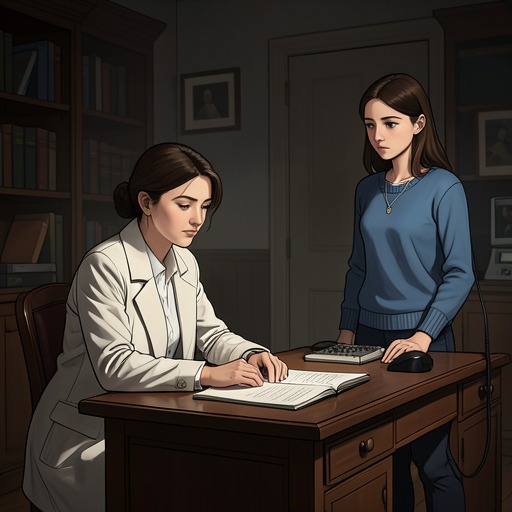
Doctor Nolan introduces herself when Esther enrolls in the hospital’s main building, identifying herself as Esther’s doctor. Esther is surprised that her psychiatrist is a woman. She registers Nolan’s white blouse, full skirt, leather belt, and crescent-shaped spectacles, describing an appearance that seems to combine Myrna Loy with Esther’s mother. Yet after Esther is moved to Caplan, the gloomy brick building where she will live, Nolan does not immediately come to see her; strange men do instead. The gap between the introduction and the delayed visit leaves Esther without an established sense of safety in the institution.
When Nolan eventually sits beside Esther’s bed and asks permission to smoke, the small courtesy becomes important to Esther. She likes the smell and hopes that Nolan will stay longer; she anticipates that when the doctor leaves, she will return to her old blankness. The exchange makes the relationship begin not with a formal explanation of illness but with Esther’s wish for a human presence. Nolan then asks directly about Doctor Gordon, and Esther answers warily. Esther suspects that the doctors are collectively aligned and imagines that another machine like Gordon’s may be hidden somewhere in the hospital. Her distrust is not abstract: it is tied to the treatment she has already endured.
Naming the Harm
Esther tells Nolan that she disliked what Doctor Gordon did to her. Asked what she means, she describes the machine, the blue flashes, the jolting, and the noise. While Esther recounts the experience, Nolan becomes very still. She says that it was a mistake and that treatment, if properly performed, should be like going to sleep. The moment matters because Nolan does not dismiss Esther’s sensory account or tell her that her fear is irrational. She distinguishes the traumatic treatment Esther experienced from the procedure she considers acceptable.
Esther responds by threatening suicide if anyone gives her another shock treatment. Nolan answers firmly that Esther will not receive treatment at the hospital without safeguards: if a further treatment is needed, Nolan will tell her beforehand and promises it will be unlike the earlier one. Her response offers a specific commitment, not a general reassurance. It also exposes the limits of Esther’s control: Nolan is still speaking about whether treatment will occur, but promises to make its timing and manner more intelligible to the patient who must undergo it.
A tiny box of matches becomes an early test of this new confidence. After Nolan leaves, Esther finds an unusually small box on the windowsill, tries to light one of its little sticks, and watches it crumple in her hand. She hides the toy matches in the hem of her bathrobe, imagining that Nolan might be testing whether she will return them. The incident shows that trust has not yet displaced suspicion: Esther reads even a small object as possibly part of a test and prepares a story in case the doctor asks about it.
Care, Limits, and a Breach
Nolan’s care is not only clinical. After Esther has a reaction, she visits her and brings out a tiny matchbox identical to the one Esther hid. Nolan strikes a match and lights her cigarette. The correspondence between the hidden toy and the working matchbox briefly makes Esther wonder whether someone found her concealed matches and returned them to Nolan, but the visit also shows Nolan continuing contact after a difficult episode. The object that had seemed to Esther like a possible test becomes part of a quieter, ordinary interaction.
Nolan later tells Esther that she is not to have visitors for a while. Esther is delighted by the restriction. Their relationship, then, includes Nolan’s power to set boundaries around Esther’s contact with others, but the particular limit meets Esther’s own desire for temporary seclusion. The episode complicates any simple division between institutional control and personal care: a rule imposed by the doctor can also answer a need Esther is glad to have recognized.
The sharper breach comes when Esther learns that she is to receive another shock treatment. She retreats beneath a blanket into a hallway alcove rather than waiting in her room, fearing that staff will come to take her. She experiences Nolan’s failure to warn her as bare-faced treachery: she had liked and loved the doctor, entrusted her with everything, and relied on her promise. Esther imagines that advance notice would have let her spend the night afraid but reach the treatment composed, walking between nurses with the dignity of someone resigned to an execution. What frightens her is therefore not only the procedure but the loss of the choice to prepare for it and the prospect of being carried away in front of other patients.
Nolan comes to the alcove and puts an arm around Esther, hugging her like a mother. Esther protests that Nolan said she would tell her. Nolan replies that she is telling her now: she came specially early and will take Esther over herself. Esther remains hurt and insists on the promise. Nolan explains that she thought advance notice would keep Esther awake, but does not leave the explanation at that; she promises to accompany Esther throughout, be there when she wakes, and bring her back. Esther asks her to promise she will stay, and Nolan promises. The reassurance does not undo the surprise, but it begins to repair the rupture by making Nolan’s presence concrete and verifiable.
The Treatment Nolan Supervises
Nolan leads Esther through the hospital’s basement network, a system of corridors linking its different buildings. Esther hangs onto her arm as they pass white tiled walls, exposed pipes, stretchers, and wheelchairs. At the green door marked Electrotherapy, Esther hesitates, while Nolan waits. Esther finally says they should get it over with, and they enter. The scene makes trust physical: Esther proceeds not because the fear has vanished, but with Nolan beside her and the promise of accompaniment still in force.
During the procedure, Miss Huey speaks soothingly, applies salve to Esther’s temples, and fits small electric buttons on either side of her head. Esther asks to be spoken to; when an object is placed on her tongue, she bites down in panic, and darkness overtakes her. When she wakes, Nolan’s face is the first thing she sees. Nolan leads her outside into fresh air. Esther feels the heat and fear leave her and describes herself as open to the circulating air, with the bell jar suspended above rather than sealing her in. Nolan asks whether the experience was as she had said it would be; Esther agrees. The contrast with the earlier procedure is central to their relationship: the treatment still involves fear and loss of consciousness, but it is followed by the presence Nolan promised and an experience Esther can accept.
Nolan states that future treatments will be like this one and specifies a schedule of three sessions a week, on Tuesday, Thursday, and Saturday. Her certainty supplies structure after the earlier shock, while also making clear that treatment will continue. Esther’s response is a long draught of air followed by a question about how long the course will last. The exchange holds relief and uncertainty together: she can trust Nolan’s account of how the procedures will be conducted without yet knowing their duration or the shape of what comes next.
Continuing Trust and Its Uneasy Stakes
Later, as the doctors hold their weekly board meeting about admissions, dismissals, and interviews, Esther waits in the hospital library. Nolan has told her not to be scared: she will be present, along with the other doctors Esther knows and visitors, while Doctor Vining, the head of the doctors, asks questions before she can go. Even with this reassurance, Esther is frightened. She had hoped departure would leave her sure of what lay ahead because she had been analyzed; instead, she can see only question marks. Nolan’s support thus reaches beyond the treatment room, but cannot turn the hospital’s scrutiny or the prospect of leaving into certainty.
The relationship’s force lies in this combination of intimacy and institutional authority. Nolan listens when Esther describes an injury, acknowledges that the treatment was a mistake, and offers her a companion through the next procedure. At the same time, she is the doctor who determines and communicates treatment, restricts visitors, and participates in the process through which Esther’s future is assessed. Esther’s trust is neither effortless nor complete: it grows through specific acts of presence, breaks when a promise appears to be violated, and is partly restored when Nolan keeps her bedside commitment. Their bond makes care consequential without presenting it as a simple escape from the hospital’s power.