Esther Greenwood's attempted suicide by overdose and rescue
The Bell JarEsther Greenwood's attempted suicide by overdose and rescue is the turning point at which a private, meticulously concealed plan becomes a public emergency and a course of psychiatric care. Esther takes more than fifty sleeping pills in a hidden cellar crevice, but survives after her mother hears groans from the disused hole. Her rescue does not end the crisis: it brings her into a medical system in which treatment, safety, and trust will themselves become urgent questions.
Background and Decision
The attempt follows Esther's return to her family home during a period of profound distress. The narrative has already connected her fear of death with the public spectacle of the Rosenbergs' execution: newspaper headlines make electrocution impossible to ignore, and Esther imagines what it would mean to be burned along the nerves. That image establishes death as both a public fact and a private terror; the overdose is a different, deliberately hidden encounter with it.
The plan becomes actionable when Esther's mother leaves. Esther changes into a white blouse, green figured skirt, and black raincoat, then writes a note on the back of a pale blue envelope saying she is going for a long walk. She has prepared an explanation for her absence, but remembers that she still needs the pills. Her attention to such practical details gives the attempt its controlled, procedural quality: she is not acting in a sudden public scene but arranging concealment step by step.
In her mother's closet, Esther retrieves a small green strongbox from the top shelf. She finds the key in a blue jewelry box, hidden in a bureau drawer beneath Irish linen handkerchiefs, and opens the box to take a new bottle of sleeping pills. There are at least fifty. Esther calculates that if she had depended on her mother dispensing the pills nightly, saving enough would have taken fifty nights; by then college would have begun and her brother would have returned from Germany. She restores the key, jewelry box, strongbox, and chair to their places, preserving the appearance that nothing has been disturbed.
The Hidden Cellar and Overdose
Esther takes a tall glass of water and the pill bottle down to the cellar. Behind the oil burner, she finds a dark opening at shoulder height, a crevice running beneath the breezeway that had been added after the cellar was built. Rotten fireplace logs partly block its mouth. She shifts them, sets the water and pills on one of the logs, and struggles to climb into the narrow space.
Once inside, Esther drags the heavy logs back across the opening. The arrangement seals her away from the cellar and makes the hidden hollow a place of deliberate isolation. She crawls toward the far wall on her knees, with her head bent, while cobwebs brush her face. Wrapped in her black coat, she opens the bottle and takes the pills one at a time, swallowing them between gulps of water. The careful sequence that secured the medicine and concealed her entrance now gives way to repetition: pill, water, pill, water.
At first she feels no effect. As she nears the bottom of the bottle, red and blue lights begin flashing before her eyes; the bottle slips from her fingers and she lies down. The narration renders the onset through a changing field of sensation: silence seems to retreat, exposing the debris of her life, then returns in a sweeping tide that carries her into sleep. The movement from orderly preparation to perceptual disintegration marks the attempt's decisive shift, but not its completion in death.
Discovery and Rescue
The apparent solitude of the cellar does not hold. After Esther disappears, newspaper reports turn her absence into a public search, and the decisive headline announces, "GIRL FOUND ALIVE!" The account describes police lifting a long, limp blanket roll into an ambulance and explains that Esther's mother, doing the week's laundry in the cellar, heard faint groans from the disused hole. The hidden place Esther chose to avoid discovery becomes the place from which she is found.
The rescue changes the status of the event without resolving its underlying crisis. Esther survives the overdose and is brought back into contact with her family and medical care. The newspaper clippings preserve the stark public sequence—missing girl, search, discovery alive—while Esther's own account has already shown the private preparations, the concealed crevice, and the pills taken in darkness. The distance between those two versions is part of the episode's force: what appears in print as a discovery is, from within Esther's experience, the outcome of a long-planned attempt.
Psychiatric Care and Treatment
Esther's rescue leads into psychiatric treatment, where the question of how care is given becomes central. At one early consultation, Doctor Gordon asks about her distress and later asks to speak with her mother. Esther has shown him scraps of a letter to Doreen, but fears he might tell her mother she should be locked up; she gathers the scraps so he cannot piece together her plan to run away. The consultation establishes a strain between clinical authority and Esther's guarded account of herself, even as the overdose has made her condition impossible to keep wholly private.
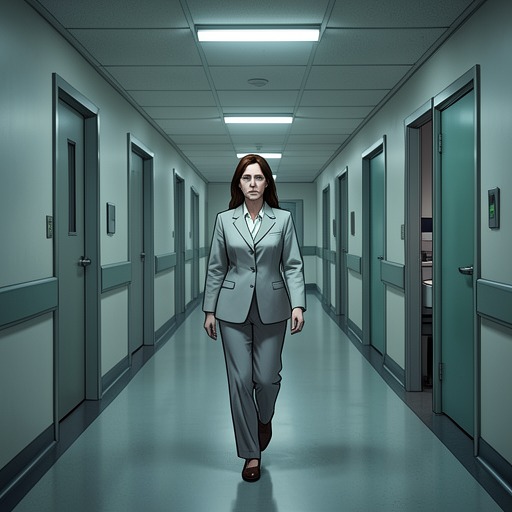
Doctor Gordon's first electroconvulsive treatment is presented as a frightening bodily ordeal. Esther follows him down a corridor to a bare room with barred windows and locks on the doors, drawers, and closet. She lies on the bed as a nurse removes her watch and hairpins and swabs her temples. Doctor Gordon fits metal plates to either side of her head, secures them with a strap, and gives her a wire to bite. After the machine begins, Esther experiences a shrill sound, flashes of blue light, and violent jolts that make her fear her bones will break. When the treatment is over, she is in a wicker chair holding tomato juice; her watch has been put back on upside down, and her hairpins feel unfamiliar. These concrete dislocations make the treatment's aftermath part of its violence.
Later, Esther tells Doctor Nolan about the machine, the flashes, the jolting, and the noise. Doctor Nolan goes still and tells her that it was a mistake and was not supposed to happen that way. This response distinguishes the traumatic treatment under Doctor Gordon from the later care that Doctor Nolan arranges; it also gives Esther's account a medical consequence, rather than treating her fear as merely a subjective impression.
That distinction does not prevent a later breach of trust. When Esther realizes another shock treatment is imminent, she retreats beneath a blanket in an alcove, upset less by the treatment itself than by Doctor Nolan's failure to warn her, despite having promised to do so. Doctor Nolan reassures her and helps her up. They take a network of basement tunnels beneath the hospital buildings to a green door marked Electrotherapy. Esther resists briefly, then agrees to get it over with. Miss Huey speaks soothingly, applies salve, fits small electric buttons at Esther's temples, and tells her she will be all right and will feel nothing. Esther bites down as instructed, and darkness wipes her out. The contrast with Doctor Gordon's treatment is not that the procedure has become emotionally simple, but that the later scene includes advance reassurance, a trusted companion, and a calmer procedure.
Significance
The overdose is both a survival event and a threshold into the novel's sustained depiction of psychiatric care. Its sequence turns on the collision of concealment and exposure: Esther hides the pills, reconstructs the closet as she found it, and seals herself behind logs, yet her mother hears her and the newspapers announce the rescue. What was meant to be a solitary exit instead becomes the cause of her entry into treatment.
The episode also sets up a recurring tension between Esther's experience and the authority of others to interpret or manage it. Doctor Gordon's questions, Esther's fear of being locked up, the nurse's control of her belongings, and the later treatment procedures place her within a system that can protect her while also frightening her. The differing scenes with Doctor Gordon and Doctor Nolan preserve that tension rather than resolving it: the treatment can be experienced as terror, acknowledged as mishandled, and later approached with reassurance, but Esther's dependence on care remains bound to the fragile question of whether she can trust the people providing it.