Esther's Sleeping-Pill Overdose
The Bell JarEsther's Sleeping-Pill Overdose is Esther Greenwood's concealed suicide attempt: after deciding to act while her mother is away, she retrieves a bottle of sleeping pills, crawls into a hidden cellar crevice, and swallows them with water. The attempt ends not in death but in discovery and rescue; newspaper clippings later reduce the ordeal to a missing-girl search and the report that she has been found alive. The episode turns private despair into a medical and public crisis, while the novel's later treatment scenes distinguish the frightening procedure Esther experiences under Doctor Gordon from the care she receives under Doctor Nolan.
Preparation and Concealment
After the car carrying her mother has left, Esther dresses, leaves a note saying she is going for a long walk, and then remembers the pills. She drags a chair into her mother's closet to reach a small green strongbox on the top shelf. From a bureau drawer she retrieves a blue jewelry box hidden beneath linen handkerchiefs, takes the key pinned inside it, and unlocks the strongbox. The bottle contains at least fifty pills—more than Esther had expected. She calculates that if she waited for her mother to dispense them nightly, saving enough would take fifty nights, by which time college would have opened and her brother would have returned from Germany. She restores the key, boxes, strongbox, and chair to their places, carefully reversing the signs of her search.
Esther takes a glass of water and the bottle down to the cellar. Behind the oil burner, a gap in the wall leads under a breezeway added after the cellar was built; old fireplace logs partly block its mouth. She pushes them aside, climbs into the narrow, earth-bottomed space, and drags the heavy logs back across the entrance. In the darkness she crawls toward the far wall, cobwebs brushing her face, and wraps herself in her black coat. One pill at a time, she swallows the tablets between gulps of water. As she nears the bottom of the bottle, red and blue lights flash before her eyes; she drops the bottle and lies down. The silence seems to gather the scattered wreckage of her life before sweeping her into sleep.
Discovery and Rescue
The concealment makes the overdose appear, for a time, to be a disappearance. Later, Esther sees newspaper clippings whose headlines first report sleeping pills feared missing with a girl, then announce, “GIRL FOUND ALIVE!” The account describes bloodhounds searching the woods and police lifting a limp, blanket-like form into an ambulance. Its final explanation is domestic and accidental: Esther's mother, doing the week's laundry in the cellar, heard faint groans coming from the disused hole. The hidden place that had insulated Esther from discovery thus becomes the route by which she is found.
The clippings frame the episode from outside, converting a desperate act into a search report, police details, and a brief account of rescue. Esther lays them on the white bedspread, and Joan tells her to keep them and make a scrapbook. The suggestion treats the public record as something Esther can preserve, even as its compressed headlines cannot convey the ordeal from within.
Medical Aftermath and Treatment
The overdose is followed by institutional care, where Esther's encounters with electroconvulsive treatment make the distinction between different medical experiences consequential. At an earlier consultation, Doctor Gordon twiddles a silver pencil and tells Esther that her mother says she is upset. Esther later brings him scraps of a letter to Doreen and asks what he thinks; instead of addressing the fragments as she expects, he asks to speak with her mother. Esther fears he may have her locked up, gathers the scraps so he cannot piece together her plan to run away, and leaves. The exchange establishes her suspicion that the clinician may act on information without giving her control over what follows.
When Esther follows Doctor Gordon into the treatment room, she cannot make herself ask what the shock will be like. The room's barred windows and lockable doors sharpen her sense of confinement. She lies on the bed while a nurse removes her watch and hairpins; Doctor Gordon positions a machine behind the bed, puts metal plates against either side of her head, straps them into place, and gives her a wire to bite. The treatment arrives as a violent shock, accompanied in Esther's perception by shrill noise and blue flashes. Afterwards, her watch has been fastened upside down and her hairpins feel unfamiliar. Later, when she tells Doctor Nolan about the machine, flashes, jolts, and noise, Nolan becomes still and says it was a mistake: it was not supposed to be like that. The contrast locates the terror in Esther's particular treatment rather than presenting it as an inevitable feature of every procedure.
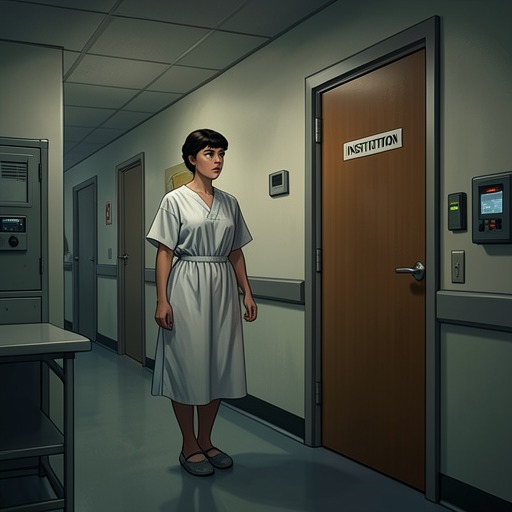
Doctor Nolan's later involvement does not erase Esther's fear or guarantee that she will feel prepared. When she learns that another treatment is due, Esther experiences the failure to warn her as a betrayal: Nolan had promised to tell her beforehand, and Esther believes that advance notice would have let her endure the dread and arrive composed. She hides under a blanket in an alcove rather than returning to her room. Nolan finds her, wipes her face, links her arm with hers, and leads her through basement corridors connecting the hospital buildings. At the Electrotherapy door, Esther holds back, then agrees to get it over with. Miss Huey speaks soothingly, applies salve to Esther's temples, fits the electric buttons, and tells her to bite down; Esther panics and loses consciousness. The passage from the cellar's self-made hiding place to the hospital's locked rooms and underground corridors traces the consequences of survival into a new struggle over fear, trust, and medical care.
The aftermath also reveals how an overdose that Esther had concealed from those around her becomes legible to them only through its physical signs and the search that follows. Newspaper clippings she later sees first report that sleeping pills are feared missing with a girl; a second headline announces, “GIRL FOUND ALIVE!” The accompanying account describes bloodhounds searching the woods and police lifting a limp, blanket-like form into an ambulance. Its explanation points back to an ordinary household task: Esther's mother, doing the week's laundry in the cellar, heard faint groans from the disused hole. The secluded crevice that had hidden Esther from the world therefore also made the faint sounds of her survival difficult to detect.
Public Record and Rescue
The clippings Esther later examines compress her private crisis into the language of a search and its outcome. One headline reports that sleeping pills are feared missing with a girl; another declares, “GIRL FOUND ALIVE!” The accompanying account describes bloodhounds searching the woods and policemen lifting a long, limp form into an ambulance. Its explanation turns on an ordinary household task: Esther’s mother, doing the week’s laundry in the cellar, heard faint groans from the disused hole. The crevice had concealed Esther, but it could not keep her cries from reaching the room above. Esther lays the clippings on the white bedspread, and Joan suggests that she keep them in a scrapbook—a gesture that treats the newspaper account as a record to preserve, though its brisk headlines cannot convey the experience from within.
Public Record and Rescue
The clippings Esther later examines compress her private crisis into the language of a search and its outcome. One headline reports sleeping pills feared missing with a girl; another declares, “GIRL FOUND ALIVE!” The account describes bloodhounds searching the woods and police lifting a long, limp form into an ambulance. Its explanation turns on an ordinary household task: Esther’s mother, doing the week’s laundry in the cellar, heard faint groans from the disused hole. The crevice had concealed Esther, but it could not keep the faint sounds of her survival from reaching the cellar above. Esther lays the clippings on the white bedspread, and Joan suggests that she keep them in a scrapbook—a gesture that makes the newspaper account a record to preserve, though its brisk headlines cannot convey the ordeal from within.
Public Record and Rescue
The clippings Esther later examines compress her private crisis into the language of a search and its outcome. One headline reports that sleeping pills are feared missing with a girl; another declares, “GIRL FOUND ALIVE!” The account describes bloodhounds searching the woods and policemen lifting a long, limp form into an ambulance. Its explanation turns on an ordinary household task: Esther’s mother, doing the week’s laundry in the cellar, heard faint groans from the disused hole. The crevice had concealed Esther, but it could not keep the faint sounds of her survival from reaching the cellar above. Esther lays the clippings on the white bedspread, and Joan suggests that she keep them in a scrapbook—a gesture that makes the newspaper account a record to preserve, though its brisk headlines cannot convey the ordeal from within.
Treatment Before and After the Overdose
Esther’s survival leads into institutional care, where her experiences of electroconvulsive treatment show how profoundly the procedure depends on the conditions in which it is administered. Before the overdose, Doctor Gordon’s manner has already unsettled her. At their consultation he twiddles a silver pencil and tells her that her mother says she is upset. Esther later lays the torn scraps of a letter to Doreen on his green blotter and asks what he thinks of them. Rather than interpret the fragments, he asks to speak with her mother. Esther fears he will have her locked up; she gathers the scraps before he can reconstruct her plan to run away and leaves his office. The encounter gives her reason to suspect that clinical authority can pass information to her mother while leaving Esther herself unsure what will happen next.
The treatment with Doctor Gordon turns that apprehension into bodily terror. Esther follows him down a corridor of shut white doors after failing to ask what the shock will feel like. In the bare room, barred windows and doors and drawers fitted with keyholes make confinement part of the setting. A nurse takes Esther’s watch and removes her hairpins; Doctor Gordon brings in a machine, fixes metal plates to either side of her head with a strap, and gives her a wire to bite. After a brief silence, Esther experiences the shock as a violent shaking, with shrill noise and flashes of blue light. When she comes round in a wicker chair holding tomato juice, the watch has been fastened upside down and her hairpins sit oddly in her hair. Her disorientation registers the procedure not as an abstract treatment but as an assault on her sense of bodily control.
When Esther later recounts the machine, flashes, jolting, and noise to Doctor Nolan, Nolan goes still and tells her it was a mistake: the treatment is not supposed to happen that way. Her response distinguishes Gordon’s frightening administration from the procedure as it is meant to be conducted. The contrast does not make Esther’s fear disappear; it makes the details of the earlier experience medically consequential and gives her account a listener who recognizes that something went wrong.
Doctor Nolan’s care is itself tested when another treatment is scheduled. Esther believes Nolan had promised to warn her beforehand, and the failure to do so feels like a betrayal of the trust she had placed in her. She imagines that advance warning would have allowed her to endure a night of dread and then go to treatment with composure. Instead, she avoids her room and curls beneath a blanket in a secluded alcove. Nolan finds her, wipes her face with a handkerchief, links her arm with hers, and helps her up. Esther lets the blanket fall as they pass Joan, who retreats into her room to wait.
Nolan leads Esther down a flight of stairs into the hospital’s basement corridors, a network of tunnels linking the buildings. Pipes run along the tiled walls, with stretchers and wheelchairs set aside; Esther clings to Nolan’s arm, and Nolan periodically squeezes hers in reassurance. At the green door marked Electrotherapy, Esther hesitates before agreeing to get it over with. Miss Huey helps her lie down, applies salve to her temples, fits the electric buttons, and speaks soothingly. Esther asks her to keep talking, but panic overtakes her as she bites down and loses consciousness. The scene retains the gap between reassurance and fear: the second treatment is presented with a gentler manner and Nolan’s accompaniment, yet Esther’s terror remains real. From the hidden cellar crevice where she was found to the hospital’s locked rooms and underground passageways, survival brings her into a continuing struggle over treatment, trust, and how much control she can have over what is done to her.
Treatment Before and After the Overdose
Esther’s survival leads into institutional care, where her experiences of electroconvulsive treatment show how profoundly the procedure depends on the conditions in which it is administered. Before the overdose, Doctor Gordon’s manner has already unsettled her. At their consultation he twiddles a silver pencil and tells her that her mother says she is upset. Esther later lays the torn scraps of a letter to Doreen on his green blotter and asks what he thinks of them. Rather than interpret the fragments, he asks to speak with her mother. Esther fears he will have her locked up; she gathers the scraps before he can reconstruct her plan to run away and leaves his office. The encounter gives her reason to suspect that clinical authority can pass information to her mother while leaving Esther herself unsure what will happen next.
The treatment with Doctor Gordon turns that apprehension into bodily terror. Esther follows him down a corridor of shut white doors after failing to ask what the shock will feel like. In the bare room, barred windows and doors and drawers fitted with keyholes make confinement part of the setting. A nurse takes Esther’s watch and removes her hairpins; Doctor Gordon brings in a machine, fixes metal plates to either side of her head with a strap, and gives her a wire to bite. After a brief silence, Esther experiences the shock as violent shaking, with shrill noise and flashes of blue light. When she comes round in a wicker chair holding tomato juice, the watch has been fastened upside down and her hairpins sit oddly in her hair. Her disorientation registers the procedure not as an abstraction but as an experience that has disrupted her bodily control.
When Esther later recounts the machine, flashes, jolting, and noise to Doctor Nolan, Nolan goes still and tells her it was a mistake: the treatment is not supposed to happen that way. Her response distinguishes Doctor Gordon’s frightening administration from the procedure as it is meant to be conducted. The contrast does not erase Esther’s fear; it makes the earlier experience medically consequential and gives her account a listener who recognizes that something went wrong.
Doctor Nolan’s care is itself tested when another treatment is scheduled. Esther believes Nolan had promised to warn her beforehand, and the failure to do so feels like a betrayal of the trust she had placed in her. She imagines that advance warning would have allowed her to endure a night of dread and then go to treatment composed. Instead, she avoids her room and curls beneath a blanket in a secluded alcove. Nolan finds her, wipes her face with a handkerchief, links her arm with hers, and helps her up. Esther lets the blanket fall as they pass Joan, who retreats into her room to wait.
Nolan leads Esther down a flight of stairs into the hospital’s basement corridors, a network of tunnels linking its buildings. Pipes run along the tiled walls, with stretchers and wheelchairs set aside; Esther clings to Nolan’s arm, and Nolan periodically squeezes hers in reassurance. At the green door marked Electrotherapy, Esther hesitates before agreeing to get it over with. Miss Huey helps her lie down, applies salve to her temples, fits the electric buttons, and speaks soothingly. Esther asks her to keep talking, but panic overtakes her as she bites down and loses consciousness. The second treatment is accompanied by a gentler manner and Nolan’s support, yet Esther’s terror remains real. Her survival has brought her from a concealed cellar crevice into a continuing struggle over treatment, trust, and control.
Medical Aftermath and Institutional Treatment
The overdose is followed by institutional care, where Esther Greenwood’s experiences of electroconvulsive treatment make the manner of treatment central to its meaning. Before the attempt, Doctor Gordon twiddles a silver pencil and tells Esther that her mother says she is upset. Esther later lays the scraps of a letter to Doreen on his green blotter and asks what he thinks. He responds by asking to speak with her mother. Esther fears that he may have her locked up, gathers the scraps so he cannot piece together her plan to run away, and leaves. The exchange leaves her wary of a clinical authority that can involve her mother while she remains uncertain about what may happen to her.
When Esther follows Doctor Gordon toward the treatment room, she tries to ask what the shock will be like but cannot speak. In a bare room with barred windows and lockable doors, a nurse removes her watch and hairpins while Doctor Gordon brings a machine to the bed. He fits metal plates on either side of her head, straps them in place, and gives her a wire to bite. After a brief silence, Esther experiences the treatment as a violent shaking accompanied by shrill noise and flashes of blue light. When she comes round holding tomato juice, her watch has been fastened upside down and her hairpins feel unfamiliar. The details make the episode an assault on her bodily control, not merely a procedure described from the outside.
Esther later tells Doctor Nolan about the machine, the flashes, the jolting, and the noise. Nolan goes very still and says that the treatment was a mistake and was not supposed to happen that way. Her response confirms that Esther’s frightening experience was not inevitable, while giving her account a listener who recognizes that something went wrong.
Nolan’s care is tested again when another treatment is due. Esther believes Nolan had promised to warn her beforehand; the lack of warning feels like a betrayal of the trust she had placed in her. Esther thinks advance notice would have allowed her to spend the night in dread and still arrive composed. Instead, she avoids her room and curls beneath a blanket in an alcove. Nolan finds her, wipes her face with a handkerchief, hooks her arm through hers, and helps her up. As they pass Joan, Esther gives her a disdainful smile, and Joan ducks back into her room to wait.
Nolan leads Esther down stairs into basement corridors that link the hospital buildings. Along the tiled walls, pipes branch through the passageways, while stretchers and wheelchairs stand aside. Esther clings to Nolan’s arm, and Nolan gives her an encouraging squeeze from time to time. At the green door marked Electrotherapy, Esther holds back, then agrees to get it over with. Miss Huey helps her lie down, applies salve to her temples, fits the electric buttons, and speaks soothingly. Esther asks her to talk, but panic overtakes her as she bites down and loses consciousness. The gentler manner and Nolan’s presence do not erase Esther’s terror; they mark a different setting for treatment, one in which reassurance and accompaniment coexist with her fear.