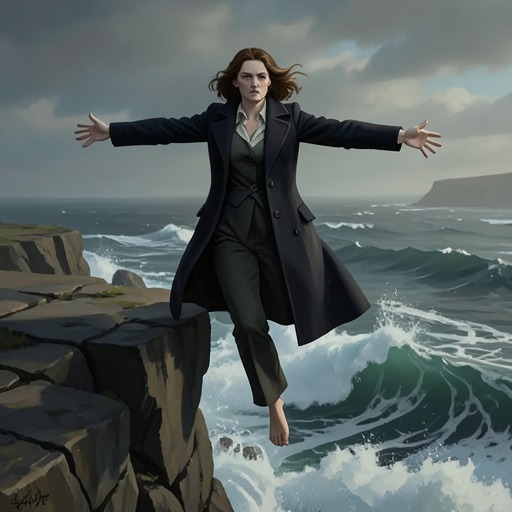
Esther's Attempt to Drown Herself
The Bell JarEsther Greenwood’s attempt to drown herself turns a suicidal plan into a physical contest with the sea—and ends not in death but in her return to shore. The scene’s decisive reversal is bodily: Esther intends to make exhaustion fatal, yet each dive brings her back to the surface, until she recognizes that the water will not do what she wants and turns back.
The Shore and the Decision
Esther walks toward the water in the broad, shadowless light of noon. Although the shallows carry candy wrappers, orange peel, and seaweed, the sea looks amiable and welcoming to her. That appearance helps make drowning seem possible: she thinks of it as the kindest way to die, in contrast to burning, which she considers the worst. Her thought of babies with gills, whom Buddy Willard had shown her in jars, briefly connects human life to an aquatic stage, but it does not soften the decision she is approaching.
Cal comes up behind her as she reaches the water. Esther proposes that they swim to an egg-shaped rock offshore, and Cal objects that it is a mile away. She challenges him as a coward, turning the proposed swim into a dare that lets her conceal its personal purpose. Once they are in the water, Cal says he cannot make it and is breathing heavily; Esther tells him to go back. His retreat leaves her alone with the distance she has chosen and the intention she has not shared.
The Attempt in the Water
Esther thinks she will swim outward until she is too tired to return. As she paddles, her heartbeat booms in her ears like a dull motor. The effort is therefore both a chosen method and an immediate bodily experience: the plan depends on her body becoming unable to swim, while the pounding heart marks how intensely that body is still working to keep her afloat. Earlier that morning, she had tried to hang herself, placing the swim within a continuing suicidal crisis rather than presenting it as an isolated impulse.
The rock gives the attempt a visible destination, but it does not draw nearer. Esther watches Cal turn back and drag himself from the neck-deep sea; in her perception, his pale body is briefly divided against the sand and shore water, then disappears among other beachgoers. She keeps paddling, yet sees that reaching the rock would only provide an excuse to climb out, lie in the sun, regain her strength, and swim back. The obstacle is not simply the distance. Her own expected return has become part of the route, and she identifies that possibility as a reason to abandon the plan if she continues toward the rock.
She concludes that the only thing to do is drown herself there and then, and stops. Bringing her hands to her breast, she ducks her head and dives, using her hands to push the water aside. The water presses on her eardrums and heart; she tries to force herself downward, but it soon spits her into the sun. The world sparkles around her in blue, green, and yellow, while she emerges panting but floating without effort. The contrast is stark: the exertion is real, but the sea keeps returning her to the surface.
Reversal and Return
Esther dives again and again, each time popping up like a cork. The repeated failure turns the rock into a mocking marker, bobbing on the water as easily as a lifebuoy. Its buoyancy makes visible what her plan cannot overcome: however deliberately she dives, her body rises. The scene’s recurring motion—down, then up—reverses the direction she intends and makes survival happen without a decision to live being stated.
At last Esther knows she is beaten and turns back. The ending is limited but consequential: she abandons this means of killing herself and returns toward shore, while the evidence does not establish that her broader suicidal crisis has ended. The scene thus distinguishes the failure of the drowning attempt from recovery. Its outcome is a return from the water, not a resolution of the distress that brought her there.
Narrative Significance
The episode is organized around the difference between intention and physical consequence. Esther chooses a method that depends on swimming until she can no longer swim, but the sea’s repeated buoyancy frustrates that intention. The heartbeat, panting, pressure in her ears, and involuntary rise to the surface keep the crisis grounded in bodily sensation; the attempt does not unfold as an abstract declaration but as repeated contact between a purpose and the limits of the body.
The failed swim also follows a morning attempt to hang herself, so its conclusion cannot be mistaken for an end to danger. Cal’s presence initially allows Esther to frame the journey as an ordinary challenge, but once he returns to shore, the distance and the decision belong to her alone. In the repeated dives and the final turn back, the episode gives physical form to a narrow reversal: Esther does not reach the death she sought, and the scene closes with her retreat from the water rather than with any assurance about what comes next.