Fig Tree
The Bell JarThe fig tree is both a story Esther reads and an image through which she understands the abundance—and cost—of possible lives. First presented as a winter-to-spring tree in a romance about a Jewish man and a nun, it returns in Esther’s comparison of her relationship with Buddy Willard and expands into a vision of futures she cannot choose among. The image makes possibility vivid, but not endlessly available: while Esther hesitates, its figs wrinkle, blacken, and fall.
The story in the book
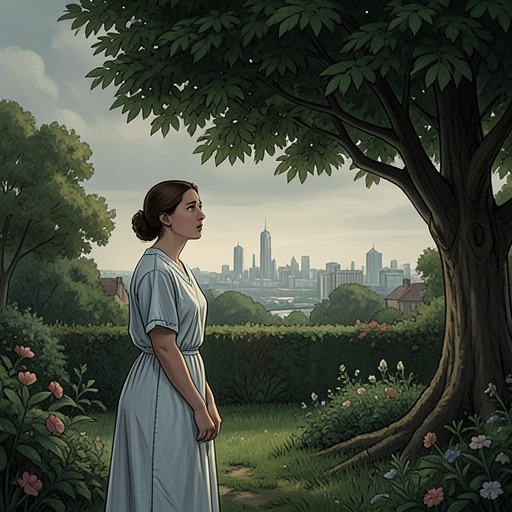
Esther encounters the fig-tree story while reading a book sent by Ladies' Day. In it, a tree grows on a green lawn between the house of a Jewish man and a convent. The man and a beautiful, dark-haired nun meet there to pick ripe figs. One day they watch a bird hatch in a nest on a branch; as the chick pecks out of its egg, the backs of their hands touch. Afterward, the nun no longer comes to pick figs with the man. A mean-faced Catholic kitchen maid takes her place, counting the figs the man picks to make sure he has not taken more than she has. He is furious.
Esther calls the story lovely, especially its seasonal image of the tree beneath winter snow and then bearing green fruit in spring. She feels sorry when she reaches its last page and longs to enter the printed scene, crawl between the lines as through a fence, and sleep beneath the green tree. Reading becomes more than a way to follow another person’s story: the page offers a passage into an imagined refuge, one Esther wants to inhabit rather than leave behind.
A remembered relationship
Esther maps the story’s meeting and separation onto her relationship with Buddy Willard. She and Buddy, she thinks, had their own imaginary fig tree. What they witnessed together was not a bird hatching but a baby being born; afterward, something awful happened and they went their separate ways. The comparison does not make their experience identical to the story’s religious romance. Esther explicitly distinguishes them from the Jewish man and the Catholic nun, noting that she and Buddy were Unitarian. Instead, the tree gives her a structure for recalling an intimate shared encounter followed by a rupture.
This recollection appears while Esther lies lonely and weak in a white hotel bed. She imagines herself back at the sanatorium in the Adirondacks and feels like a heel. Buddy’s letters, she recalls, now describe his reading of poems by a poet who was also a doctor and of a famous Russian short-story writer who was a doctor. His new interest suggests to him that doctors and writers might get along after all. Esther contrasts this with the different position he had taken during the two years in which they were getting to know each other. The remembered tree thus joins a past bond to the altered terms on which Buddy now writes to her.
Branches of possible lives
The image acquires its widest meaning when Esther sees her life branching before her like the green tree in the story. From every branch hangs a fat purple fig representing a different future. Some possibilities are conventional or domestic: a husband, a happy home, and children. Others are professional or expansive: becoming a famous poet, a brilliant professor, or Ee Gee, the amazing editor; travelling to Europe, Africa, or South America; or becoming an Olympic lady crew champion. The imagined choices also include Constantin, Socrates, Attila, and other lovers with unusual names and professions, while further figs remain indistinct above and beyond the ones she can identify.
The catalogue’s force lies in its variety. Esther does not see a single desirable future opposed to a single unwanted one; she wants each and every fig. The branches hold competing kinds of fulfillment—marriage and work, achievement and travel, familiar roles and unconventional lovers—without resolving them into a ranked list. The tree gives this plurality a visible shape, allowing possibility to appear simultaneously abundant and precarious.
Choice, delay, and loss
Esther imagines herself sitting in the fork of the tree and starving because she cannot decide which fig to take. Choosing one would mean losing all the others. As she remains unable to choose, the figs wrinkle and turn black, then fall one by one at her feet. The image transforms indecision from an abstract difficulty into a sequence of changes: fruit first promises a future, then deteriorates, and finally becomes unavailable. Esther’s predicament is not simply that she has many ambitions, but that each choice seems to close off lives she also wants, while refusing to choose does not preserve them indefinitely.
The metaphor’s consequence is deliberately severe: abundance offers no protection against deprivation. A tree laden with futures becomes the setting for imagined starvation, and the promise of fruit ends in loss. The fig tree therefore links the tenderness Esther feels toward the story’s spring growth with the fear contained in her own vision of the falling figs. Across the remembered story, her relationship with Buddy, and her imagined future, it represents possibility as something vivid and desirable but subject to time, separation, and the pressure of choice.