Jay Cee
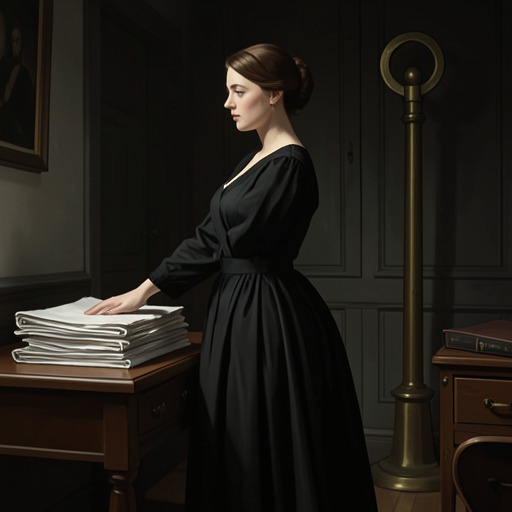
The Bell JarJay Cee is Esther Greenwood’s editor at the fashion magazine where Esther works during her month in New York, and she embodies a form of female authority unlike the magazine’s polished spectacle. Intelligent, widely read, and respected in publishing, she is both an exacting employer and a potential mentor. Her questions about Esther’s work and future draw out the uncertainty Esther has been unable to acknowledge, and her parting reassurance gives their relationship a warmth that Esther does not find in her own mother’s practical advice.
Identity and Professional Authority
Jay Cee is Esther’s boss, but she is not one of the magazine’s fashionable women whose appearance and manner seem designed to advertise the world they inhabit. Esther likes her despite Doreen’s contemptuous remarks about her looks and marriage: Jay Cee has brains, reads several languages, and knows the important writers in the business. Her professional standing rests on knowledge and judgment rather than on the feminine glamour surrounding the magazine.
That authority is visible in her work. She discusses a lunch with two writers whose reputations are unequal: one has sold six stories each to two magazines, while the other has published far less. Jay Cee recognizes the tact required to flatter the more successful man without humiliating the woman. The scene presents editorial work as a practice of discernment and social management, not simply a matter of selecting manuscripts. At noon, she releases Esther to attend the magazine’s scheduled tour, banquet, and film premiere, while expecting her back early the next day.
The Magazine and Its Manufactured Glamour
Jay Cee’s workplace belongs to a commercial world that makes appearances into both product and promise. Esther and the other eleven contest winners have received a month of New York jobs, expenses, and a stream of promotional bonuses: tickets, fashion-show invitations, salon appointments, introductions, and advice about complexions. Their banquet tour passes through glossy kitchens where food is staged for photographs; even ice cream must be propped up with toothpicks and replaced when it melts under the lights. Against this machinery of presentation, Jay Cee’s intelligence and editorial competence offer a different standard of value.
The gap between image and experience also shapes Esther’s response to the culture around the magazine. She sees a Technicolor football romance as a parade of lurid costumes and arranged outcomes, with women divided into the respectable heroine and the sexualized rival. That formula resembles the commercial world’s ready-made pictures of femininity, not the complicated life Esther is trying to imagine. Jay Cee does not dissolve that contradiction, but she represents a working woman whose expertise cannot be reduced to the spectacle the magazine sells.
Esther’s Crisis of Direction
Jay Cee becomes most consequential when she shuts the office door and asks Esther directly whether the work interests her. Esther insists that it does, but the insistence cannot settle the question. In the enclosed office, with shelves of potted plants rising behind Jay Cee, the conversation turns from immediate performance to the future: Esther has another year of college, so what does she intend to do after graduation?
The question reaches a plan Esther has long treated as ready to hand. She has imagined winning a graduate scholarship or a grant to study in Europe, becoming a professor, and writing books of poems or working as an editor. But when Jay Cee asks, Esther answers that she does not really know. The shock lies in hearing the answer aloud and recognizing its truth. Jay Cee does not cause Esther’s uncertainty; her direct question gives that uncertainty a precise, unavoidable form.
Her advice is demanding rather than soothing. She tells Esther she can learn a great deal during the month if she applies herself, and points to a previous assistant who moved from the office to a job at Time. The example makes professional possibility concrete, but it also sharpens the contrast between a career path Esther might pursue and her inability to say what she wants. Jay Cee’s standards expose the distance between Esther’s visible promise and her inward paralysis.
Mentorship, Work, and Domestic Expectations
Esther’s wish that she had a mother like Jay Cee reveals how she understands the editor’s authority: Jay Cee seems able to know what to do and to teach it. Esther’s own mother, widowed and supporting the family by teaching shorthand and typing, urges Esther to acquire shorthand as a practical skill. The mother’s advice is grounded in economic necessity, but Esther resists the prospect of turning an English degree into secretarial service. She hates the thought of serving men and would rather dictate her own letters. Jay Cee’s mentorship is different in emphasis: it directs Esther toward learning the work of publishing, though the evidence does not show that Jay Cee offers a settled answer to Esther’s larger questions.
Those questions are bound up with Esther’s fear that women’s work will be displaced by marriage and domestic labor. Imagining life with Constantin, she pictures herself rising early to cook breakfast, washing dishes and making the bed after he leaves, then preparing dinner and cleaning again until she is exhausted. Her image is reinforced by Mrs. Willard’s daily housework and by the rug she painstakingly braided from old suits, which ends up soiled beneath people’s feet as a kitchen mat. Esther interprets such domestic service as the fate a husband may expect after courtship ends. Jay Cee’s professional identity therefore matters not merely as an individual success but as a visible alternative to the domestic future Esther dreads.
The Parting Gesture and Narrative Role
After her demanding conversation with Esther, Jay Cee continues with her own workday. She puts on a suit jacket over her lilac blouse, pins an imitation-lilac hat in place, powders her nose, and adjusts her thick spectacles. Esther finds that she looks terrible but very wise. The contrast condenses the difference between appearance and authority: Jay Cee may fail the standards of fashionable beauty, yet Esther sees a mind and judgment worth emulating.
As she leaves, Jay Cee pats Esther’s shoulder with a lilac-gloved hand and says, "Don't let the wicked city get you down." The warning acknowledges the city’s pressures without pretending Esther has overcome them. Esther sits alone afterward and imagines being the famous editor, in an office of rubber plants and African violets that a secretary waters each morning. Her wish to have a mother like Jay Cee is not a simple identification: it registers a hunger for direction and for a model of capable womanhood at a moment when her own plans have ceased to feel real. Jay Cee’s role is brief but structurally important. She makes Esther’s uncertainty speakable, offers professional possibility without disguising its demands, and remains in Esther’s mind as a standard against which both career and domestic life can be measured.